

209
15 Biogeochemical Indicators of Nutrient Enrichments in Wetlands …
under denitrifying, SO 4
2− reducing and methanogenic conditions (D’Angelo and Reddy 1999). The sequential reduction
of electron acceptors strongly depends on their availability.
Higher rates of heterotrophic microbial activities have been
measured under sulfate reducing rather than under nitrate
conditions associated with higher SO 4
2− concentration and
lower nitrate concentration which tended to support sulfate reduction and limit denitrification (Wright and Reddy
2001b). Availability of electron acceptors including O 2 and
NO 3
− generally result in complete and immediate inhibition
of methanogenesis while availability of Fe(III) and SO 4
2−
often resulted in less effective inhibition (Fig. 15.1; for further information on methane inhibition see D’Angelo and
Reddy 1999).
Exposure of soil to O 2 , as occurs in periods of low rainfall
or low water inputs, increases wetland heterotrophic microbial activity. This increase in microbial activity contributes
to enhance organic matter degradation rates and increase regeneration and cycling of nutrients in wetlands which might
potentially lead to increased nutrient concentrations in the
water column (Wright and Reddy 2001b).
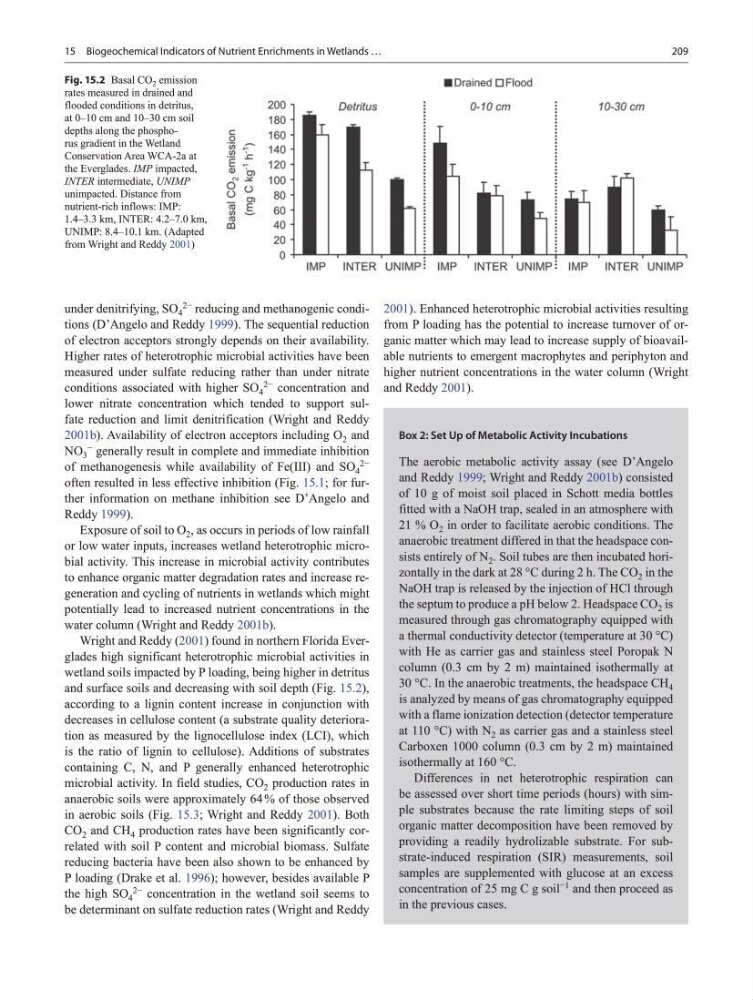
Wright and Reddy (2001) found in northern Florida Everglades high significant heterotrophic microbial activities in
wetland soils impacted by P loading, being higher in detritus
and surface soils and decreasing with soil depth (Fig. 15.2),
according to a lignin content increase in conjunction with
decreases in cellulose content (a substrate quality deterioration as measured by the lignocellulose index (LCI), which
is the ratio of lignin to cellulose). Additions of substrates
containing C, N, and P generally enhanced heterotrophic
microbial activity. In field studies, CO 2 production rates in
anaerobic soils were approximately 64 % of those observed
in aerobic soils (Fig. 15.3; Wright and Reddy 2001). Both
CO 2 and CH 4 production rates have been significantly correlated with soil P content and microbial biomass. Sulfate
reducing bacteria have been also shown to be enhanced by
P loading (Drake et al. 1996); however, besides available P
the high SO 4
2− concentration in the wetland soil seems to
be determinant on sulfate reduction rates (Wright and Reddy
2001). Enhanced heterotrophic microbial activities resulting
from P loading has the potential to increase turnover of organic matter which may lead to increase supply of bioavailable nutrients to emergent macrophytes and periphyton and
higher nutrient concentrations in the water column (Wright
and Reddy 2001).
Fig. 15.2 Basal CO 2 emission
rates measured in drained and
flooded conditions in detritus,
at 0–10 cm and 10–30 cm soil
depths along the phosphorus gradient in the Wetland
Conservation Area WCA-2a at
the Everglades. IMP impacted,
INTER intermediate, UNIMP
unimpacted. Distance from
nutrient-rich inflows: IMP:
1.4–3.3 km, INTER: 4.2–7.0 km,
UNIMP: 8.4–10.1 km. (Adapted
from Wright and Reddy 2001)
Box 2: Set Up of Metabolic Activity Incubations
The aerobic metabolic activity assay (see D’Angelo
and Reddy 1999; Wright and Reddy 2001b) consisted
of 10 g of moist soil placed in Schott media bottles
fitted with a NaOH trap, sealed in an atmosphere with
21 % O 2 in order to facilitate aerobic conditions. The
anaerobic treatment differed in that the headspace consists entirely of N 2 . Soil tubes are then incubated horizontally in the dark at 28 °C during 2 h. The CO 2 in the
NaOH trap is released by the injection of HCl through
the septum to produce a pH below 2. Headspace CO 2 is
measured through gas chromatography equipped with
a thermal conductivity detector (temperature at 30 °C)
with He as carrier gas and stainless steel Poropak N
column (0.3 cm by 2 m) maintained isothermally at
30 °C. In the anaerobic treatments, the headspace CH 4
is analyzed by means of gas chromatography equipped
with a flame ionization detection (detector temperature
at 110 °C) with N 2 as carrier gas and a stainless steel
Carboxen 1000 column (0.3 cm by 2 m) maintained
isothermally at 160 °C.
Differences in net heterotrophic respiration can
be assessed over short time periods (hours) with simple substrates because the rate limiting steps of soil
organic matter decomposition have been removed by
providing a readily hydrolizable substrate. For substrate-induced respiration (SIR) measurements, soil
samples are supplemented with glucose at an excess
concentration of 25 mg C g soil
−1
and then proceed as
in the previous cases.
15 Biogeochemical Indicators of Nutrient Enrichments in Wetlands …
under denitrifying, SO 4
2− reducing and methanogenic conditions (D’Angelo and Reddy 1999). The sequential reduction
of electron acceptors strongly depends on their availability.
Higher rates of heterotrophic microbial activities have been
measured under sulfate reducing rather than under nitrate
conditions associated with higher SO 4
2− concentration and
lower nitrate concentration which tended to support sulfate reduction and limit denitrification (Wright and Reddy
2001b). Availability of electron acceptors including O 2 and
NO 3
− generally result in complete and immediate inhibition
of methanogenesis while availability of Fe(III) and SO 4
2−
often resulted in less effective inhibition (Fig. 15.1; for further information on methane inhibition see D’Angelo and
Reddy 1999).
Exposure of soil to O 2 , as occurs in periods of low rainfall
or low water inputs, increases wetland heterotrophic microbial activity. This increase in microbial activity contributes
to enhance organic matter degradation rates and increase regeneration and cycling of nutrients in wetlands which might
potentially lead to increased nutrient concentrations in the
water column (Wright and Reddy 2001b).
Wright and Reddy (2001) found in northern Florida Everglades high significant heterotrophic microbial activities in
wetland soils impacted by P loading, being higher in detritus
and surface soils and decreasing with soil depth (Fig. 15.2),
according to a lignin content increase in conjunction with
decreases in cellulose content (a substrate quality deterioration as measured by the lignocellulose index (LCI), which
is the ratio of lignin to cellulose). Additions of substrates
containing C, N, and P generally enhanced heterotrophic
microbial activity. In field studies, CO 2 production rates in
anaerobic soils were approximately 64 % of those observed
in aerobic soils (Fig. 15.3; Wright and Reddy 2001). Both
CO 2 and CH 4 production rates have been significantly correlated with soil P content and microbial biomass. Sulfate
reducing bacteria have been also shown to be enhanced by
P loading (Drake et al. 1996); however, besides available P
the high SO 4
2− concentration in the wetland soil seems to
be determinant on sulfate reduction rates (Wright and Reddy
2001). Enhanced heterotrophic microbial activities resulting
from P loading has the potential to increase turnover of organic matter which may lead to increase supply of bioavailable nutrients to emergent macrophytes and periphyton and
higher nutrient concentrations in the water column (Wright
and Reddy 2001).
Fig. 15.2 Basal CO 2 emission
rates measured in drained and
flooded conditions in detritus,
at 0–10 cm and 10–30 cm soil
depths along the phosphorus gradient in the Wetland
Conservation Area WCA-2a at
the Everglades. IMP impacted,
INTER intermediate, UNIMP
unimpacted. Distance from
nutrient-rich inflows: IMP:
1.4–3.3 km, INTER: 4.2–7.0 km,
UNIMP: 8.4–10.1 km. (Adapted
from Wright and Reddy 2001)
Box 2: Set Up of Metabolic Activity Incubations
The aerobic metabolic activity assay (see D’Angelo
and Reddy 1999; Wright and Reddy 2001b) consisted
of 10 g of moist soil placed in Schott media bottles
fitted with a NaOH trap, sealed in an atmosphere with
21 % O 2 in order to facilitate aerobic conditions. The
anaerobic treatment differed in that the headspace consists entirely of N 2 . Soil tubes are then incubated horizontally in the dark at 28 °C during 2 h. The CO 2 in the
NaOH trap is released by the injection of HCl through
the septum to produce a pH below 2. Headspace CO 2 is
measured through gas chromatography equipped with
a thermal conductivity detector (temperature at 30 °C)
with He as carrier gas and stainless steel Poropak N
column (0.3 cm by 2 m) maintained isothermally at
30 °C. In the anaerobic treatments, the headspace CH 4
is analyzed by means of gas chromatography equipped
with a flame ionization detection (detector temperature
at 110 °C) with N 2 as carrier gas and a stainless steel
Carboxen 1000 column (0.3 cm by 2 m) maintained
isothermally at 160 °C.
Differences in net heterotrophic respiration can
be assessed over short time periods (hours) with simple substrates because the rate limiting steps of soil
organic matter decomposition have been removed by
providing a readily hydrolizable substrate. For substrate-induced respiration (SIR) measurements, soil
samples are supplemented with glucose at an excess
concentration of 25 mg C g soil
−1
and then proceed as
in the previous cases.