

200
D. Liu et al.
the characteristics of phytoplankton species composition
well reflected the warm temperate climatic regime in southern NSW, as evidenced by a large number of temperate water
species and some warm water species. In addition, these
shallow ICOLLs were characterized by extensive estuarine
vegetation communities, such as, seagrass, macroalgae, and
saltmarsh, and these plants provided suitable habitats and
substrata for the epiphytic and periphytic species. As a result, phytoplankton assemblages in these coastal lakes were
composed of euplanktonic, tychoplanktonic, epiphytic, and
periphytic species (Table 14.3).
Moreover, phytoplankton species composition showed a
relationship to the gradient of salinity and pH in the studied
lakes. During the sampling period, the proportion of freshwater, brackish, and marine species within the assemblages
displayed good consistency with the salinity characteristics
of the lakes (Table 14.3; Fig. 14.2): 51 % freshwater and
brackish species were found in Swan Lake which had the
lowest salinity (17.1 psu), 36 % in Conjola Lake (salinity:
19 psu), and 26–29 % in higher salinity lakes (Coila Lake,
Lake Illawarra, St. Georges Basin, Durra Lake, and Burrill
Lake).
Mixtures of the seawater (pH close to 8.2) and typical
river water (pH = 6–7.5) make estuary pHs generally range
from 7.5 to 8.0. During the sampling period, pH values in
most estuaries, except for Swan Lake, fluctuated within this
normal range and would have had little influence on the
phytoplankton species composition. It is difficult to explain
why the high pH (mean pH = 8.53) occurred in Swan Lake,
but this result is similar to previous studies (Sullivan 2003).
Cyanophyta species were usually dominant in alkaline and
saline lakes owing to their adaptation to very high pH (10–
10.5) (Finlay et al. 1987; Ballot et al. 2005). Increased Cyanophyta species were identified in Swan Lake, and this led
to a major difference in Swan Lake phytoplankton communities, compared to all of the other lakes investigated.
Nutrient status was the third factor influencing phytoplankton assemblages. Nutrient-poor conditions not only affect the phytoplankton abundance but also can decrease the
species diversity (Dawes 1997). Swan Lake was characterized by very low DIN (average: 0.94 µM) and DIP (average:
0.04 µM) concentrations compared to the other lakes during
the sampling period. Only 61 species were identified from
this lake, which was much lower than for most of the other
lakes (> 100 species).
14.4.2 Role of Phytoplankton Biomass as an
Indicator of Water Quality
In this study, Chl a concentrations basically showed a gradient between the seven lakes (Fig. 14.5). Lake Illawarra and
St. Georges Basin, characterized by a high degree of catchment urbanization displayed the highest Chl a concentrations,
Swan Lake with a small population in the catchment had the
lowest nutrient levels and the lowest Chl a concentrations.
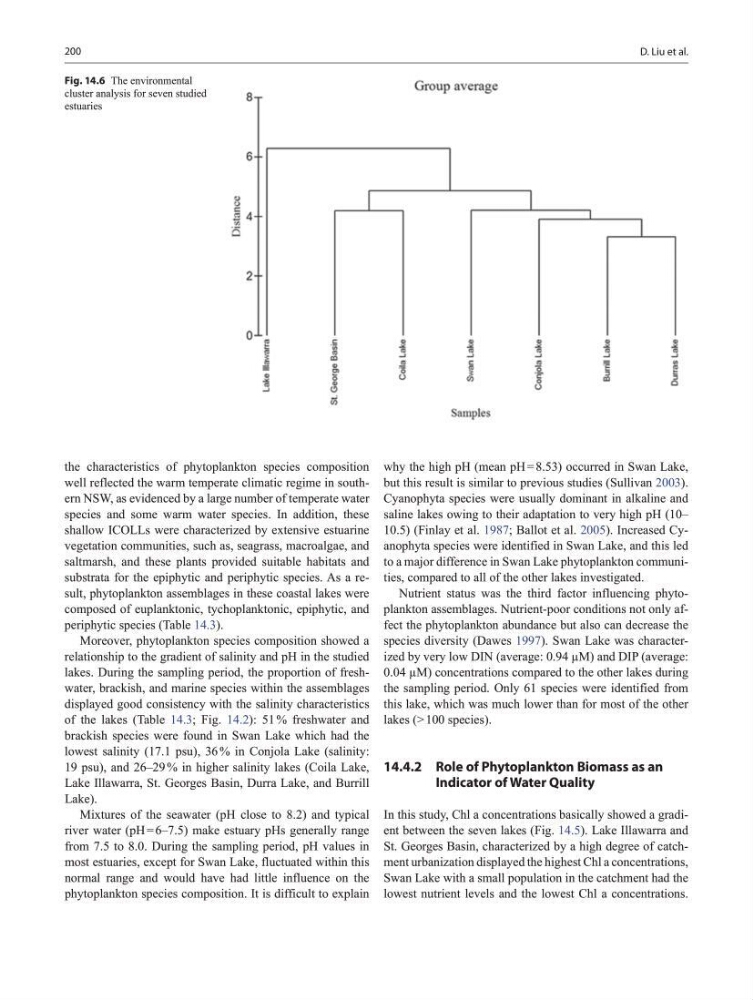
Fig. 14.6 The environmental
cluster analysis for seven studied
estuaries
D. Liu et al.
the characteristics of phytoplankton species composition
well reflected the warm temperate climatic regime in southern NSW, as evidenced by a large number of temperate water
species and some warm water species. In addition, these
shallow ICOLLs were characterized by extensive estuarine
vegetation communities, such as, seagrass, macroalgae, and
saltmarsh, and these plants provided suitable habitats and
substrata for the epiphytic and periphytic species. As a result, phytoplankton assemblages in these coastal lakes were
composed of euplanktonic, tychoplanktonic, epiphytic, and
periphytic species (Table 14.3).
Moreover, phytoplankton species composition showed a
relationship to the gradient of salinity and pH in the studied
lakes. During the sampling period, the proportion of freshwater, brackish, and marine species within the assemblages
displayed good consistency with the salinity characteristics
of the lakes (Table 14.3; Fig. 14.2): 51 % freshwater and
brackish species were found in Swan Lake which had the
lowest salinity (17.1 psu), 36 % in Conjola Lake (salinity:
19 psu), and 26–29 % in higher salinity lakes (Coila Lake,
Lake Illawarra, St. Georges Basin, Durra Lake, and Burrill
Lake).
Mixtures of the seawater (pH close to 8.2) and typical
river water (pH = 6–7.5) make estuary pHs generally range
from 7.5 to 8.0. During the sampling period, pH values in
most estuaries, except for Swan Lake, fluctuated within this
normal range and would have had little influence on the
phytoplankton species composition. It is difficult to explain
why the high pH (mean pH = 8.53) occurred in Swan Lake,
but this result is similar to previous studies (Sullivan 2003).
Cyanophyta species were usually dominant in alkaline and
saline lakes owing to their adaptation to very high pH (10–
10.5) (Finlay et al. 1987; Ballot et al. 2005). Increased Cyanophyta species were identified in Swan Lake, and this led
to a major difference in Swan Lake phytoplankton communities, compared to all of the other lakes investigated.
Nutrient status was the third factor influencing phytoplankton assemblages. Nutrient-poor conditions not only affect the phytoplankton abundance but also can decrease the
species diversity (Dawes 1997). Swan Lake was characterized by very low DIN (average: 0.94 µM) and DIP (average:
0.04 µM) concentrations compared to the other lakes during
the sampling period. Only 61 species were identified from
this lake, which was much lower than for most of the other
lakes (> 100 species).
14.4.2 Role of Phytoplankton Biomass as an
Indicator of Water Quality
In this study, Chl a concentrations basically showed a gradient between the seven lakes (Fig. 14.5). Lake Illawarra and
St. Georges Basin, characterized by a high degree of catchment urbanization displayed the highest Chl a concentrations,
Swan Lake with a small population in the catchment had the
lowest nutrient levels and the lowest Chl a concentrations.
Fig. 14.6 The environmental
cluster analysis for seven studied
estuaries