

133
11 Eutrophication Impacts on Salt Marshes Natural Metal Remediation
well-established salt marshes, the intense competition for
nutrients results in increased allocation of biomass to root
material (Gross et al. 1991). High root:shoot biomass common in halophyte species has been considered to be indicative of adaptive mechanisms, with a need for greater root
surface under unfavorable soil conditions (Lana et al. 1991).
Many factors, such as elevation, interstitial salinity, nitrogen
availability, oxygenation of the root system, and anthropogenic factors, have been reported to have important roles
in biomass production (Lana et al. 1991). Nitrogen fertilizations field experiments can give good insights about the
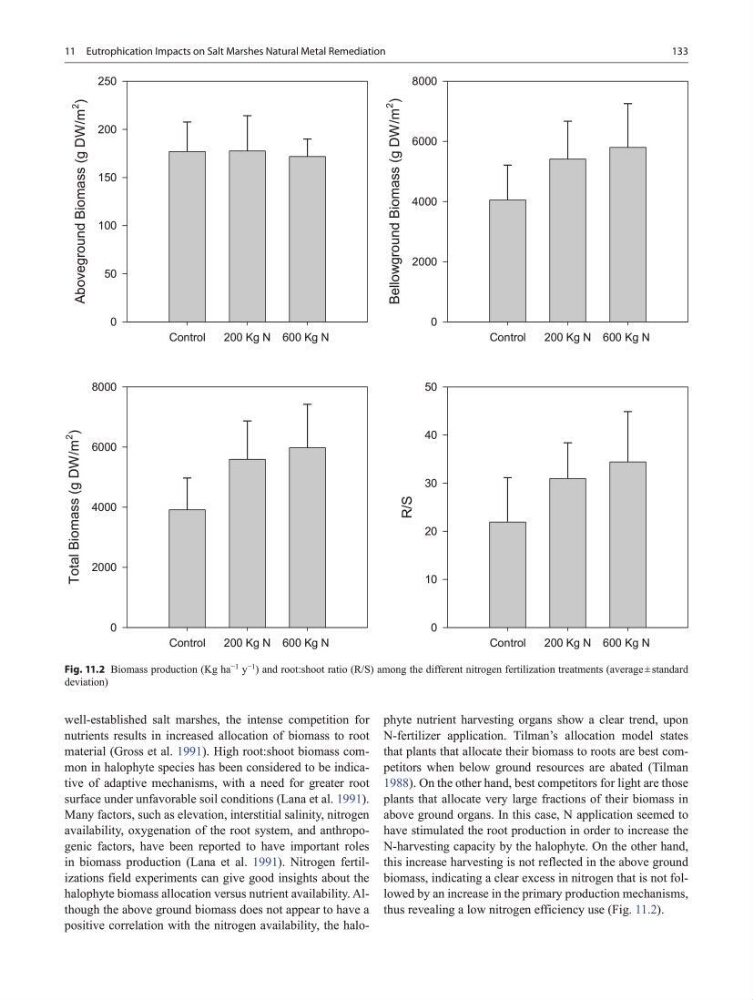
halophyte biomass allocation versus nutrient availability. Although the above ground biomass does not appear to have a
positive correlation with the nitrogen availability, the halophyte nutrient harvesting organs show a clear trend, upon
N-fertilizer application. Tilman’s allocation model states
that plants that allocate their biomass to roots are best competitors when below ground resources are abated (Tilman
1988). On the other hand, best competitors for light are those
plants that allocate very large fractions of their biomass in
above ground organs. In this case, N application seemed to
have stimulated the root production in order to increase the
N-harvesting capacity by the halophyte. On the other hand,
this increase harvesting is not reflected in the above ground
biomass, indicating a clear excess in nitrogen that is not followed by an increase in the primary production mechanisms,
thus revealing a low nitrogen efficiency use (Fig. 11.2).
&RQWURO
.J1 .J1
$ERYHJURXQG%LRPDVVJ':P
&RQWURO
.J1 .J1
%HOORZJURXQG%LRPDVVJ':P
&RQWURO
.J1 .J1
7RWDO%LRPDVVJ':P
&RQWURO
.J1 .J1
56
Fig. 11.2 Biomass production (Kg ha −1 y −1 ) and root:shoot ratio (R/S) among the different nitrogen fertilization treatments (average ± standard
deviation)
11 Eutrophication Impacts on Salt Marshes Natural Metal Remediation
well-established salt marshes, the intense competition for
nutrients results in increased allocation of biomass to root
material (Gross et al. 1991). High root:shoot biomass common in halophyte species has been considered to be indicative of adaptive mechanisms, with a need for greater root
surface under unfavorable soil conditions (Lana et al. 1991).
Many factors, such as elevation, interstitial salinity, nitrogen
availability, oxygenation of the root system, and anthropogenic factors, have been reported to have important roles
in biomass production (Lana et al. 1991). Nitrogen fertilizations field experiments can give good insights about the
halophyte biomass allocation versus nutrient availability. Although the above ground biomass does not appear to have a
positive correlation with the nitrogen availability, the halophyte nutrient harvesting organs show a clear trend, upon
N-fertilizer application. Tilman’s allocation model states
that plants that allocate their biomass to roots are best competitors when below ground resources are abated (Tilman
1988). On the other hand, best competitors for light are those
plants that allocate very large fractions of their biomass in
above ground organs. In this case, N application seemed to
have stimulated the root production in order to increase the
N-harvesting capacity by the halophyte. On the other hand,
this increase harvesting is not reflected in the above ground
biomass, indicating a clear excess in nitrogen that is not followed by an increase in the primary production mechanisms,
thus revealing a low nitrogen efficiency use (Fig. 11.2).
&RQWURO
.J1 .J1
$ERYHJURXQG%LRPDVVJ':P
&RQWURO
.J1 .J1
%HOORZJURXQG%LRPDVVJ':P
&RQWURO
.J1 .J1
7RWDO%LRPDVVJ':P
&RQWURO
.J1 .J1
56
Fig. 11.2 Biomass production (Kg ha −1 y −1 ) and root:shoot ratio (R/S) among the different nitrogen fertilization treatments (average ± standard
deviation)