

132
I. Caçador and B. Duarte
system (Caçador et al. 1996; Sundby et al. 1998; Weis and
Weis 2004).
11.2 Estuarine Eutrophication
One of the greatest problems in coastal waters is eutrophication. Salt marshes import inorganic nutrients and export
organic nutrients. As tidal water flows through salt marshes,
plants, bacteria, and algae produce or transform the organic
matter of the food chain that supports fish and shellfish populations (Teal and Howes 2000). While salt marshes modify
the forms of the principal plant nutrients N and P, some of
the pathways result in removal of nutrients from biologically
active systems. Flooding with seawater leads to an input
of inorganic and organic substances into the marsh (Rozemaet al. 2002). Nitrogen is removed primarily either by (1)
being trapped in refractory organic matter that contributes to
marsh maintenance through accretion, or (2) by loss to the
atmosphere (as N 2 ) through denitrification. Coastal marshes
tend to be nitrogen limited. With increasing nitrogen supply,
marshes show greater primary productivity by both grasses
and algae. Unlike some coastal systems, salt marshes can
withstand very large additions of nitrogen without severe
damage (Teal and Howes 2000). In addition, estimates of the
size of the N-pool do not always indicate the availability of
nitrogen to plants. The increasing soil nitrogen content with
salt marsh age indicates that the salt marsh soil acts as a sink
for N. Some other studies focused on the N-content of salt
marsh compartments have been published (Caçador et al.
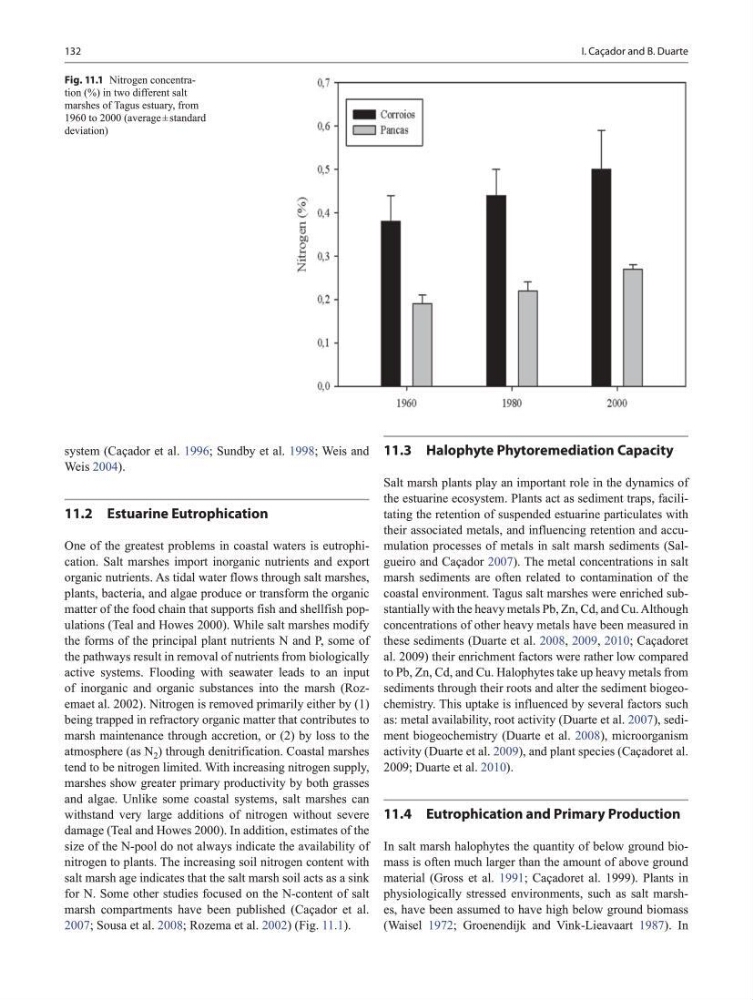
2007; Sousa et al. 2008; Rozema et al. 2002) (Fig. 11.1).
11.3 Halophyte Phytoremediation Capacity
Salt marsh plants play an important role in the dynamics of
the estuarine ecosystem. Plants act as sediment traps, facilitating the retention of suspended estuarine particulates with
their associated metals, and influencing retention and accumulation processes of metals in salt marsh sediments (Salgueiro and Caçador 2007). The metal concentrations in salt
marsh sediments are often related to contamination of the
coastal environment. Tagus salt marshes were enriched substantially with the heavy metals Pb, Zn, Cd, and Cu. Although
concentrations of other heavy metals have been measured in
these sediments (Duarte et al. 2008, 2009, 2010; Caçadoret
al. 2009) their enrichment factors were rather low compared
to Pb, Zn, Cd, and Cu. Halophytes take up heavy metals from
sediments through their roots and alter the sediment biogeochemistry. This uptake is influenced by several factors such
as: metal availability, root activity (Duarte et al. 2007), sediment biogeochemistry (Duarte et al. 2008), microorganism
activity (Duarte et al. 2009), and plant species (Caçadoret al.
2009; Duarte et al. 2010).
11.4 Eutrophication and Primary Production
In salt marsh halophytes the quantity of below ground biomass is often much larger than the amount of above ground
material (Gross et al. 1991; Caçadoret al. 1999). Plants in
physiologically stressed environments, such as salt marshes, have been assumed to have high below ground biomass
(Waisel 1972; Groenendijk and Vink-Lieavaart 1987). In
Fig. 11.1 Nitrogen concentration (%) in two different salt
marshes of Tagus estuary, from
1960 to 2000 (average ± standard
deviation)
I. Caçador and B. Duarte
system (Caçador et al. 1996; Sundby et al. 1998; Weis and
Weis 2004).
11.2 Estuarine Eutrophication
One of the greatest problems in coastal waters is eutrophication. Salt marshes import inorganic nutrients and export
organic nutrients. As tidal water flows through salt marshes,
plants, bacteria, and algae produce or transform the organic
matter of the food chain that supports fish and shellfish populations (Teal and Howes 2000). While salt marshes modify
the forms of the principal plant nutrients N and P, some of
the pathways result in removal of nutrients from biologically
active systems. Flooding with seawater leads to an input
of inorganic and organic substances into the marsh (Rozemaet al. 2002). Nitrogen is removed primarily either by (1)
being trapped in refractory organic matter that contributes to
marsh maintenance through accretion, or (2) by loss to the
atmosphere (as N 2 ) through denitrification. Coastal marshes
tend to be nitrogen limited. With increasing nitrogen supply,
marshes show greater primary productivity by both grasses
and algae. Unlike some coastal systems, salt marshes can
withstand very large additions of nitrogen without severe
damage (Teal and Howes 2000). In addition, estimates of the
size of the N-pool do not always indicate the availability of
nitrogen to plants. The increasing soil nitrogen content with
salt marsh age indicates that the salt marsh soil acts as a sink
for N. Some other studies focused on the N-content of salt
marsh compartments have been published (Caçador et al.
2007; Sousa et al. 2008; Rozema et al. 2002) (Fig. 11.1).
11.3 Halophyte Phytoremediation Capacity
Salt marsh plants play an important role in the dynamics of
the estuarine ecosystem. Plants act as sediment traps, facilitating the retention of suspended estuarine particulates with
their associated metals, and influencing retention and accumulation processes of metals in salt marsh sediments (Salgueiro and Caçador 2007). The metal concentrations in salt
marsh sediments are often related to contamination of the
coastal environment. Tagus salt marshes were enriched substantially with the heavy metals Pb, Zn, Cd, and Cu. Although
concentrations of other heavy metals have been measured in
these sediments (Duarte et al. 2008, 2009, 2010; Caçadoret
al. 2009) their enrichment factors were rather low compared
to Pb, Zn, Cd, and Cu. Halophytes take up heavy metals from
sediments through their roots and alter the sediment biogeochemistry. This uptake is influenced by several factors such
as: metal availability, root activity (Duarte et al. 2007), sediment biogeochemistry (Duarte et al. 2008), microorganism
activity (Duarte et al. 2009), and plant species (Caçadoret al.
2009; Duarte et al. 2010).
11.4 Eutrophication and Primary Production
In salt marsh halophytes the quantity of below ground biomass is often much larger than the amount of above ground
material (Gross et al. 1991; Caçadoret al. 1999). Plants in
physiologically stressed environments, such as salt marshes, have been assumed to have high below ground biomass
(Waisel 1972; Groenendijk and Vink-Lieavaart 1987). In
Fig. 11.1 Nitrogen concentration (%) in two different salt
marshes of Tagus estuary, from
1960 to 2000 (average ± standard
deviation)