

A. Pavlidou et al.
122
This shift from Si-limitation to N-limitation during almost
25 years suggests changes in the marine ecosystem and the
phytoplankton community, probably owing to the removal of
N during the secondary sewage treatment. The nutrient concentrations for the period 2005–2010 gave a mean Si:DIN
atomic ratio of 1.5, with an increasing trend with distance
southeast from the sewage outfall, whereas at station S8
which is located southwest of Psittalia Island outfall the mean
Si:DIN ratio was slightly decreased. Decreasing Si:DIN ratio
may exacerbate eutrophication by reducing the potential for
diatom growth, in favοr of noxious flagellates (Alonso-Rodriguez et al. 2009, Pavlidou et al. 2004). Ηoweνer, this is not
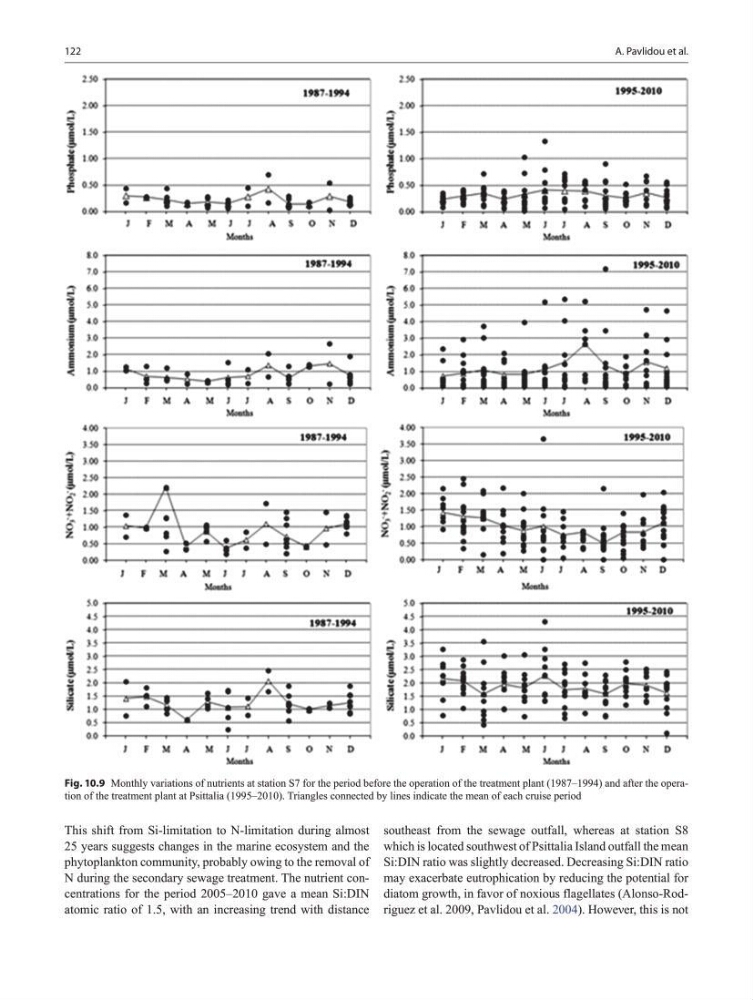
Fig. 10.9 Monthly variations of nutrients at station S7 for the period before the operation of the treatment plant (1987–1994) and after the operation of the treatment plant at Psittalia (1995–2010). Triangles connected by lines indicate the mean of each cruise period
122
This shift from Si-limitation to N-limitation during almost
25 years suggests changes in the marine ecosystem and the
phytoplankton community, probably owing to the removal of
N during the secondary sewage treatment. The nutrient concentrations for the period 2005–2010 gave a mean Si:DIN
atomic ratio of 1.5, with an increasing trend with distance
southeast from the sewage outfall, whereas at station S8
which is located southwest of Psittalia Island outfall the mean
Si:DIN ratio was slightly decreased. Decreasing Si:DIN ratio
may exacerbate eutrophication by reducing the potential for
diatom growth, in favοr of noxious flagellates (Alonso-Rodriguez et al. 2009, Pavlidou et al. 2004). Ηoweνer, this is not
Fig. 10.9 Monthly variations of nutrients at station S7 for the period before the operation of the treatment plant (1987–1994) and after the operation of the treatment plant at Psittalia (1995–2010). Triangles connected by lines indicate the mean of each cruise period