

331
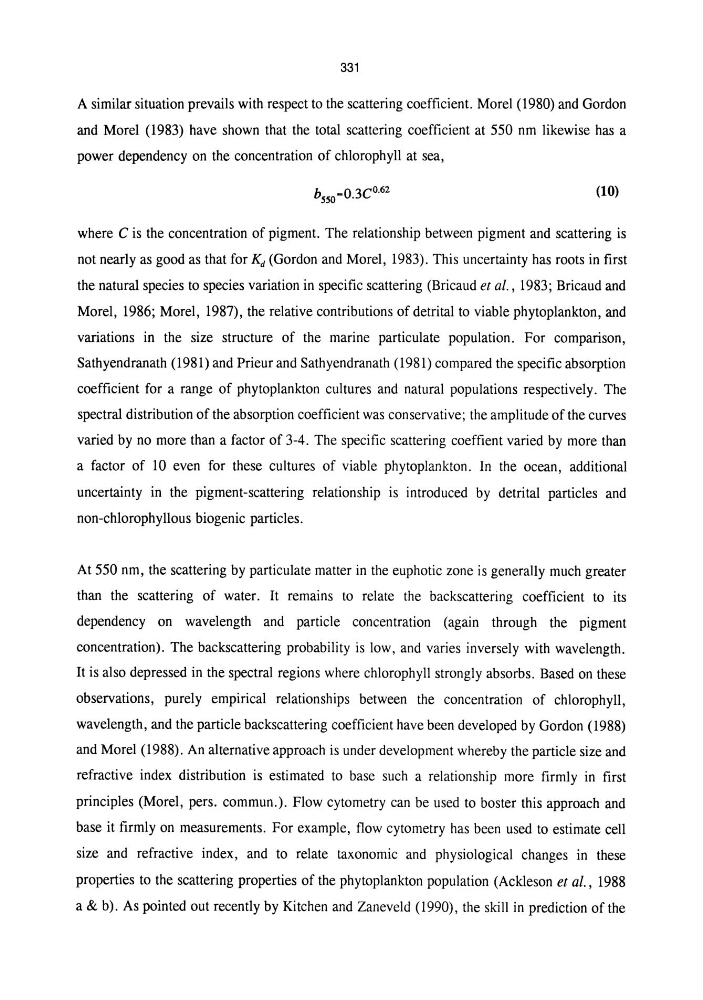
A similar situation prevails with respect to the scattering coefficient. Morel (1980) and Gordon
and Morel (1983) have shown that the total scattering coefficient at 550 nm likewise has a
power dependency on the concentration of chlorophyll at sea,
(10)
where C is the concentration of pigment. The relationship between pigment and scattering is
not nearly as good as that for Kd (Gordon and Morel, 1983). This uncertainty has roots in first
the natural species to species variation in specific scattering (Bricaud et al., 1983; Bricaud and
Morel, 1986; Morel, 1987), the relative contributions of detrital to viable phytoplankton, and
variations in the size structure of the marine particulate population. For comparison,
Sathyendranath (1981) and Prieur and Sathyendranath (1981) compared the specific absorption
coefficient for a range of phytoplankton cultures and natural populations respectively. The
spectral distribution of the absorption coefficient was conservative; the amplitude of the curves
varied by no more than a factor of 3-4. The specific scattering coeffient varied by more than
a factor of 10 even for these cultures of viable phytoplankton. In the ocean, additional
uncertainty in the pigment-scattering relationship is introduced by detrital particles and
non-chlorophyllous biogenic particles.
At 550 nm, the scattering by particulate matter in the euphotic zone is generally much greater
than the scattering of water. It remains to relate the backscattering coefficient to its
dependency on wavelength and particle concentration (again through the pigment
concentration). The backscattering probability is low, and varies inversely with wavelength.
It is also depressed in the spectral regions where chlorophyll strongly absorbs. Based on these
observations, purely empirical relationships between the concentration of chlorophyll,
wavelength, and the particle backscattering coefficient have been developed by Gordon (1988)
and Morel (1988). An alternative approach is under development whereby the particle size and
refractive index distribution is estimated to base such a relationship more firmly in first
principles (Morel, pers. commun.). Flow cytometry can be used to boster this approach and
base it firmly on measurements. For example, flow cytometry has been used to estimate cell
size and refractive index, and to relate taxonomic and physiological changes in these
properties to the scattering properties of the phytoplankton population (Ackleson et al., 1988
a & b). As pointed out recent! y by Kitchen and Zaneveld (1990), the skill in prediction of the
A similar situation prevails with respect to the scattering coefficient. Morel (1980) and Gordon
and Morel (1983) have shown that the total scattering coefficient at 550 nm likewise has a
power dependency on the concentration of chlorophyll at sea,
(10)
where C is the concentration of pigment. The relationship between pigment and scattering is
not nearly as good as that for Kd (Gordon and Morel, 1983). This uncertainty has roots in first
the natural species to species variation in specific scattering (Bricaud et al., 1983; Bricaud and
Morel, 1986; Morel, 1987), the relative contributions of detrital to viable phytoplankton, and
variations in the size structure of the marine particulate population. For comparison,
Sathyendranath (1981) and Prieur and Sathyendranath (1981) compared the specific absorption
coefficient for a range of phytoplankton cultures and natural populations respectively. The
spectral distribution of the absorption coefficient was conservative; the amplitude of the curves
varied by no more than a factor of 3-4. The specific scattering coeffient varied by more than
a factor of 10 even for these cultures of viable phytoplankton. In the ocean, additional
uncertainty in the pigment-scattering relationship is introduced by detrital particles and
non-chlorophyllous biogenic particles.
At 550 nm, the scattering by particulate matter in the euphotic zone is generally much greater
than the scattering of water. It remains to relate the backscattering coefficient to its
dependency on wavelength and particle concentration (again through the pigment
concentration). The backscattering probability is low, and varies inversely with wavelength.
It is also depressed in the spectral regions where chlorophyll strongly absorbs. Based on these
observations, purely empirical relationships between the concentration of chlorophyll,
wavelength, and the particle backscattering coefficient have been developed by Gordon (1988)
and Morel (1988). An alternative approach is under development whereby the particle size and
refractive index distribution is estimated to base such a relationship more firmly in first
principles (Morel, pers. commun.). Flow cytometry can be used to boster this approach and
base it firmly on measurements. For example, flow cytometry has been used to estimate cell
size and refractive index, and to relate taxonomic and physiological changes in these
properties to the scattering properties of the phytoplankton population (Ackleson et al., 1988
a & b). As pointed out recent! y by Kitchen and Zaneveld (1990), the skill in prediction of the