

330
(8)
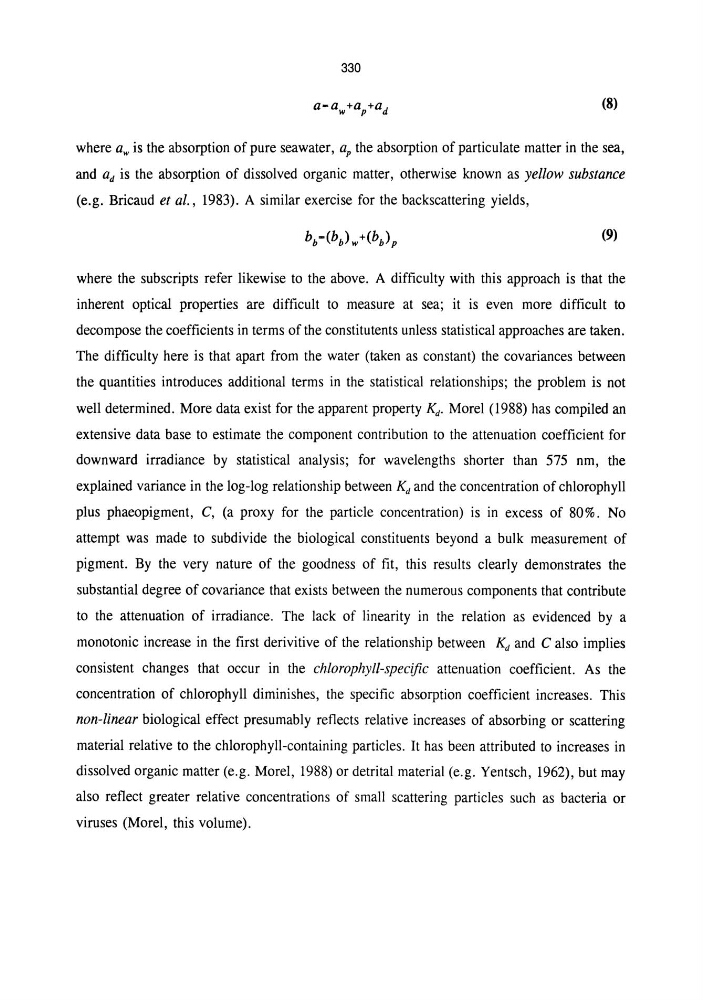
where a w is the absorption of pure seawater, a p the absorption of particulate matter in the sea,
and ad is the absorption of dissolved organic matter, otherwise known as yellow substance
(e.g. Bricaud et aZ., 1983). A similar exercise for the backscattering yields,
(9)
where the subscripts refer likewise to the above. A difficulty with this approach is that the
inherent optical properties are difficult to measure at sea; it is even more difficult to
decompose the coefficients in terms of the constitutents unless statistical approaches are taken.
The difficulty here is that apart from the water (taken as constant) the covariances between
the quantities introduces additional terms in the statistical relationships; the problem is not
well determined. More data exist for the apparent property K d • Morel (1988) has compiled an
extensive data base to estimate the component contribution to the attenuation coefficient for
downward irradiance by statistical analysis; for wavelengths shorter than 575 nm, the
explained variance in the log-log relationship between Kd and the concentration of chlorophyll
plus phaeopigment, C, (a proxy for the particle concentration) is in excess of 80%. No
attempt was made to subdivide the biological constituents beyond a bulk measurement of
pigment. By the very nature of the goodness of fit, this results clearly demonstrates the
substantial degree of covariance that exists between the numerous components that contribute
to the attenuation of irradiance. The lack of linearity in the relation as evidenced by a
monotonic increase in the first derivitive of the relationship between Kd and C also implies
consistent changes that occur in the chlorophyll-specific attenuation coefficient. As the
concentration of chlorophyll diminishes, the specific absorption coefficient increases. This
non-linear biological effect presumably reflects relative increases of absorbing or scattering
material relative to the chlorophyll-containing particles. It has been attributed to increases in
dissolved organic matter (e.g. Morel, 1988) or detrital material (e.g. Yentsch, 1962), but may
also reflect greater relative concentrations of small scattering particles such as bacteria or
viruses (Morel, this volume).
(8)
where a w is the absorption of pure seawater, a p the absorption of particulate matter in the sea,
and ad is the absorption of dissolved organic matter, otherwise known as yellow substance
(e.g. Bricaud et aZ., 1983). A similar exercise for the backscattering yields,
(9)
where the subscripts refer likewise to the above. A difficulty with this approach is that the
inherent optical properties are difficult to measure at sea; it is even more difficult to
decompose the coefficients in terms of the constitutents unless statistical approaches are taken.
The difficulty here is that apart from the water (taken as constant) the covariances between
the quantities introduces additional terms in the statistical relationships; the problem is not
well determined. More data exist for the apparent property K d • Morel (1988) has compiled an
extensive data base to estimate the component contribution to the attenuation coefficient for
downward irradiance by statistical analysis; for wavelengths shorter than 575 nm, the
explained variance in the log-log relationship between Kd and the concentration of chlorophyll
plus phaeopigment, C, (a proxy for the particle concentration) is in excess of 80%. No
attempt was made to subdivide the biological constituents beyond a bulk measurement of
pigment. By the very nature of the goodness of fit, this results clearly demonstrates the
substantial degree of covariance that exists between the numerous components that contribute
to the attenuation of irradiance. The lack of linearity in the relation as evidenced by a
monotonic increase in the first derivitive of the relationship between Kd and C also implies
consistent changes that occur in the chlorophyll-specific attenuation coefficient. As the
concentration of chlorophyll diminishes, the specific absorption coefficient increases. This
non-linear biological effect presumably reflects relative increases of absorbing or scattering
material relative to the chlorophyll-containing particles. It has been attributed to increases in
dissolved organic matter (e.g. Morel, 1988) or detrital material (e.g. Yentsch, 1962), but may
also reflect greater relative concentrations of small scattering particles such as bacteria or
viruses (Morel, this volume).