

329
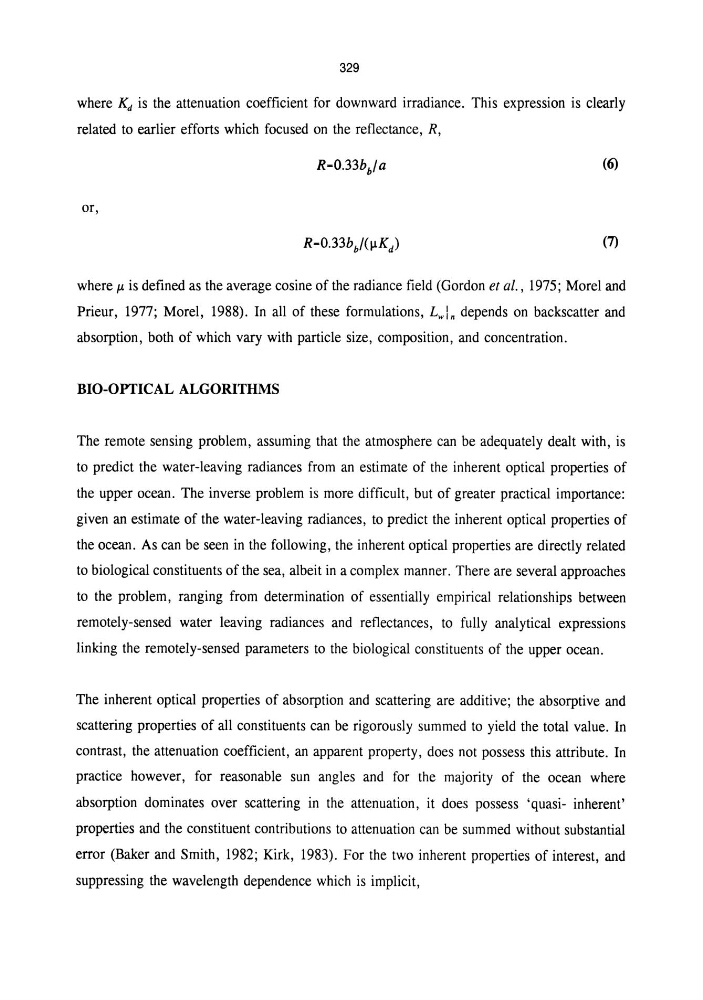
where Kd is the attenuation coefficient for downward irradiance. This expression is clearly
related to earlier efforts which focused on the reflectance, R,
(6)
or,
(7)
where p. is defined as the average cosine of the radiance field (Gordon et al., 1975; Morel and
Prieur, 1977; Morel, 1988). In all of these formulations, Lwi. depends on backscatter and
absorption, both of which vary with particle size, composition, and concentration.
BIO-OPTICAL ALGORITHMS
The remote sensing problem, assuming that the atmosphere can be adequately dealt with, is
to predict the water-leaving radiances from an estimate of the inherent optical properties of
the upper ocean. The inverse problem is more difficult, but of greater practical importance:
given an estimate of the water-leaving radiances, to predict the inherent optical properties of
the ocean. As can be seen in the following, the inherent optical properties are directly related
to biological constituents of the sea, albeit in a complex manner. There are several approaches
to the problem, ranging from determination of essentially empirical relationships between
remotely-sensed water leaving radiances and reflectances, to fully analytical expressions
linking the remotely-sensed parameters to the biological constituents of the upper ocean.
The inherent optical properties of absorption and scattering are additive; the absorptive and
scattering properties of all constituents can be rigorously summed to yield the total value. In
contrast, the attenuation coefficient, an apparent property, does not possess this attribute. In
practice however, for reasonable sun angles and for the majority of the ocean where
absorption dominates over scattering in the attenuation, it does possess 'quasi- inherent'
properties and the constituent contributions to attenuation can be summed without substantial
error (Baker and Smith, 1982; Kirk, 1983). For the two inherent properties of interest, and
suppressing the wavelength dependence which is implicit,
where Kd is the attenuation coefficient for downward irradiance. This expression is clearly
related to earlier efforts which focused on the reflectance, R,
(6)
or,
(7)
where p. is defined as the average cosine of the radiance field (Gordon et al., 1975; Morel and
Prieur, 1977; Morel, 1988). In all of these formulations, Lwi. depends on backscatter and
absorption, both of which vary with particle size, composition, and concentration.
BIO-OPTICAL ALGORITHMS
The remote sensing problem, assuming that the atmosphere can be adequately dealt with, is
to predict the water-leaving radiances from an estimate of the inherent optical properties of
the upper ocean. The inverse problem is more difficult, but of greater practical importance:
given an estimate of the water-leaving radiances, to predict the inherent optical properties of
the ocean. As can be seen in the following, the inherent optical properties are directly related
to biological constituents of the sea, albeit in a complex manner. There are several approaches
to the problem, ranging from determination of essentially empirical relationships between
remotely-sensed water leaving radiances and reflectances, to fully analytical expressions
linking the remotely-sensed parameters to the biological constituents of the upper ocean.
The inherent optical properties of absorption and scattering are additive; the absorptive and
scattering properties of all constituents can be rigorously summed to yield the total value. In
contrast, the attenuation coefficient, an apparent property, does not possess this attribute. In
practice however, for reasonable sun angles and for the majority of the ocean where
absorption dominates over scattering in the attenuation, it does possess 'quasi- inherent'
properties and the constituent contributions to attenuation can be summed without substantial
error (Baker and Smith, 1982; Kirk, 1983). For the two inherent properties of interest, and
suppressing the wavelength dependence which is implicit,