

328
optical thickness. Given that Lalm is 95 % of Ll' it is essential that the atmospheric correction
be made with the greatest care. We will not discuss it further; a complete discussion can be
found in Gordon (1978), Gordon and Morel (1983), Bricaud and Morel (1987), Gordon et al.,
(1988), and Andre and Morel (1989).
It remains to interpret variations in Lw in terms of first the optical properties of the upper
ocean, and second in terms of more biologically relevant quantities such as the chlorophyll
concentration or primary production. Following Gordon et al. (1988), we define the
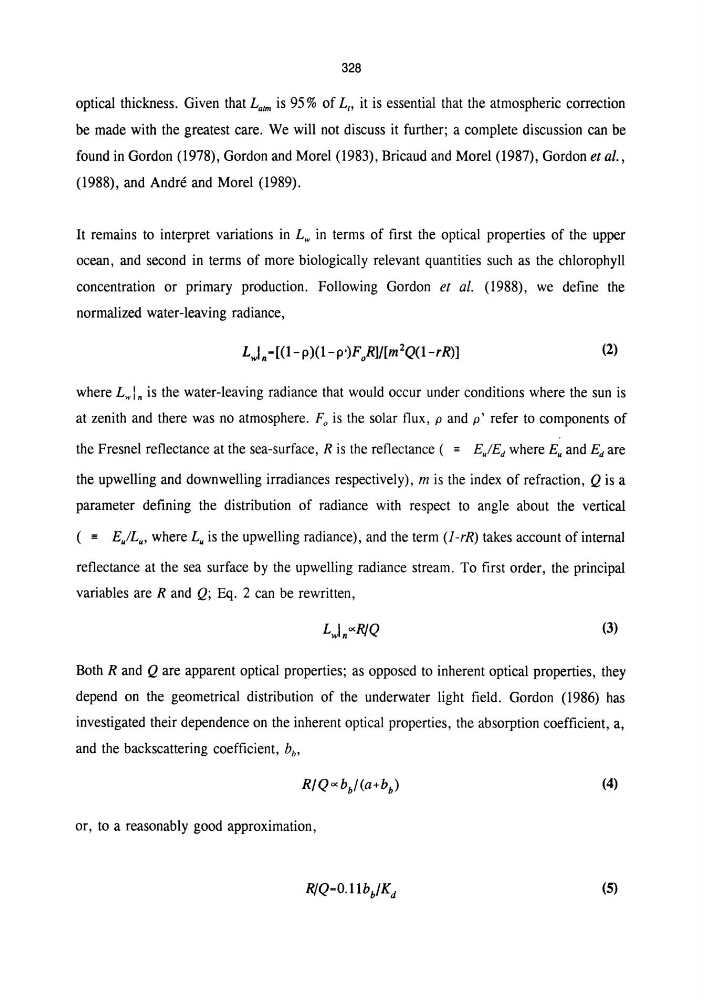
normalized water-leaving radiance,
(2)
where Lw I n is the water-leaving radiance that would occur under conditions where the sun is
at zenith and there was no atmosphere. Fo is the solar flux, p and p' refer to components of
the Fresnel reflectance at the sea-surface, R is the reflectance ( ,. EjEd where Eu and Ed are
the upwelling and downwelling irradiances respectively), m is the index of refraction, Q is a
parameter defining the distribution of radiance with respect to angle about the vertical
( ,. E/Lu, where Lu is the upwelling radiance), and the term (l-rR) takes account of internal
reflectance at the sea surface by the upwelling radiance stream. To first order, the principal
variables are Rand Q; Eq. 2 can be rewritten,
(3)
Both Rand Q are apparent optical properties; as opposed to inherent optical properties, they
depend on the geometrical distribution of the underwater light field. Gordon (1986) has
investigated their dependence on the inherent optical properties, the absorption coefficient, a,
and the backscattering coefficient, bb,
(4)
or, to a reasonably good approximation,
(5)
optical thickness. Given that Lalm is 95 % of Ll' it is essential that the atmospheric correction
be made with the greatest care. We will not discuss it further; a complete discussion can be
found in Gordon (1978), Gordon and Morel (1983), Bricaud and Morel (1987), Gordon et al.,
(1988), and Andre and Morel (1989).
It remains to interpret variations in Lw in terms of first the optical properties of the upper
ocean, and second in terms of more biologically relevant quantities such as the chlorophyll
concentration or primary production. Following Gordon et al. (1988), we define the
normalized water-leaving radiance,
(2)
where Lw I n is the water-leaving radiance that would occur under conditions where the sun is
at zenith and there was no atmosphere. Fo is the solar flux, p and p' refer to components of
the Fresnel reflectance at the sea-surface, R is the reflectance ( ,. EjEd where Eu and Ed are
the upwelling and downwelling irradiances respectively), m is the index of refraction, Q is a
parameter defining the distribution of radiance with respect to angle about the vertical
( ,. E/Lu, where Lu is the upwelling radiance), and the term (l-rR) takes account of internal
reflectance at the sea surface by the upwelling radiance stream. To first order, the principal
variables are Rand Q; Eq. 2 can be rewritten,
(3)
Both Rand Q are apparent optical properties; as opposed to inherent optical properties, they
depend on the geometrical distribution of the underwater light field. Gordon (1986) has
investigated their dependence on the inherent optical properties, the absorption coefficient, a,
and the backscattering coefficient, bb,
(4)
or, to a reasonably good approximation,
(5)