

327
difficult challenges currently facing biological oceanography. Resolving the optical properties
of individual cells is one of the demonstrated strengths of flow cytometry; what is lacking is
an appropriate coupling of the scales in order to permit a parameterization of satellite viewed
ocean color in terms of the ensemble of individual phytoplankton cells in the upper ocean.
Here, we discuss the historical bases for observations of ocean color and its interpretation.
We review some of the applications of remote sensing to computation of primary production
at the global scale, and to computations of the variability in upper ocean heating rates
associated with variations in the optical characteristics of the ocean. Finally, we discuss future
observations of ocean color and some of the basic problems linking the scales of variability
that must be addressed to interpret and apply these observations to current problems in
oceanography.
BASES FOR OCEAN COLOR OBSERVATIONS
The Coastal Zone Color Scanner (CZCS), launched in 1978 and which operated until 1986,
viewed radiance incident at the level of the spacecraft in 5 visible spectral bands centered at
443, 520, 550, 670 and 750 nm (e.g. Gordon et al., 1980). These measurements did not
derive solely from the ocean; as much as 95-99% of the radiance was derived from light
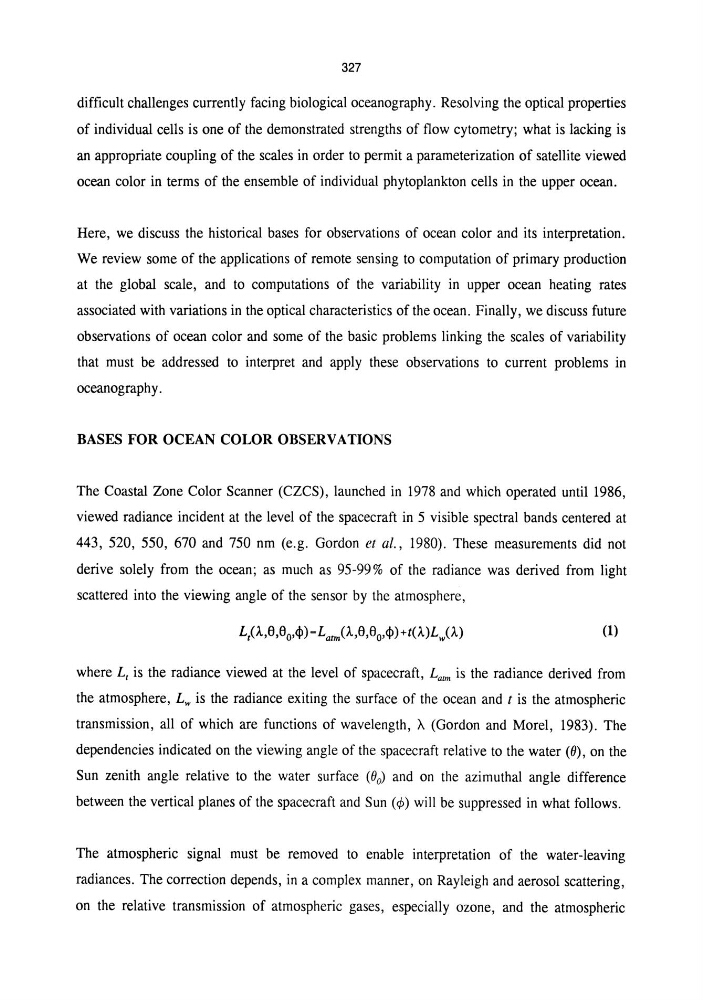
scattered into the viewing angle of the sensor by the atmosphere,
(1)
where LI is the radiance viewed at the level of spacecraft, LaIn! is the radiance derived from
the atmosphere, Lw is the radiance exiting the surface of the ocean and t is the atmospheric
transmission, all of which are functions of wavelength, A (Gordon and Morel, 1983). The
dependencies indicated on the viewing angle of the spacecraft relative to the water (0), on the
Sun zenith angle relative to the water surface (8 0 ) and on the azimuthal angle difference
between the vertical planes of the spacecraft and Sun (¢) will be suppressed in what follows.
The atmospheric signal must be removed to enable interpretation of the water-leaving
radiances. The correction depends, in a complex manner, on Rayleigh and aerosol scattering,
on the relative transmission of atmospheric gases, especially ozone, and the atmospheric
difficult challenges currently facing biological oceanography. Resolving the optical properties
of individual cells is one of the demonstrated strengths of flow cytometry; what is lacking is
an appropriate coupling of the scales in order to permit a parameterization of satellite viewed
ocean color in terms of the ensemble of individual phytoplankton cells in the upper ocean.
Here, we discuss the historical bases for observations of ocean color and its interpretation.
We review some of the applications of remote sensing to computation of primary production
at the global scale, and to computations of the variability in upper ocean heating rates
associated with variations in the optical characteristics of the ocean. Finally, we discuss future
observations of ocean color and some of the basic problems linking the scales of variability
that must be addressed to interpret and apply these observations to current problems in
oceanography.
BASES FOR OCEAN COLOR OBSERVATIONS
The Coastal Zone Color Scanner (CZCS), launched in 1978 and which operated until 1986,
viewed radiance incident at the level of the spacecraft in 5 visible spectral bands centered at
443, 520, 550, 670 and 750 nm (e.g. Gordon et al., 1980). These measurements did not
derive solely from the ocean; as much as 95-99% of the radiance was derived from light
scattered into the viewing angle of the sensor by the atmosphere,
(1)
where LI is the radiance viewed at the level of spacecraft, LaIn! is the radiance derived from
the atmosphere, Lw is the radiance exiting the surface of the ocean and t is the atmospheric
transmission, all of which are functions of wavelength, A (Gordon and Morel, 1983). The
dependencies indicated on the viewing angle of the spacecraft relative to the water (0), on the
Sun zenith angle relative to the water surface (8 0 ) and on the azimuthal angle difference
between the vertical planes of the spacecraft and Sun (¢) will be suppressed in what follows.
The atmospheric signal must be removed to enable interpretation of the water-leaving
radiances. The correction depends, in a complex manner, on Rayleigh and aerosol scattering,
on the relative transmission of atmospheric gases, especially ozone, and the atmospheric