

332
scattering coefficient from the chlorophyll concentration is restricted to the upper ocean where
there is good covariance between the constituent components; it fails deeper in the water
column presumably since viable phytoplankton are not responsible for most of the scattering
in the deeper ocean. In the end, the uncertainty in the relationship between the backscattering
coefficient and chlorophyll concentration remains the largest impediment to further
improvement in the remote sensing biooptical algorithms.
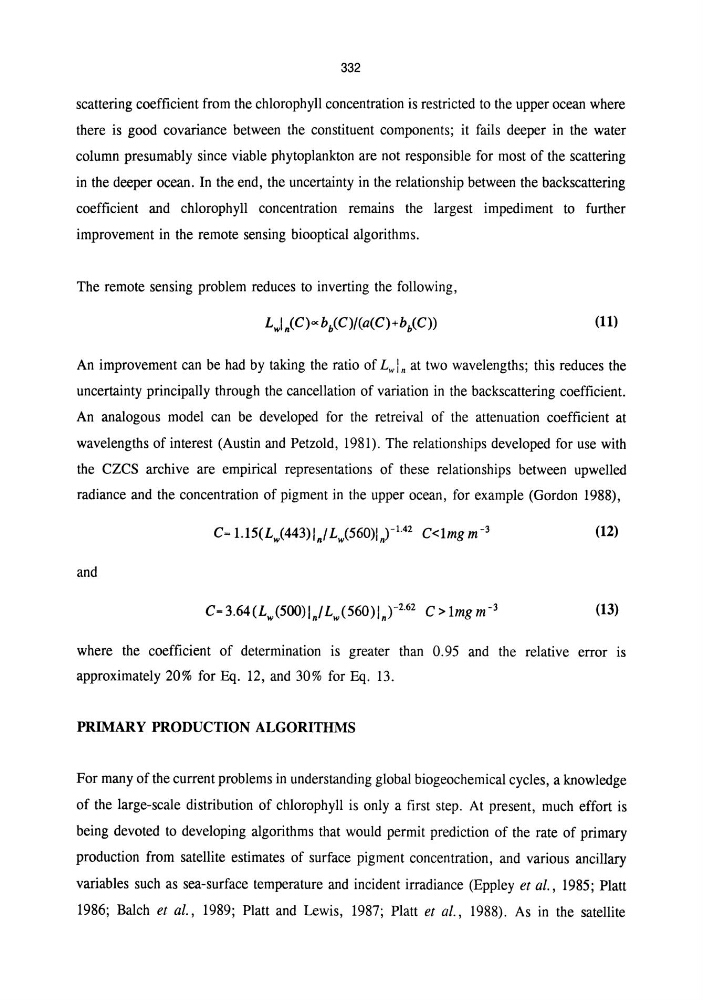
The remote sensing problem reduces to inverting the following,
(11)
An improvement can be had by taking the ratio of Lw I n at two wavelengths; this reduces the
uncertainty principally through the cancellation of variation in the backscattering coefficient.
An analogous model can be developed for the retreival of the attenuation coefficient at
wavelengths of interest (Austin and Petzold, 1981). The relationships developed for use with
the CZCS archive are empirical representations of these relationships between upwelled
radiance and the concentration of pigment in the upper ocean, for example (Gordon 1988),
C-1.15(L w (443) 1,.1 L w (560)1 nl-1. 42 C
and
(13)
where the coefficient of determination is greater than 0.95 and the relative error is
approximately 20% for Eq. 12, and 30% for Eq. 13.
PRIMARY PRODUCTION ALGORITHMS
For many of the current problems in understanding global biogeochemical cycles, a knowledge
of the large-scale distribution of chlorophyll is only a first step. At present, much effort is
being devoted to developing algorithms that would permit prediction of the rate of primary
production from satellite estimates of surface pigment concentration, and various ancillary
variables such as sea-surface temperature and incident irradiance (Eppley et al., 1985; Platt
1986; Balch et al., 1989; Platt and Lewis, 1987; Platt et al., 1988). As in the satellite
scattering coefficient from the chlorophyll concentration is restricted to the upper ocean where
there is good covariance between the constituent components; it fails deeper in the water
column presumably since viable phytoplankton are not responsible for most of the scattering
in the deeper ocean. In the end, the uncertainty in the relationship between the backscattering
coefficient and chlorophyll concentration remains the largest impediment to further
improvement in the remote sensing biooptical algorithms.
The remote sensing problem reduces to inverting the following,
(11)
An improvement can be had by taking the ratio of Lw I n at two wavelengths; this reduces the
uncertainty principally through the cancellation of variation in the backscattering coefficient.
An analogous model can be developed for the retreival of the attenuation coefficient at
wavelengths of interest (Austin and Petzold, 1981). The relationships developed for use with
the CZCS archive are empirical representations of these relationships between upwelled
radiance and the concentration of pigment in the upper ocean, for example (Gordon 1988),
C-1.15(L w (443) 1,.1 L w (560)1 nl-1. 42 C
and
(13)
where the coefficient of determination is greater than 0.95 and the relative error is
approximately 20% for Eq. 12, and 30% for Eq. 13.
PRIMARY PRODUCTION ALGORITHMS
For many of the current problems in understanding global biogeochemical cycles, a knowledge
of the large-scale distribution of chlorophyll is only a first step. At present, much effort is
being devoted to developing algorithms that would permit prediction of the rate of primary
production from satellite estimates of surface pigment concentration, and various ancillary
variables such as sea-surface temperature and incident irradiance (Eppley et al., 1985; Platt
1986; Balch et al., 1989; Platt and Lewis, 1987; Platt et al., 1988). As in the satellite