

308
from satellite data will always depend on additional knowledge about the thickness of the
coccolith-rich layer.
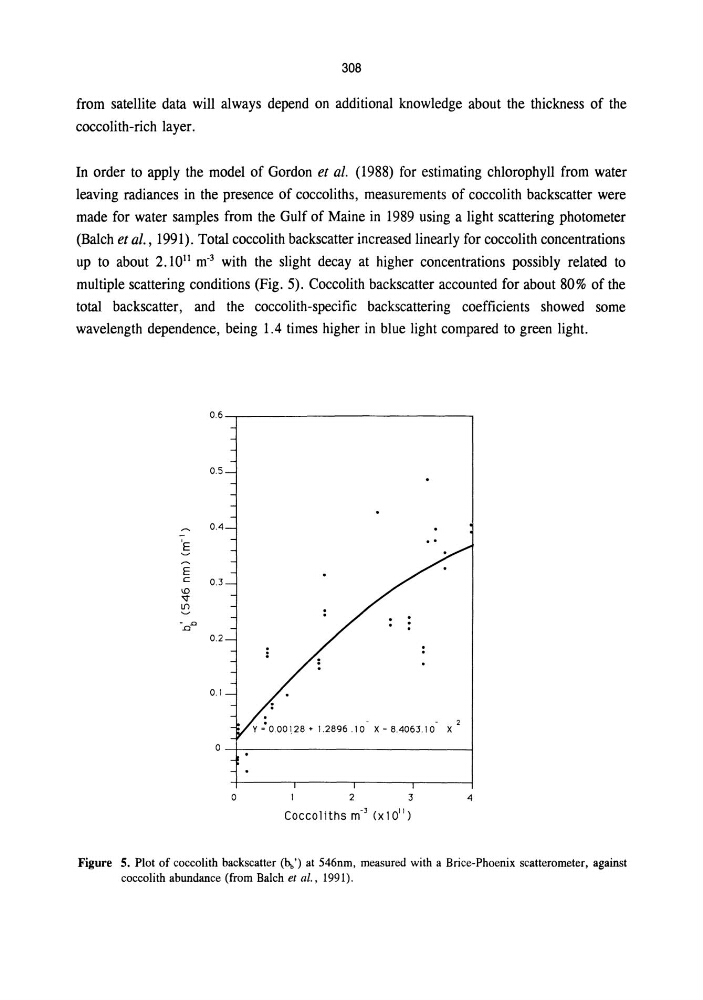
In order to apply the model of Gordon et al. (1988) for estimating chlorophyll from water
leaving radiances in the presence of coccoliths, measurements of coccolith backscatter were
made for water samples from the Gulf of Maine in 1989 using a light scattering photometer
(Balch et al., 1991). Total coccolith backscatter increased linearly for coccolith concentrations
up to about 2.10 11 m- 3 with the slight decay at higher concentrations possibly related to
multiple scattering conditions (Fig. 5). Coccolith backscatter accounted for about 80% of the
total backscatter, and the coccolith-specific backscattering coefficients showed some
wavelength dependence, being 1.4 times higher in blue light compared to green light.
-;E
E
c
\0
""
If')
- n
.0
0 . 6 - - - r - - - - - - - - - - - - - - - - - ,
0.5
0.4
0.3
0.2
0.1
.10 x - 8.4063.10 X
o - + - - - - - - - -________ ~
o
1 2 3
Coccoliths m- 3 (x 1 0")
4
Figure 5. Plot of coccolith backscatter (iJ,,') at 546nm, measured with a Brice-Phoenix scatterometer, against
coccolith abundance (from Balch et ai., 1991).
from satellite data will always depend on additional knowledge about the thickness of the
coccolith-rich layer.
In order to apply the model of Gordon et al. (1988) for estimating chlorophyll from water
leaving radiances in the presence of coccoliths, measurements of coccolith backscatter were
made for water samples from the Gulf of Maine in 1989 using a light scattering photometer
(Balch et al., 1991). Total coccolith backscatter increased linearly for coccolith concentrations
up to about 2.10 11 m- 3 with the slight decay at higher concentrations possibly related to
multiple scattering conditions (Fig. 5). Coccolith backscatter accounted for about 80% of the
total backscatter, and the coccolith-specific backscattering coefficients showed some
wavelength dependence, being 1.4 times higher in blue light compared to green light.
-;E
E
c
\0
""
If')
- n
.0
0 . 6 - - - r - - - - - - - - - - - - - - - - - ,
0.5
0.4
0.3
0.2
0.1
.10 x - 8.4063.10 X
o - + - - - - - - - -________ ~
o
1 2 3
Coccoliths m- 3 (x 1 0")
4
Figure 5. Plot of coccolith backscatter (iJ,,') at 546nm, measured with a Brice-Phoenix scatterometer, against
coccolith abundance (from Balch et ai., 1991).