

307
A study of coccolithophores in the North Atlantic in 1987 demonstrated a good qualitative
correlation between satellite reflectance (580-680nm, NOAA-AVHRR, channell) and
underwater reflectance measured with the Undulating Oceanographic Recorder (UOR) (Aiken
and Bellan, 1990) as shown in Fig. 3. Quantitative analysis of the data was limited either by
time differences > 1 day between the satellite and ship measurements or by problems with
locating ship sampling positions on the satellite images. However, measurements of coccolith
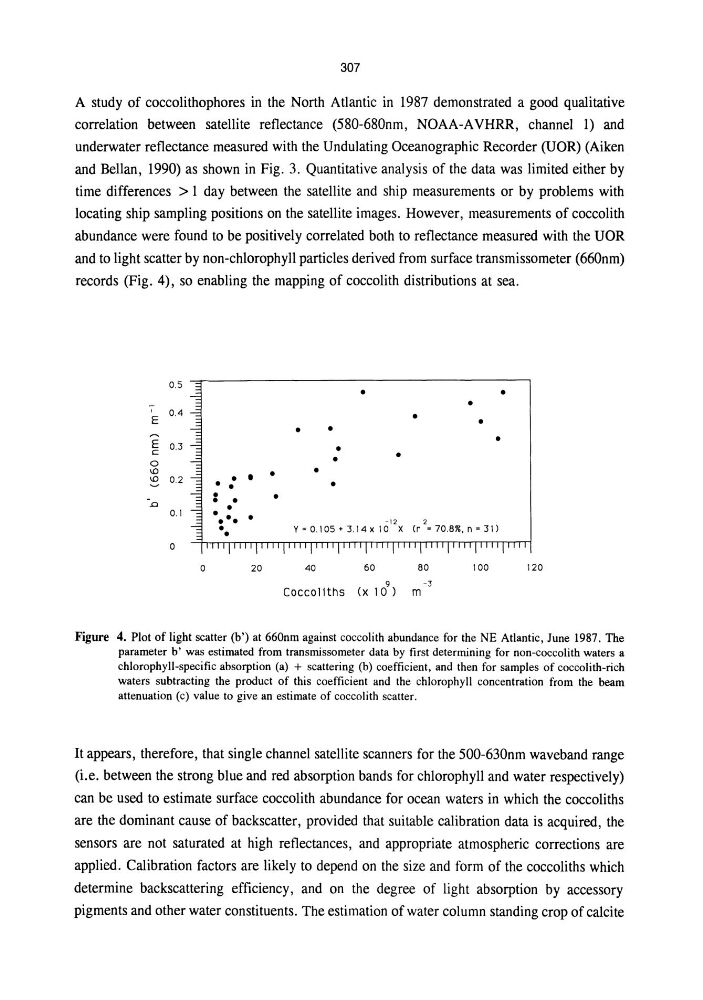
abundance were found to be positively correlated both to reflectance measured with the UOR
and to light scatter by non-chlorophyll particles derived from surface transmissometer (660nm)
records (Fig. 4), so enabling the mapping of coccolith distributions at sea.
0.5
-;- 0.4
E
E 0.3
c
0
ID
ID 0.2
-.0
0.1
0
0
20
40
60
80
100
120
9
-3
Coccol iths (x 10) m
Figure 4. Plot of light scatter (b') at 660nm against coccolith abundance for the NE Atlantic, June 1987. The
parameter b' was estimated from transmissometer data by first determining for non-coccolith waters a
chlorophyll-specific absorption (a) + scattering (b) coefficient, and then for samples of coccolith-rich
waters subtracting the product of this coefficient and the chlorophyll concentration from the beam
attenuation (c) value to give an estimate of coccolith scatter.
It appears, therefore, that single channel satellite scanners for the 500-630nm waveband range
(i.e. between the strong blue and red absorption bands for chlorophyll and water respectively)
can be used to estimate surface coccolith abundance for ocean waters in which the coccoliths
are the dominant cause of backscatter, provided that suitable calibration data is acquired, the
sensors are not saturated at high reflectances, and appropriate atmospheric corrections are
applied. Calibration factors are likely to depend on the size and form of the coccoliths which
determine backscattering efficiency, and on the degree of light absorption by accessory
pigments and other water constituents. The estimation of water column standing crop of calcite
A study of coccolithophores in the North Atlantic in 1987 demonstrated a good qualitative
correlation between satellite reflectance (580-680nm, NOAA-AVHRR, channell) and
underwater reflectance measured with the Undulating Oceanographic Recorder (UOR) (Aiken
and Bellan, 1990) as shown in Fig. 3. Quantitative analysis of the data was limited either by
time differences > 1 day between the satellite and ship measurements or by problems with
locating ship sampling positions on the satellite images. However, measurements of coccolith
abundance were found to be positively correlated both to reflectance measured with the UOR
and to light scatter by non-chlorophyll particles derived from surface transmissometer (660nm)
records (Fig. 4), so enabling the mapping of coccolith distributions at sea.
0.5
-;- 0.4
E
E 0.3
c
0
ID
ID 0.2
-.0
0.1
0
0
20
40
60
80
100
120
9
-3
Coccol iths (x 10) m
Figure 4. Plot of light scatter (b') at 660nm against coccolith abundance for the NE Atlantic, June 1987. The
parameter b' was estimated from transmissometer data by first determining for non-coccolith waters a
chlorophyll-specific absorption (a) + scattering (b) coefficient, and then for samples of coccolith-rich
waters subtracting the product of this coefficient and the chlorophyll concentration from the beam
attenuation (c) value to give an estimate of coccolith scatter.
It appears, therefore, that single channel satellite scanners for the 500-630nm waveband range
(i.e. between the strong blue and red absorption bands for chlorophyll and water respectively)
can be used to estimate surface coccolith abundance for ocean waters in which the coccoliths
are the dominant cause of backscatter, provided that suitable calibration data is acquired, the
sensors are not saturated at high reflectances, and appropriate atmospheric corrections are
applied. Calibration factors are likely to depend on the size and form of the coccoliths which
determine backscattering efficiency, and on the degree of light absorption by accessory
pigments and other water constituents. The estimation of water column standing crop of calcite