

309
Confidence in the backscattering coefficient values is based is based on comparable estimates
from the DOR reflectance data (Fig. 3) using the following approximate relationships (see
Bricaud and Morel, 1986; Gordon et al., 1988):
and
leading to
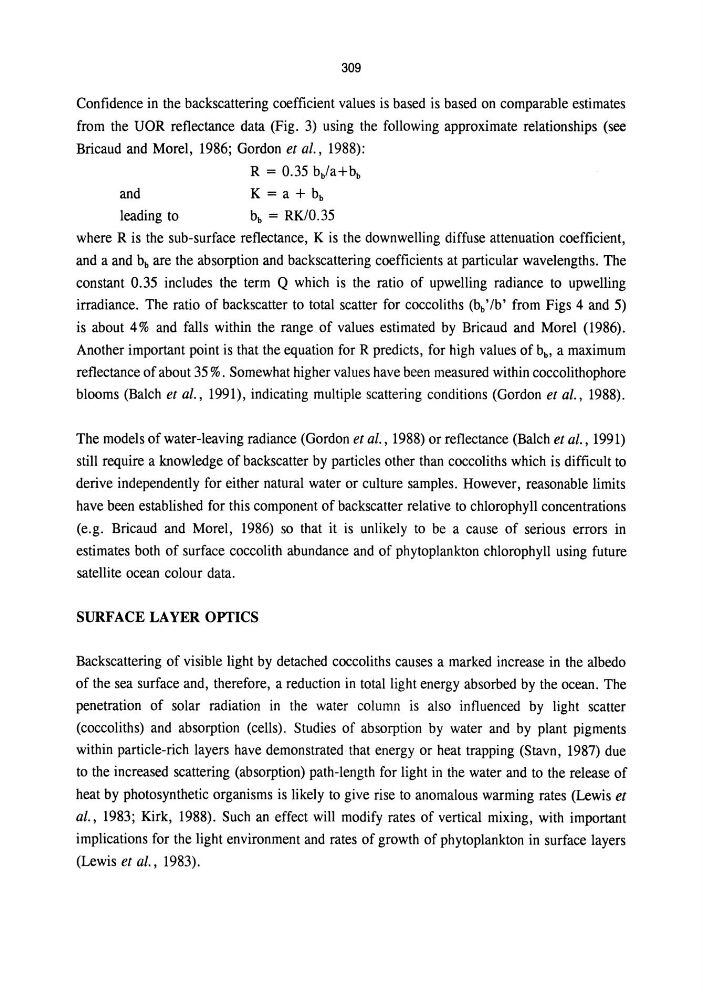
R = 0.35 bb/a+bb
K=a+bb
bb = RKlO.35
where R is the sub-surface reflectance, K is the downwelling diffuse attenuation coefficient,
and a and bb are the absorption and backscattering coefficients at particular wavelengths. The
constant 0.35 includes the term Q which is the ratio of upwelling radiance to upwelling
irradiance. The ratio of backscatter to total scatter for coccoliths (bb'/b' from Figs 4 and 5)
is about 4% and falls within the range of values estimated by Bricaud and Morel (1986).
Another important point is that the equation for R predicts, for high values of bb, a maximum
reflectance of about 35 %. Somewhat higher values have been measured within coccolithophore
blooms (Balch et al., 1991), indicating multiple scattering conditions (Gordon et al., 1988).
The models of water-leaving radiance (Gordon et al., 1988) or reflectance (Balch et al., 1991)
still require a knowledge of backscatter by particles other than coccoliths which is difficult to
derive independently for either natural water or culture samples. However, reasonable limits
have been established for this component of backscatter relative to chlorophyll concentrations
(e.g. Bricaud and Morel, 1986) so that it is unlikely to be a cause of serious errors in
estimates both of surface coccolith abundance and of phytoplankton chlorophyll using future
satellite ocean colour data.
SURFACE LAYER OPTICS
Backscattering of visible light by detached coccoliths causes a marked increase in the albedo
of the sea surface and, therefore, a reduction in total light energy absorbed by the ocean. The
penetration of solar radiation in the water column is also influenced by light scatter
(coccoliths) and absorption (cells). Studies of absorption by water and by plant pigments
within particle-rich layers have demonstrated that energy or heat trapping (Stavn, 1987) due
to the increased scattering (absorption) path-length for light in the water and to the release of
heat by photosynthetic organisms is likely to give rise to anomalous warming rates (Lewis et
al., 1983; Kirk, 1988). Such an effect will modify rates of vertical mixing, with important
implications for the light environment and rates of growth of phytoplankton in surface layers
(Lewis et al., 1983).
Confidence in the backscattering coefficient values is based is based on comparable estimates
from the DOR reflectance data (Fig. 3) using the following approximate relationships (see
Bricaud and Morel, 1986; Gordon et al., 1988):
and
leading to
R = 0.35 bb/a+bb
K=a+bb
bb = RKlO.35
where R is the sub-surface reflectance, K is the downwelling diffuse attenuation coefficient,
and a and bb are the absorption and backscattering coefficients at particular wavelengths. The
constant 0.35 includes the term Q which is the ratio of upwelling radiance to upwelling
irradiance. The ratio of backscatter to total scatter for coccoliths (bb'/b' from Figs 4 and 5)
is about 4% and falls within the range of values estimated by Bricaud and Morel (1986).
Another important point is that the equation for R predicts, for high values of bb, a maximum
reflectance of about 35 %. Somewhat higher values have been measured within coccolithophore
blooms (Balch et al., 1991), indicating multiple scattering conditions (Gordon et al., 1988).
The models of water-leaving radiance (Gordon et al., 1988) or reflectance (Balch et al., 1991)
still require a knowledge of backscatter by particles other than coccoliths which is difficult to
derive independently for either natural water or culture samples. However, reasonable limits
have been established for this component of backscatter relative to chlorophyll concentrations
(e.g. Bricaud and Morel, 1986) so that it is unlikely to be a cause of serious errors in
estimates both of surface coccolith abundance and of phytoplankton chlorophyll using future
satellite ocean colour data.
SURFACE LAYER OPTICS
Backscattering of visible light by detached coccoliths causes a marked increase in the albedo
of the sea surface and, therefore, a reduction in total light energy absorbed by the ocean. The
penetration of solar radiation in the water column is also influenced by light scatter
(coccoliths) and absorption (cells). Studies of absorption by water and by plant pigments
within particle-rich layers have demonstrated that energy or heat trapping (Stavn, 1987) due
to the increased scattering (absorption) path-length for light in the water and to the release of
heat by photosynthetic organisms is likely to give rise to anomalous warming rates (Lewis et
al., 1983; Kirk, 1988). Such an effect will modify rates of vertical mixing, with important
implications for the light environment and rates of growth of phytoplankton in surface layers
(Lewis et al., 1983).