

18
from light scattering is not possible in absolute terms. The light scattering intensity also
increases strongly with the refractive index of the cell, which in turn is a function of its
chemical composition. In practice, the size of cells of the same or similar types can be
determined on a relative scale, which in turn has to be related to absolute values by an
absolute sizing by means of electrical volume determination (Coulter volume) or microscopy.
A further complication in size determination by light scattering measurement is that the
scattering also depends on the shape of the cell, and the theory of light scattering is so
complex that there is no practical way that the shape can be quantitatively accounted for.
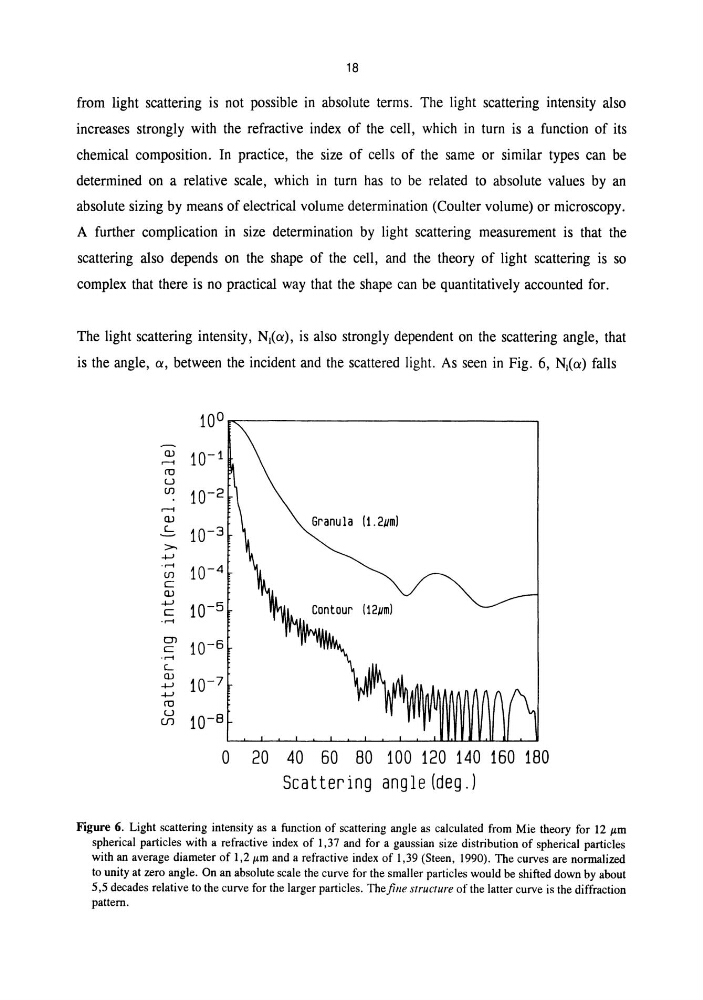
The light scattering intensity, N,(a), is also strongly dependent on the scattering angle, that
is the angle, a, between the incident and the scattered light. As seen in Fig. 6, N,(a) falls
Q)
10- 1
r-i
m
u
(j)
r-i
Q)
c....
>-+-'
- r-!
10-4
(j)
c
Q)
-+-'
10-5
C
-r-!
en
10-6
c
- r-!
c....
Q)
10-7
-+-'
-+-'
m
u
10- 8
en
0 20 40 60 80 100 120 140 160 180
Scattering angle (deg.)
Figure 6. Light scattering intensity as a function of scattering angle as calculated from Mie theory for 12 I'm
spherical particles with a refractive index of 1,37 and for a gaussian size distribution of spherical particles
with an average diameter of 1,2 I'm and a refractive index of 1,39 (Steen, 1990). The curves are normalized
to unity at zero angle. On an absolute scale the curve for the smaller particles would be shifted down by about
5,5 decades relative to the curve for the larger particles. Thejille structure of the latter curve is the diffraction
pattern.
from light scattering is not possible in absolute terms. The light scattering intensity also
increases strongly with the refractive index of the cell, which in turn is a function of its
chemical composition. In practice, the size of cells of the same or similar types can be
determined on a relative scale, which in turn has to be related to absolute values by an
absolute sizing by means of electrical volume determination (Coulter volume) or microscopy.
A further complication in size determination by light scattering measurement is that the
scattering also depends on the shape of the cell, and the theory of light scattering is so
complex that there is no practical way that the shape can be quantitatively accounted for.
The light scattering intensity, N,(a), is also strongly dependent on the scattering angle, that
is the angle, a, between the incident and the scattered light. As seen in Fig. 6, N,(a) falls
Q)
10- 1
r-i
m
u
(j)
r-i
Q)
c....
>-+-'
- r-!
10-4
(j)
c
Q)
-+-'
10-5
C
-r-!
en
10-6
c
- r-!
c....
Q)
10-7
-+-'
-+-'
m
u
10- 8
en
0 20 40 60 80 100 120 140 160 180
Scattering angle (deg.)
Figure 6. Light scattering intensity as a function of scattering angle as calculated from Mie theory for 12 I'm
spherical particles with a refractive index of 1,37 and for a gaussian size distribution of spherical particles
with an average diameter of 1,2 I'm and a refractive index of 1,39 (Steen, 1990). The curves are normalized
to unity at zero angle. On an absolute scale the curve for the smaller particles would be shifted down by about
5,5 decades relative to the curve for the larger particles. Thejille structure of the latter curve is the diffraction
pattern.