

17
The reason may be that with a smaller pinhole alignment becomes more critical and difficult.
Furthermore, if the optics do not exhibit sufficient contrast and resolution, a small measuring
aperture will reduce not only the background, but the signal as well. Laser-based instruments
generally do not employ spatial filtering of the low angle scattering. A significant increase of
the signal to noise ratio can be achieved if this is introduced.
Light scattering measurement: The light scattering of the cells provides two types of
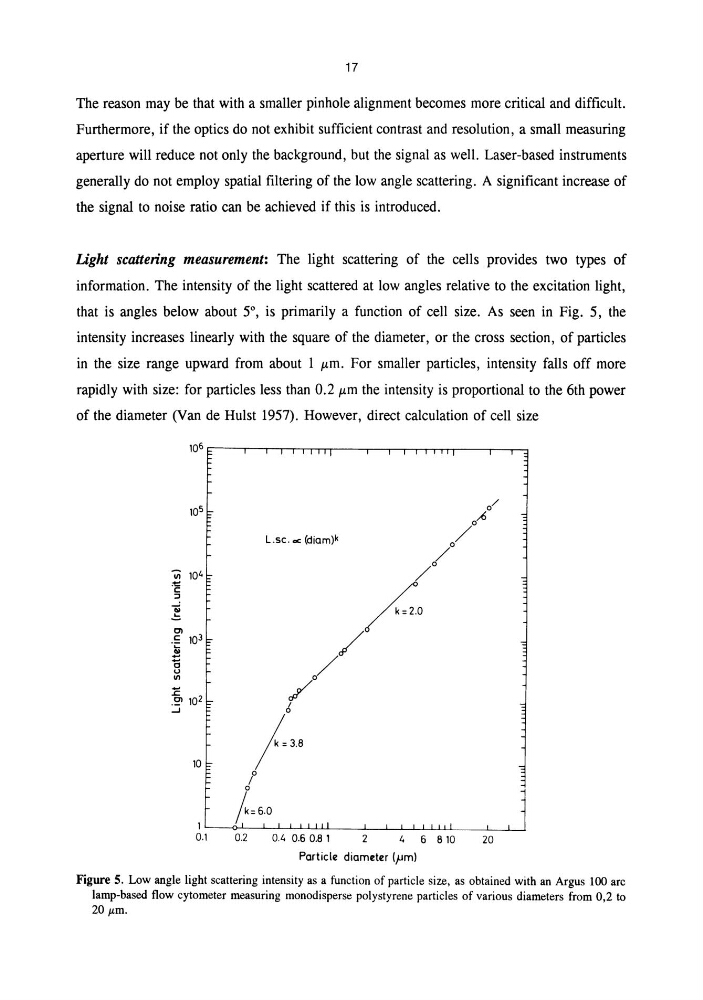
information. The intensity of the light scattered at low angles relative to the excitation light,
that is angles below about 5°, is primarily a function of cell size. As seen in Fig. 5, the
intensity increases linearly with the square of the diameter, or the cross section, of particles
in the size range upward from about I j.tm. For smaller particles, intensity falls off more
rapidly with size: for particles less than 0.2 j.tm the intensity is proportional to the 6th power
of the diameter (Van de Hulst 1957). However, direct calculation of cell size
0)
.§ 10 3 E~
c U
111
1::
.~ 10 2 ,="
...J
10
L .sc. aC (diam)k
0.4 0.60.81
2
4
6 810
20
Particle diameter (jJm)
Figure 5. Low angle light scattering intensity as a function of particle size, as obtained with an Argus 100 arc
lamp-based flow cytometer measuring monodisperse polystyrene particles of various diameters from 0,2 to
20 ~m.
The reason may be that with a smaller pinhole alignment becomes more critical and difficult.
Furthermore, if the optics do not exhibit sufficient contrast and resolution, a small measuring
aperture will reduce not only the background, but the signal as well. Laser-based instruments
generally do not employ spatial filtering of the low angle scattering. A significant increase of
the signal to noise ratio can be achieved if this is introduced.
Light scattering measurement: The light scattering of the cells provides two types of
information. The intensity of the light scattered at low angles relative to the excitation light,
that is angles below about 5°, is primarily a function of cell size. As seen in Fig. 5, the
intensity increases linearly with the square of the diameter, or the cross section, of particles
in the size range upward from about I j.tm. For smaller particles, intensity falls off more
rapidly with size: for particles less than 0.2 j.tm the intensity is proportional to the 6th power
of the diameter (Van de Hulst 1957). However, direct calculation of cell size
0)
.§ 10 3 E~
c U
111
1::
.~ 10 2 ,="
...J
10
L .sc. aC (diam)k
0.4 0.60.81
2
4
6 810
20
Particle diameter (jJm)
Figure 5. Low angle light scattering intensity as a function of particle size, as obtained with an Argus 100 arc
lamp-based flow cytometer measuring monodisperse polystyrene particles of various diameters from 0,2 to
20 ~m.