

281
their transient and local nature, and would be found side-by-side with the microbial food loop
where primary production and biomass is dominated by very small cells. According to
Goldman, episodic blooms of large cells might be responsible for a large fraction of the (new)
primary production in deep oceanic waters (see Type 5 below).
Distance from
50
150
shore (km)
250
~ 4
202
, -, V
:~~
80 -j
. . .
'.
i
.
,
,
' .
. .
I'
\
,
.
"
.
,
100 J Chlorophyll (~g / litre)
:~I7fM'E'G;
60j
80 ,
i
100J Density
,
. , . . ,.
.... -.~-',
,II
,
.
/
I
,
,
,
I
,
,
,
,
,
,..
350
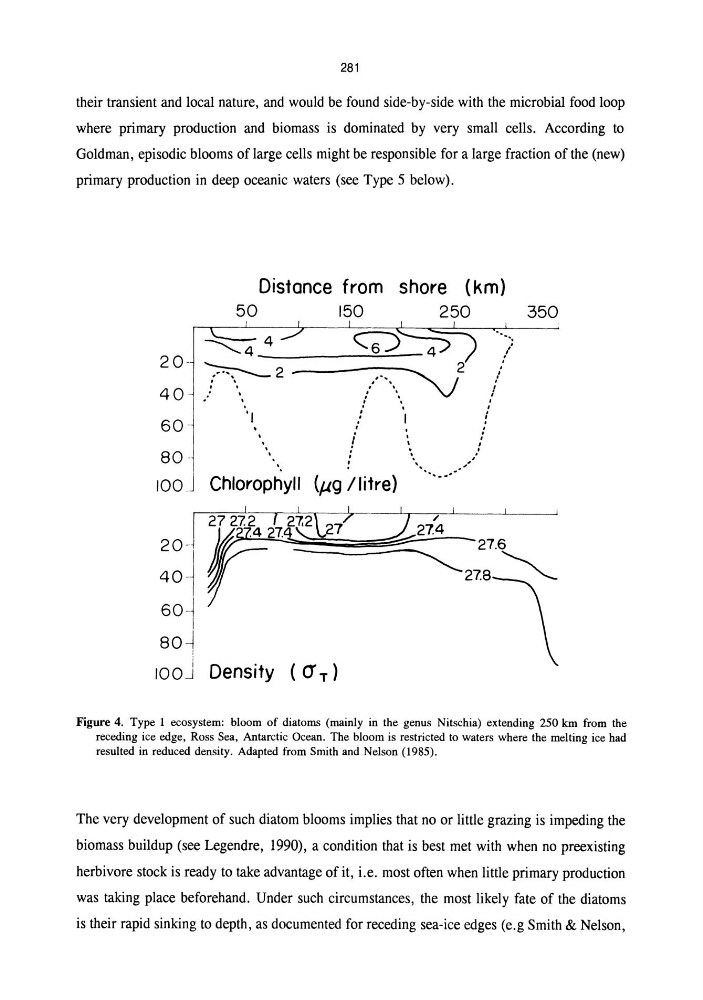
Figure 4. Type 1 ecosystem: bloom of diatoms (mainly in the genus Nitschia) extending 250 km from the
receding ice edge, Ross Sea, Antarctic Ocean. The bloom is restricted to waters where the melting ice had
resulted in reduced density. Adapted from Smith and Nelson (1985).
The very development of such diatom blooms implies that no or little grazing is impeding the
biomass buildup (see Legendre, 1990), a condition that is best met with when no preexisting
herbivore stock is ready to take advantage of it, i.e. most often when little primary production
was taking place beforehand. Under such circumstances, the most likely fate of the diatoms
is their rapid sinking to depth, as documented for receding sea-ice edges (e.g Smith & Nelson,
their transient and local nature, and would be found side-by-side with the microbial food loop
where primary production and biomass is dominated by very small cells. According to
Goldman, episodic blooms of large cells might be responsible for a large fraction of the (new)
primary production in deep oceanic waters (see Type 5 below).
Distance from
50
150
shore (km)
250
~ 4
202
, -, V
:~~
80 -j
. . .
'.
i
.
,
,
' .
. .
I'
\
,
.
"
.
,
100 J Chlorophyll (~g / litre)
:~I7fM'E'G;
60j
80 ,
i
100J Density
,
. , . . ,.
.... -.~-',
,II
,
.
/
I
,
,
,
I
,
,
,
,
,
,..
350
Figure 4. Type 1 ecosystem: bloom of diatoms (mainly in the genus Nitschia) extending 250 km from the
receding ice edge, Ross Sea, Antarctic Ocean. The bloom is restricted to waters where the melting ice had
resulted in reduced density. Adapted from Smith and Nelson (1985).
The very development of such diatom blooms implies that no or little grazing is impeding the
biomass buildup (see Legendre, 1990), a condition that is best met with when no preexisting
herbivore stock is ready to take advantage of it, i.e. most often when little primary production
was taking place beforehand. Under such circumstances, the most likely fate of the diatoms
is their rapid sinking to depth, as documented for receding sea-ice edges (e.g Smith & Nelson,