

282
1985; Nelson and Smith, 1986; Olson, 1980) and upwelling areas (e.g. Cronin and Morris,
1982; Poutanen and Morris, 1983; Smith et ai., 1983; Barlow, 1984), and hypothesized for
episodic blooms of large cells in open oceanic waters (Goldman, 1989). Rapidly settling cells,
as explained above, are efficient in transporting carbon to depths where it may be effectively
sequestered.
TYPE 2. PRODUCTION BY SMALL AND LARGE CELLS, STANDING STOCK
DOMINATED BY LARGE CELLS
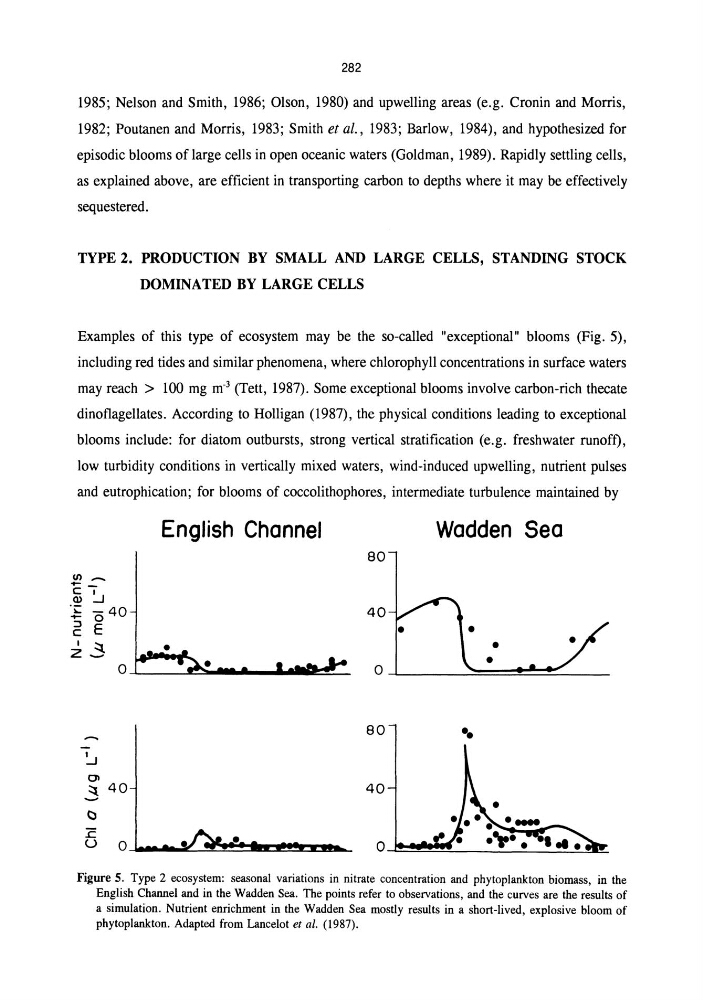
Examples of this type of ecosystem may be the so-called "exceptional" blooms (Fig. 5),
including red tides and similar phenomena, where chlorophyll concentrations in surface waters
may reach> 100 mg m- 3 (Tett, 1987). Some exceptional blooms involve carbon-rich thecate
dinoflagellates. According to Holligan (1987), the physical conditions leading to exceptional
blooms include: for diatom outbursts, strong vertical stratification (e.g. freshwater runoff),
low turbidity conditions in vertically mixed waters, wind-induced upwelling, nutrient pulses
and eutrophication; for blooms of coccolithophores, intermediate turbulence maintained by
English Channel
(/) -
~~
.~ -40
+- 0
E E
23
•
~
0'1
3 40
()
:c
u
O~~ ... ~~~·~Im~~~MM~
80
40
Wadden Sea
•
•
•
O~ ____ ~==~~~ __ _
80
••
Figure 5. Type 2 ecosystem: seasonal variations in nitrate concentration and phytoplankton biomass, in the
English Channel and in the Wadden Sea. The points refer to observations, and the curves are the results of
a simulation. Nutrient enrichment in the Wadden Sea mostly results in a short-lived, explosive bloom of
phytoplankton. Adapted from Lancelot et al. (1987).
1985; Nelson and Smith, 1986; Olson, 1980) and upwelling areas (e.g. Cronin and Morris,
1982; Poutanen and Morris, 1983; Smith et ai., 1983; Barlow, 1984), and hypothesized for
episodic blooms of large cells in open oceanic waters (Goldman, 1989). Rapidly settling cells,
as explained above, are efficient in transporting carbon to depths where it may be effectively
sequestered.
TYPE 2. PRODUCTION BY SMALL AND LARGE CELLS, STANDING STOCK
DOMINATED BY LARGE CELLS
Examples of this type of ecosystem may be the so-called "exceptional" blooms (Fig. 5),
including red tides and similar phenomena, where chlorophyll concentrations in surface waters
may reach> 100 mg m- 3 (Tett, 1987). Some exceptional blooms involve carbon-rich thecate
dinoflagellates. According to Holligan (1987), the physical conditions leading to exceptional
blooms include: for diatom outbursts, strong vertical stratification (e.g. freshwater runoff),
low turbidity conditions in vertically mixed waters, wind-induced upwelling, nutrient pulses
and eutrophication; for blooms of coccolithophores, intermediate turbulence maintained by
English Channel
(/) -
~~
.~ -40
+- 0
E E
23
•
~
0'1
3 40
()
:c
u
O~~ ... ~~~·~Im~~~MM~
80
40
Wadden Sea
•
•
•
O~ ____ ~==~~~ __ _
80
••
Figure 5. Type 2 ecosystem: seasonal variations in nitrate concentration and phytoplankton biomass, in the
English Channel and in the Wadden Sea. The points refer to observations, and the curves are the results of
a simulation. Nutrient enrichment in the Wadden Sea mostly results in a short-lived, explosive bloom of
phytoplankton. Adapted from Lancelot et al. (1987).