

280
hydrodynamic singularity) suddenly frees the algae from the previously prevailing limitation,
which may either be irradiance, as in Sverdrup's (1953) critical depth model of the triggering
Physical forcing
... - - - - Hydrodynamic singularities - - - - -
Lorge cells
Lorge and small cells
Small cells
Primary production dominated by: ".--=---;-11-~---2--=---="1-:::::~=----4--'1-5Standing stock of phytoplankton
Lorge cells
Lorge and small cells
Small cells
dominated by: •
Low
Spatio-temporal heterogeneity
~igh
of ecosystem: +.~----------------Low
Export I sequestrati~n of
High
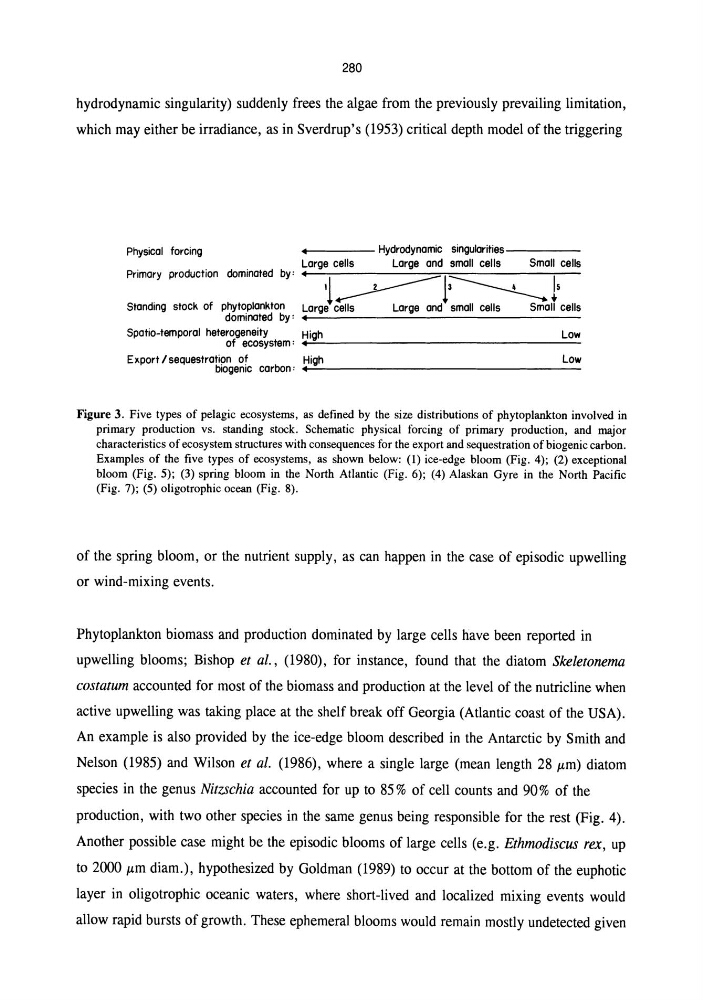
biogeniC carbon: •• --=-----------------Figure 3. Five types of pelagic ecosystems, as defined by the size distributions of phytoplankton involved in
primary production vs. standing stock. Schematic physical forcing of primary production, and major
characteristics of ecosystem structures with consequences for the export and sequestration of biogenic carbon.
Examples of the five types of ecosystems, as shown below: (1) ice-edge bloom (Fig. 4); (2) exceptional
bloom (Fig. 5); (3) spring bloom in the North Atlantic (Fig. 6); (4) Alaskan Gyre in the North Pacific
(Fig. 7); (5) oligotrophic ocean (Fig. 8).
of the spring bloom, or the nutrient supply, as can happen in the case of episodic upwelling
or wind-mixing events.
Phytoplankton biomass and production dominated by large cells have been reported in
upwelling blooms; Bishop et al., (1980), for instance, found that the diatom Skeletonema
costatum accounted for most of the biomass and production at the level of the nutricline when
active upwelling was taking place at the shelf break off Georgia (Atlantic coast of the USA).
An example is also provided by the ice-edge bloom described in the Antarctic by Smith and
Nelson (1985) and Wilson et al. (1986), where a single large (mean length 28 /-tm) diatom
species in the genus Nitzschia accounted for up to 85 % of cell counts and 90 % of the
production, with two other species in the same genus being responsible for the rest (Fig. 4).
Another possible case might be the episodic blooms of large cells (e.g. Ethmodiscus rex, up
to 2000 /-tm diam.), hypothesized by Goldman (1989) to occur at the bottom of the euphotic
layer in oligotrophic oceanic waters, where short-lived and localized mixing events would
allow rapid bursts of growth. These ephemeral blooms would remain mostly undetected given
hydrodynamic singularity) suddenly frees the algae from the previously prevailing limitation,
which may either be irradiance, as in Sverdrup's (1953) critical depth model of the triggering
Physical forcing
... - - - - Hydrodynamic singularities - - - - -
Lorge cells
Lorge and small cells
Small cells
Primary production dominated by: ".--=---;-11-~---2--=---="1-:::::~=----4--'1-5Standing stock of phytoplankton
Lorge cells
Lorge and small cells
Small cells
dominated by: •
Low
Spatio-temporal heterogeneity
~igh
of ecosystem: +.~----------------Low
Export I sequestrati~n of
High
biogeniC carbon: •• --=-----------------Figure 3. Five types of pelagic ecosystems, as defined by the size distributions of phytoplankton involved in
primary production vs. standing stock. Schematic physical forcing of primary production, and major
characteristics of ecosystem structures with consequences for the export and sequestration of biogenic carbon.
Examples of the five types of ecosystems, as shown below: (1) ice-edge bloom (Fig. 4); (2) exceptional
bloom (Fig. 5); (3) spring bloom in the North Atlantic (Fig. 6); (4) Alaskan Gyre in the North Pacific
(Fig. 7); (5) oligotrophic ocean (Fig. 8).
of the spring bloom, or the nutrient supply, as can happen in the case of episodic upwelling
or wind-mixing events.
Phytoplankton biomass and production dominated by large cells have been reported in
upwelling blooms; Bishop et al., (1980), for instance, found that the diatom Skeletonema
costatum accounted for most of the biomass and production at the level of the nutricline when
active upwelling was taking place at the shelf break off Georgia (Atlantic coast of the USA).
An example is also provided by the ice-edge bloom described in the Antarctic by Smith and
Nelson (1985) and Wilson et al. (1986), where a single large (mean length 28 /-tm) diatom
species in the genus Nitzschia accounted for up to 85 % of cell counts and 90 % of the
production, with two other species in the same genus being responsible for the rest (Fig. 4).
Another possible case might be the episodic blooms of large cells (e.g. Ethmodiscus rex, up
to 2000 /-tm diam.), hypothesized by Goldman (1989) to occur at the bottom of the euphotic
layer in oligotrophic oceanic waters, where short-lived and localized mixing events would
allow rapid bursts of growth. These ephemeral blooms would remain mostly undetected given