

201
VERY THIN COATED SPHERE x
1.0
40
~
0
I
G;""'" 35
I
a
8 -2
b
S 30
X
~
-4
,
X 25
~
20
::: -6
j
15
[f]
,
[f]
~ -8
j
10
'----[f]
5
-10
0
30
60
90
120
150
180
0
30
60
90
120
150
180
ANGLE (degrees)
ANGLE (degrees)
::;---10
~
rI
I
0
0
\c
0
.-.
~ -5
X
(I
~
, -"'--10
-15
[f]
'\
ril-2O
~ -5
~-25
M
..
M
C"')-30
[f]
[f]
-10
-35
0
30
60
90
120
150
180
0
30
60
90
120
150
180
ANGLf, (degrees)
ANGLE (degrees)
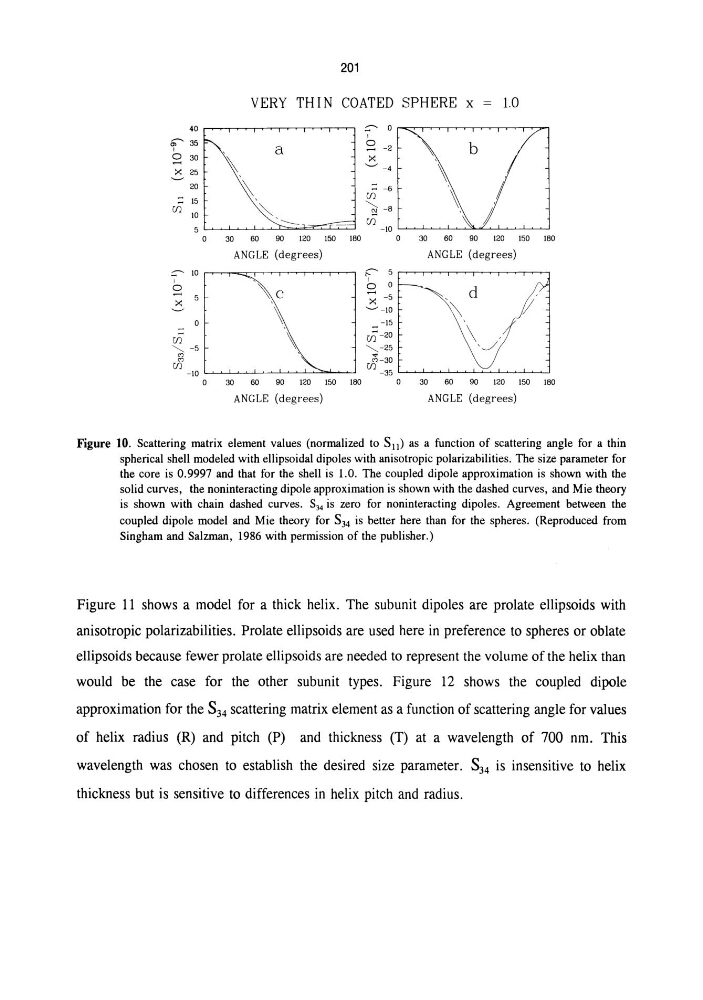
Figure 10. Scattering matrix element values (normalized to SIl) as a function of scattering angle for a thin
spherical shell modeled with ellipsoidal dipoles with anisotropic polarizabilities. The size parameter for
the core is 0.9997 and that for the shell is 1.0. The coupled dipole approximation is shown with the
solid curves, the noninteracting dipole approximation is shown with the dashed curves, and Mie theory
is shown with chain dashed curves. S34 is zero for noninteracting dipoles. Agreement between the
coupled dipole model and Mie theory for S34 is better here than for the spheres. (Reproduced from
Singham and Salzman, 1986 with permission of the publisher.)
Figure 11 shows a model for a thick helix. The subunit dipoles are prolate ellipsoids with
anisotropic polarizabilities. Prolate ellipsoids are used here in preference to spheres or oblate
ellipsoids because fewer prolate ellipsoids are needed to represent the volume of the helix than
would be the case for the other subunit types. Figure 12 shows the coupled dipole
approximation for the S34 scattering matrix element as a function of scattering angle for values
of helix radius (R) and pitch (P) and thickness (T) at a wavelength of 700 nm. This
wavelength was chosen to establish the desired size parameter. ~4 is insensitive to helix
thickness but is sensitive to differences in helix pitch and radius.
VERY THIN COATED SPHERE x
1.0
40
~
0
I
G;""'" 35
I
a
8 -2
b
S 30
X
~
-4
,
X 25
~
20
::: -6
j
15
[f]
,
[f]
~ -8
j
10
'----[f]
5
-10
0
30
60
90
120
150
180
0
30
60
90
120
150
180
ANGLE (degrees)
ANGLE (degrees)
::;---10
~
rI
I
0
0
\c
0
.-.
~ -5
X
(I
~
, -"'--10
-15
[f]
'\
ril-2O
~ -5
~-25
M
..
M
C"')-30
[f]
[f]
-10
-35
0
30
60
90
120
150
180
0
30
60
90
120
150
180
ANGLf, (degrees)
ANGLE (degrees)
Figure 10. Scattering matrix element values (normalized to SIl) as a function of scattering angle for a thin
spherical shell modeled with ellipsoidal dipoles with anisotropic polarizabilities. The size parameter for
the core is 0.9997 and that for the shell is 1.0. The coupled dipole approximation is shown with the
solid curves, the noninteracting dipole approximation is shown with the dashed curves, and Mie theory
is shown with chain dashed curves. S34 is zero for noninteracting dipoles. Agreement between the
coupled dipole model and Mie theory for S34 is better here than for the spheres. (Reproduced from
Singham and Salzman, 1986 with permission of the publisher.)
Figure 11 shows a model for a thick helix. The subunit dipoles are prolate ellipsoids with
anisotropic polarizabilities. Prolate ellipsoids are used here in preference to spheres or oblate
ellipsoids because fewer prolate ellipsoids are needed to represent the volume of the helix than
would be the case for the other subunit types. Figure 12 shows the coupled dipole
approximation for the S34 scattering matrix element as a function of scattering angle for values
of helix radius (R) and pitch (P) and thickness (T) at a wavelength of 700 nm. This
wavelength was chosen to establish the desired size parameter. ~4 is insensitive to helix
thickness but is sensitive to differences in helix pitch and radius.