

202
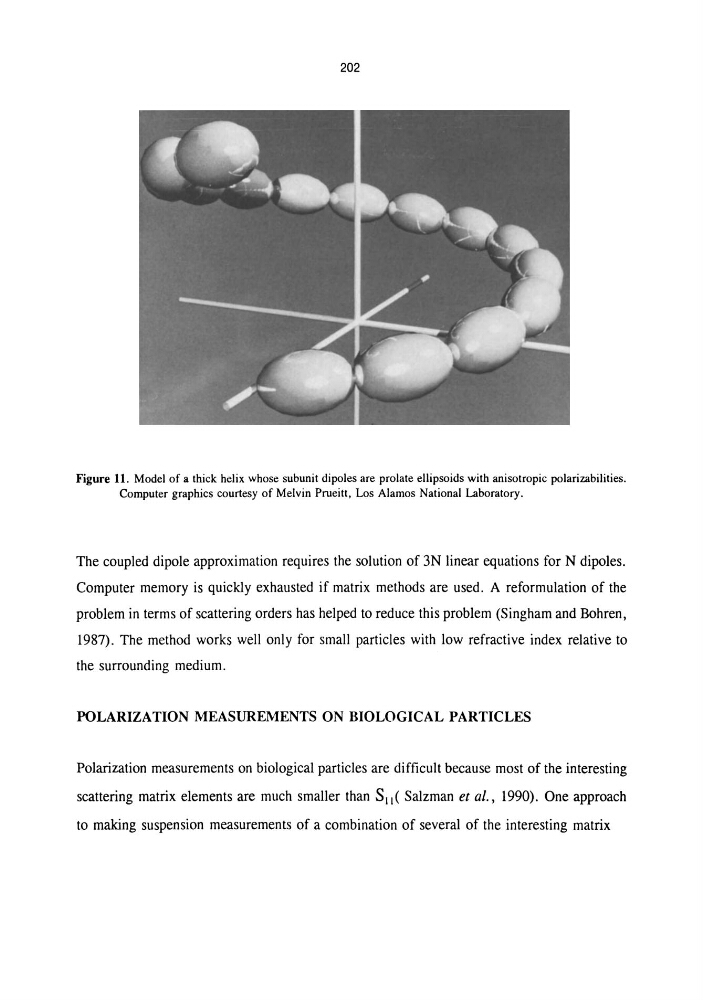
Figure 11. Model of a thick helix whose subunit dipoles are prolate ellipsoids with anisotropic polarizabilities.
Computer graphics courtesy of Melvin Prueitt, Los Alamos National Laboratory.
The coupled dipole approximation requires the solution of 3N linear equations for N dipoles.
Computer memory is quickly exhausted if matrix methods are used. A reformulation of the
problem in terms of scattering orders has helped to reduce this problem (Singham and Bohren,
1987). The method works well only for small particles with low refractive index relative to
the surrounding medium.
POLARIZATION MEASUREMENTS ON BIOLOGICAL PARTICLES
Polarization measurements on biological particles are difficult because most of the interesting
scattering matrix elements are much smaller than Sll( Salzman et aI., 1990). One approach
to making suspension measurements of a combination of several of the interesting matrix
Figure 11. Model of a thick helix whose subunit dipoles are prolate ellipsoids with anisotropic polarizabilities.
Computer graphics courtesy of Melvin Prueitt, Los Alamos National Laboratory.
The coupled dipole approximation requires the solution of 3N linear equations for N dipoles.
Computer memory is quickly exhausted if matrix methods are used. A reformulation of the
problem in terms of scattering orders has helped to reduce this problem (Singham and Bohren,
1987). The method works well only for small particles with low refractive index relative to
the surrounding medium.
POLARIZATION MEASUREMENTS ON BIOLOGICAL PARTICLES
Polarization measurements on biological particles are difficult because most of the interesting
scattering matrix elements are much smaller than Sll( Salzman et aI., 1990). One approach
to making suspension measurements of a combination of several of the interesting matrix