

199
COATED SPHERE x
0.75
.......
T 25
o
~20
.......,
15
rn 10
.~
<~
a
... ~-~/
5L.o.........L~...J........-....J~L....L~ ...................
o
30
60
90
120
150
160
ANGLE (degrees)
:::::' 10
I
0
....... 5
X
.......,
0
rn
~ -5
OJ
OJ
rn -10
0
30
60
90
120
150
180
ANGLE (degrees)
30
60
90
120
150
180
ANGLE (degrees)
~
..,.
I
S -2
"\
d
~ -4
\
-6
rn -B
\ /
~
~-1O
"'-"
rn -12
0
30
60
90
120
150
1BO
ANGLE (degrees)
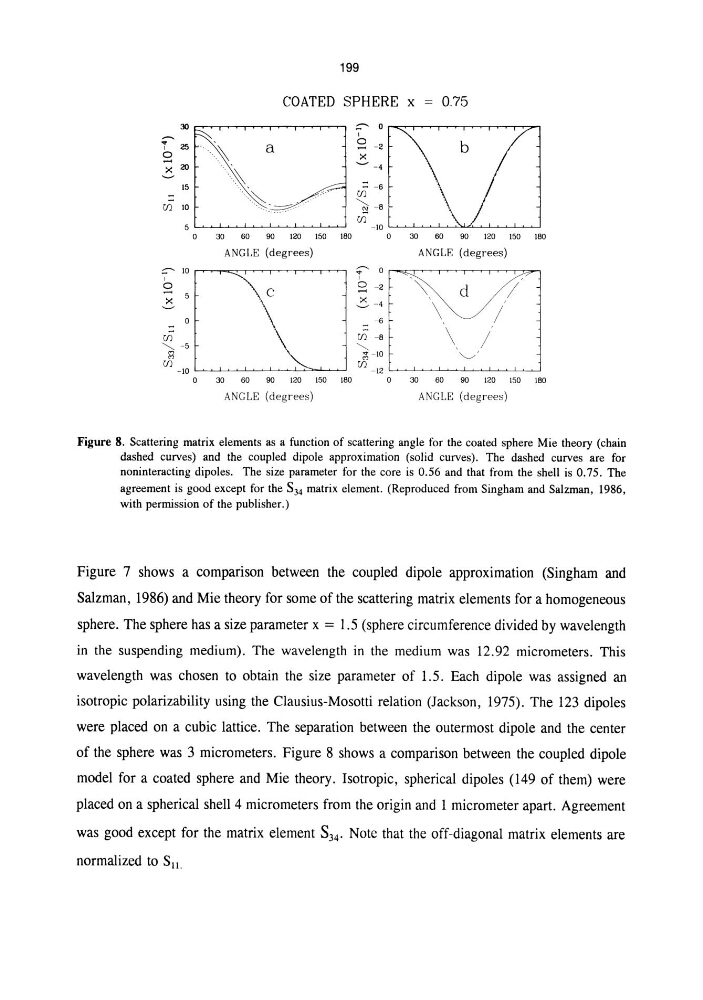
Figure 8. Scattering matrix elements as a function of scattering angle for the coated sphere Mie theory (chain
dashed curves) and the coupled dipole approximation (solid curves). The dashed curves are for
noninteracting dipoles. The size parameter for the core is 0.56 and that from the shell is 0.75. The
agreement is good except for the S34 matrix element. (Reproduced from Singham and Salzman, 1986,
with permission of the publisher.)
Figure 7 shows a comparison between the coupled dipole approximation (Singham and
Salzman, 1986) and Mie theory for some of the scattering matrix elements for a homogeneous
sphere. The sphere has a size parameter x = 1.5 (sphere circumference divided by wavelength
in the suspending medium). The wavelength in the medium was 12.92 micrometers. This
wavelength was chosen to obtain the size parameter of 1.5. Each dipole was assigned an
isotropic polarizability using the Clausius-Mosotti relation (Jackson, 1975). The 123 dipoles
were placed on a cubic lattice. The separation between the outermost dipole and the center
of the sphere was 3 micrometers. Figure 8 shows a comparison between the coupled dipole
model for a coated sphere and Mie theory. Isotropic, spherical dipoles (149 of them) were
placed on a spherical shell 4 micrometers from the origin and 1 micrometer apart. Agreement
was good except for the matrix element 5 34 • Note that the off-diagonal matrix elements are
normalized to Sll.
COATED SPHERE x
0.75
.......
T 25
o
~20
.......,
15
rn 10
.~
<~
a
... ~-~/
5L.o.........L~...J........-....J~L....L~ ...................
o
30
60
90
120
150
160
ANGLE (degrees)
:::::' 10
I
0
....... 5
X
.......,
0
rn
~ -5
OJ
OJ
rn -10
0
30
60
90
120
150
180
ANGLE (degrees)
30
60
90
120
150
180
ANGLE (degrees)
~
..,.
I
S -2
"\
d
~ -4
\
-6
rn -B
\ /
~
~-1O
"'-"
rn -12
0
30
60
90
120
150
1BO
ANGLE (degrees)
Figure 8. Scattering matrix elements as a function of scattering angle for the coated sphere Mie theory (chain
dashed curves) and the coupled dipole approximation (solid curves). The dashed curves are for
noninteracting dipoles. The size parameter for the core is 0.56 and that from the shell is 0.75. The
agreement is good except for the S34 matrix element. (Reproduced from Singham and Salzman, 1986,
with permission of the publisher.)
Figure 7 shows a comparison between the coupled dipole approximation (Singham and
Salzman, 1986) and Mie theory for some of the scattering matrix elements for a homogeneous
sphere. The sphere has a size parameter x = 1.5 (sphere circumference divided by wavelength
in the suspending medium). The wavelength in the medium was 12.92 micrometers. This
wavelength was chosen to obtain the size parameter of 1.5. Each dipole was assigned an
isotropic polarizability using the Clausius-Mosotti relation (Jackson, 1975). The 123 dipoles
were placed on a cubic lattice. The separation between the outermost dipole and the center
of the sphere was 3 micrometers. Figure 8 shows a comparison between the coupled dipole
model for a coated sphere and Mie theory. Isotropic, spherical dipoles (149 of them) were
placed on a spherical shell 4 micrometers from the origin and 1 micrometer apart. Agreement
was good except for the matrix element 5 34 • Note that the off-diagonal matrix elements are
normalized to Sll.