

197
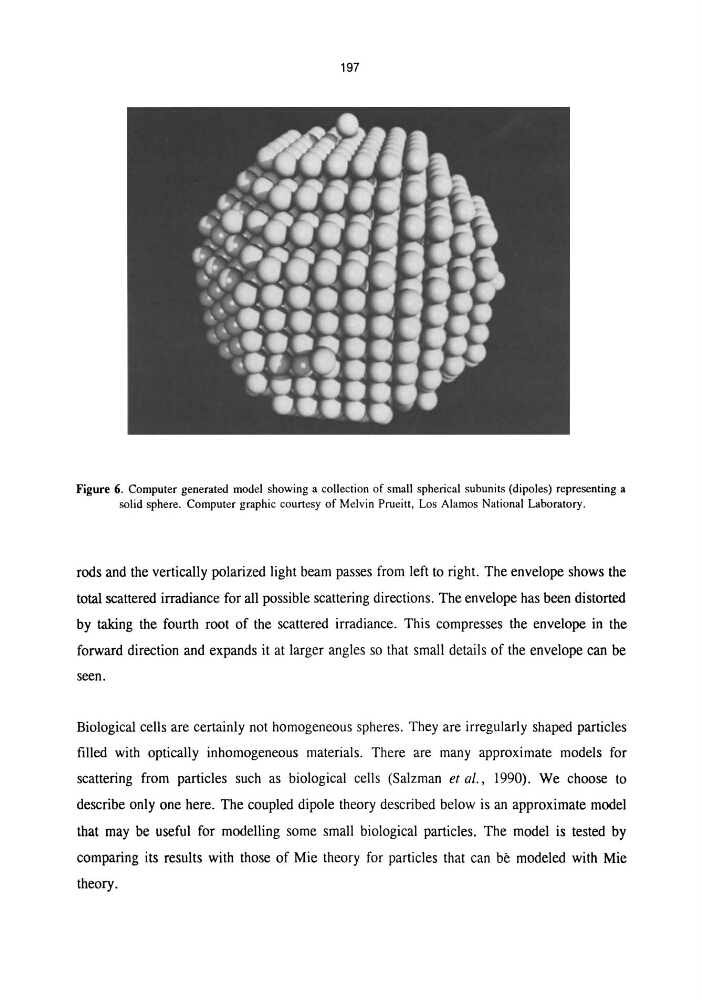
Figure 6. Computer generated model showing a collection of small spherical subunits (dipoles) representing a
solid sphere. Computer graphic courtesy of Melvin Prueitt, Los Alamos National Laboratory.
rods and the vertically polarized light beam passes from left to right. The envelope shows the
total scattered irradiance for all possible scattering directions. The envelope has been distorted
by taking the fourth root of the scattered irradiance. This compresses the envelope in the
forward direction and expands it at larger angles so that small details of the envelope can be
seen.
Biological cells are certainly not homogeneous spheres. They are irregularly shaped particles
filled with optically inhomogeneous materials. There are many approximate models for
scattering from particles such as biological cells (Salzman et al., 1990). We choose to
describe only one here. The coupled dipole theory described below is an approximate model
that may be useful for modelling some small biological particles. The model is tested by
comparing its results with those of Mie theory for particles that can be modeled with Mie
theory.
Figure 6. Computer generated model showing a collection of small spherical subunits (dipoles) representing a
solid sphere. Computer graphic courtesy of Melvin Prueitt, Los Alamos National Laboratory.
rods and the vertically polarized light beam passes from left to right. The envelope shows the
total scattered irradiance for all possible scattering directions. The envelope has been distorted
by taking the fourth root of the scattered irradiance. This compresses the envelope in the
forward direction and expands it at larger angles so that small details of the envelope can be
seen.
Biological cells are certainly not homogeneous spheres. They are irregularly shaped particles
filled with optically inhomogeneous materials. There are many approximate models for
scattering from particles such as biological cells (Salzman et al., 1990). We choose to
describe only one here. The coupled dipole theory described below is an approximate model
that may be useful for modelling some small biological particles. The model is tested by
comparing its results with those of Mie theory for particles that can be modeled with Mie
theory.