

195
angles to the laser beam. This scattering process is described by a number of mathematical
theories usually linked to the size of the particle. Each of the theories obscures the underlying
physics of the process, which is best represented by the above model of interacting, radiating
dipoles.
Mie theory (Bohren and Huffman, 1983) models an uncoated particle as an arbitrary diameter
sphere with a homogeneous refractive index. The theory is an exact solution of Maxwell's
electromagnetic field equations for a sphere. It has been extended to cylinders and coated
spheres (Aden and Kerker, 1951; Kerker et al., 1978). The scattering matrix for a sphere is
given by (Bohren and Huffman, 1983)
11 S12
0
0 Ii
S22
0
U
0 0 S33
Vs
0 0 -S34 S
The coated sphere model from Mie theory views a cell such as a lymphocyte as homogeneous
spherical nucleus surrounded by a concentric spherical coating of cytoplasm. An osmotically
x
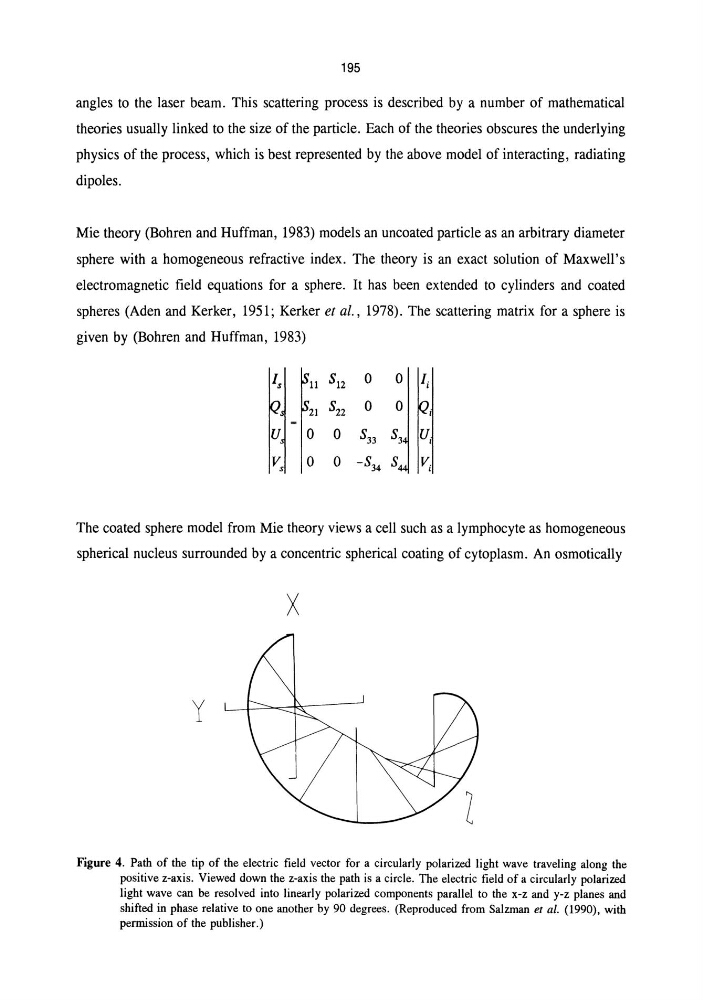
Figure 4. Path of the tip of the electric field vector for a circularly polarized light wave traveling along the
positive z-axis. Viewed down the z-axis the path is a circle. The electric field of a circularly polarized
light wave can be resolved into linearly polarized components parallel to the x-z and y-z planes and
shifted in phase relative to one another by 90 degrees. (Reproduced from Salzman et al. (1990), with
permission of the publisher.)
angles to the laser beam. This scattering process is described by a number of mathematical
theories usually linked to the size of the particle. Each of the theories obscures the underlying
physics of the process, which is best represented by the above model of interacting, radiating
dipoles.
Mie theory (Bohren and Huffman, 1983) models an uncoated particle as an arbitrary diameter
sphere with a homogeneous refractive index. The theory is an exact solution of Maxwell's
electromagnetic field equations for a sphere. It has been extended to cylinders and coated
spheres (Aden and Kerker, 1951; Kerker et al., 1978). The scattering matrix for a sphere is
given by (Bohren and Huffman, 1983)
11 S12
0
0 Ii
S22
0
U
0 0 S33
Vs
0 0 -S34 S
The coated sphere model from Mie theory views a cell such as a lymphocyte as homogeneous
spherical nucleus surrounded by a concentric spherical coating of cytoplasm. An osmotically
x
Figure 4. Path of the tip of the electric field vector for a circularly polarized light wave traveling along the
positive z-axis. Viewed down the z-axis the path is a circle. The electric field of a circularly polarized
light wave can be resolved into linearly polarized components parallel to the x-z and y-z planes and
shifted in phase relative to one another by 90 degrees. (Reproduced from Salzman et al. (1990), with
permission of the publisher.)