

194
same for all directions in the scattering plane. For light whose electric field is linearly
polarized parallel to the scattering plane, the intensity scattered by the dipole is greatest at 0
degrees and 180 degrees and is zero at 90 degrees with respect to the direction of the incident
wave. Scattering by a single dipole or by an array of dipoles depends on the direction of the
polarization of the incident light.
Figure 4 shows a circularly polarized light wave moving down the Z axis. The electric field
of a circularly polarized wave rotates around the direction of the wave. The heavy line shows
the path traced out by the tip of the electric field vector as the wave moves through space.
The Stokes parameters, I, Q, U and V, specify the polarization state of any wave. I is the
intensity or irradiance of the wave, Q is the fraction of horizontal linear polarization, U is the
fraction of 45 degree linear polarization, V is the fraction of circular polarization. The
incident light wave can be represented mathematically as a 4 element Stokes vector with each
element having a subscript i; the elements of the scattered light Stokes vector have subscript s.
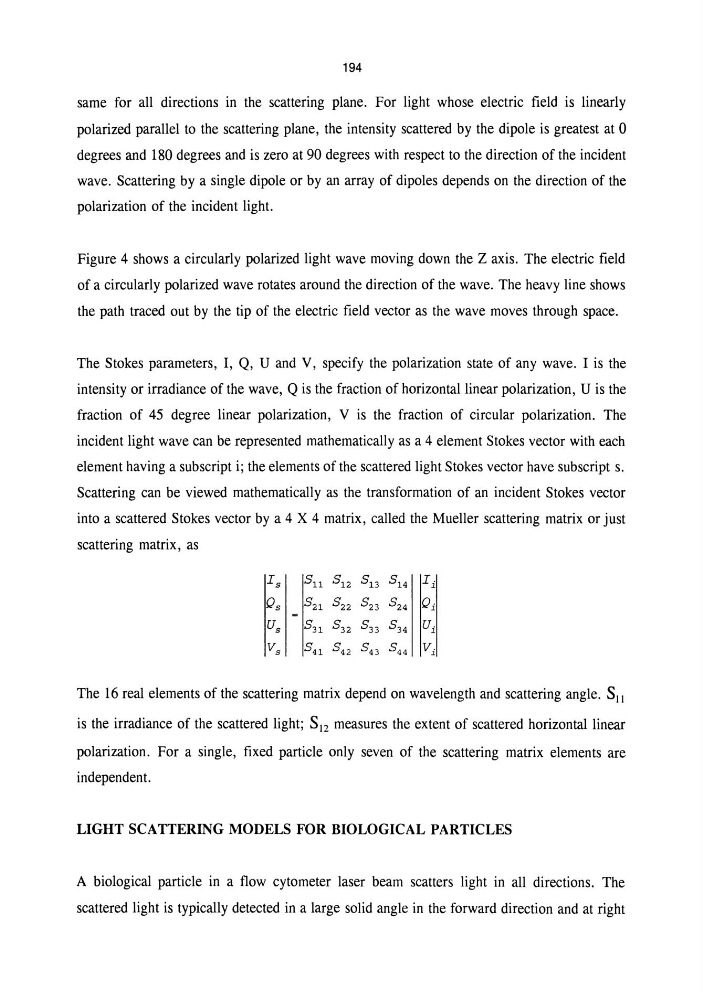
Scattering can be viewed mathematically as the transformation of an incident Stokes vector
into a scattered Stokes vector by a 4 X 4 matrix, called the Mueller scattering matrix or just
scattering matrix, as
Is
Sll S12 S13 S14
Ii
Q s
S21 S22 S23 S24
Q i
Us
S31 S32 S33 S34
U i
Vs
S41 S42 S43 S44
Vi
The 16 real elements of the scattering matrix depend on wavelength and scattering angle. Sl1
is the irradiance of the scattered light; S12 measures the extent of scattered horizontal linear
polarization. For a single, fixed particle only seven of the scattering matrix elements are
independent.
LIGHT SCATTERING MODELS FOR BIOLOGICAL PARTICLES
A biological particle in a flow cytometer laser beam scatters light in all directions. The
scattered light is typically detected in a large solid angle in the forward direction and at right
same for all directions in the scattering plane. For light whose electric field is linearly
polarized parallel to the scattering plane, the intensity scattered by the dipole is greatest at 0
degrees and 180 degrees and is zero at 90 degrees with respect to the direction of the incident
wave. Scattering by a single dipole or by an array of dipoles depends on the direction of the
polarization of the incident light.
Figure 4 shows a circularly polarized light wave moving down the Z axis. The electric field
of a circularly polarized wave rotates around the direction of the wave. The heavy line shows
the path traced out by the tip of the electric field vector as the wave moves through space.
The Stokes parameters, I, Q, U and V, specify the polarization state of any wave. I is the
intensity or irradiance of the wave, Q is the fraction of horizontal linear polarization, U is the
fraction of 45 degree linear polarization, V is the fraction of circular polarization. The
incident light wave can be represented mathematically as a 4 element Stokes vector with each
element having a subscript i; the elements of the scattered light Stokes vector have subscript s.
Scattering can be viewed mathematically as the transformation of an incident Stokes vector
into a scattered Stokes vector by a 4 X 4 matrix, called the Mueller scattering matrix or just
scattering matrix, as
Is
Sll S12 S13 S14
Ii
Q s
S21 S22 S23 S24
Q i
Us
S31 S32 S33 S34
U i
Vs
S41 S42 S43 S44
Vi
The 16 real elements of the scattering matrix depend on wavelength and scattering angle. Sl1
is the irradiance of the scattered light; S12 measures the extent of scattered horizontal linear
polarization. For a single, fixed particle only seven of the scattering matrix elements are
independent.
LIGHT SCATTERING MODELS FOR BIOLOGICAL PARTICLES
A biological particle in a flow cytometer laser beam scatters light in all directions. The
scattered light is typically detected in a large solid angle in the forward direction and at right