

1'0
~
10.0
*
2.0
----..
0.0 o
30
191
COUPlED DIPOLE SCATI'ERING
Fbur Coupled Dipoles in line
Two Coupled Dipoles in line
- - Single Dipole
-------------------60
90
120
150
Scattering Angle (deg)
180
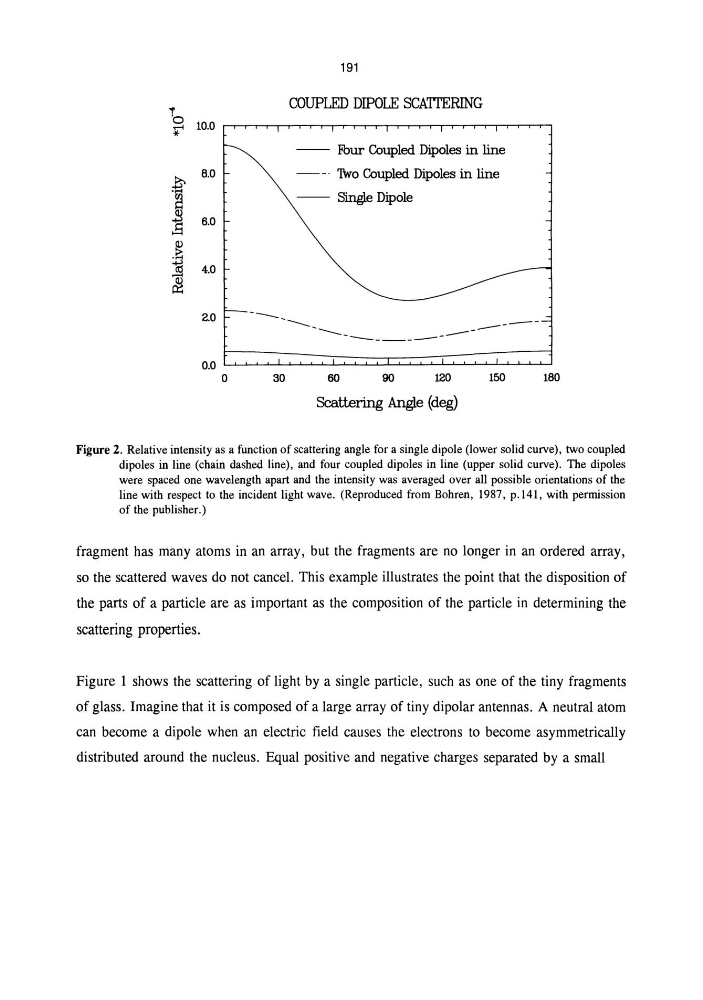
Figure 2. Relative intensity as a function of scattering angle for a single dipole (lower solid curve), two coupled
dipoles in line (chain dashed line), and four coupled dipoles in line (upper solid curve). The dipoles
were spaced one wavelength apart and the intensity was averaged over all possible orientations of the
line with respect to the incident light wave. (Reproduced from Bohren, 1987, p.141, with permission
of the publisher.)
fragment has many atoms in an array, but the fragments are no longer in an ordered array,
so the scattered waves do not cancel. This example illustrates the point that the disposition of
the parts of a particle are as important as the composition of the particle in determining the
scattering properties.
Figure 1 shows the scattering of light by a single particle, such as one of the tiny fragments
of glass. Imagine that it is composed of a large array of tiny dipolar antennas. A neutral atom
can become a dipole when an electric field causes the electrons to become asymmetrically
distributed around the nucleus. Equal positive and negative charges separated by a small
~
10.0
*
2.0
----..
0.0 o
30
191
COUPlED DIPOLE SCATI'ERING
Fbur Coupled Dipoles in line
Two Coupled Dipoles in line
- - Single Dipole
-------------------60
90
120
150
Scattering Angle (deg)
180
Figure 2. Relative intensity as a function of scattering angle for a single dipole (lower solid curve), two coupled
dipoles in line (chain dashed line), and four coupled dipoles in line (upper solid curve). The dipoles
were spaced one wavelength apart and the intensity was averaged over all possible orientations of the
line with respect to the incident light wave. (Reproduced from Bohren, 1987, p.141, with permission
of the publisher.)
fragment has many atoms in an array, but the fragments are no longer in an ordered array,
so the scattered waves do not cancel. This example illustrates the point that the disposition of
the parts of a particle are as important as the composition of the particle in determining the
scattering properties.
Figure 1 shows the scattering of light by a single particle, such as one of the tiny fragments
of glass. Imagine that it is composed of a large array of tiny dipolar antennas. A neutral atom
can become a dipole when an electric field causes the electrons to become asymmetrically
distributed around the nucleus. Equal positive and negative charges separated by a small