

192
x
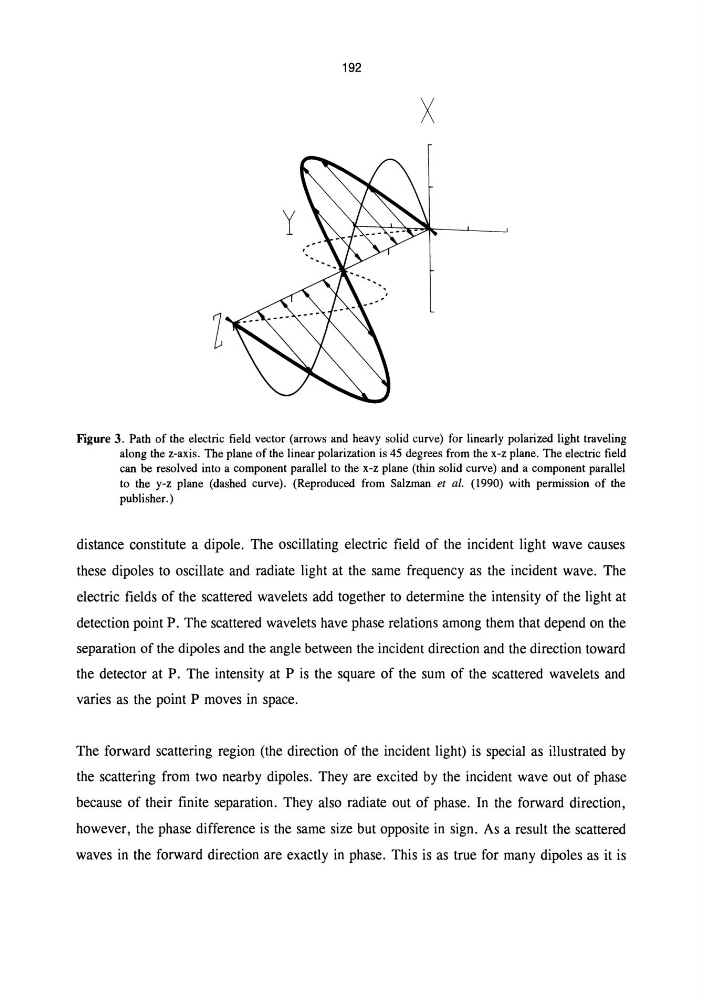
Figure 3. Path of the electric field vector (arrows and heavy solid curve) for linearly polarized light traveling
along the z-axis. The plane of the linear polarization is 45 degrees from the x-z plane. The electric field
can be resolved into a component parallel to the x-z plane (thin solid curve) and a component parallel
to the y-z plane (dashed curve). (Reproduced from Salzman et al. (1990) with permission of the
publisher. )
distance constitute a dipole. The oscillating electric field of the incident light wave causes
these dipoles to oscillate and radiate light at the same frequency as the incident wave. The
electric fields of the scattered wavelets add together to determine the intensity of the light at
detection point P. The scattered wavelets have phase relations among them that depend on the
separation of the dipoles and the angle between the incident direction and the direction toward
the detector at P. The intensity at P is the square of the sum of the scattered wavelets and
varies as the point P moves in space.
The forward scattering region (the direction of the incident light) is special as illustrated by
the scattering from two nearby dipoles. They are excited by the incident wave out of phase
because of their finite separation. They also radiate out of phase. In the forward direction,
however, the phase difference is the same size but opposite in sign. As a result the scattered
waves in the forward direction are exactly in phase. This is as true for many dipoles as it is
x
Figure 3. Path of the electric field vector (arrows and heavy solid curve) for linearly polarized light traveling
along the z-axis. The plane of the linear polarization is 45 degrees from the x-z plane. The electric field
can be resolved into a component parallel to the x-z plane (thin solid curve) and a component parallel
to the y-z plane (dashed curve). (Reproduced from Salzman et al. (1990) with permission of the
publisher. )
distance constitute a dipole. The oscillating electric field of the incident light wave causes
these dipoles to oscillate and radiate light at the same frequency as the incident wave. The
electric fields of the scattered wavelets add together to determine the intensity of the light at
detection point P. The scattered wavelets have phase relations among them that depend on the
separation of the dipoles and the angle between the incident direction and the direction toward
the detector at P. The intensity at P is the square of the sum of the scattered wavelets and
varies as the point P moves in space.
The forward scattering region (the direction of the incident light) is special as illustrated by
the scattering from two nearby dipoles. They are excited by the incident wave out of phase
because of their finite separation. They also radiate out of phase. In the forward direction,
however, the phase difference is the same size but opposite in sign. As a result the scattered
waves in the forward direction are exactly in phase. This is as true for many dipoles as it is