

145
A brief review of the known or expected nand n' values for particulates in oceanic waters is
given below. A detailed study has been provided by Aas (1981).
Minerogenic particles originating from continental margins and river discharges or reaching
the open ocean through eolian transport, are relatively well known with respect to their
composition and thus their refractive index. Quartz particles have n values around 1.15,
diminishing when the amorphous phase replaces the cristallized state. Aluminosilicate and iron
hydroxyde particles have n values ranging from 1.10 to 1.18; various clays studied by Ahn
(1990) exhibit n values in the range 1.10 - 1.14 and n' values in the range 4 to 8 10'3 (at the
most, in the blue part of the spectrum).
Other mineral particles, biologically produced, originate from the tests of diatoms (amorphous
silica or opale) and cocolithophorids (calcite and aragonite plates). Their relative indices are
in the ranges 1.05 - 1.06 and 1.19 - 1.21, respectively, with no notable absorption.
At least in the upper parts of the open ocean, the predominant particles are of biogenous
origin and organic in composition. They include all living organisms (heterotrophs and
phototrophs, uni- or pluricellular) and all kinds of detritus, generated along the prey - predator
trophic chain and through their natural decay; they are permanently modified by the physical
or chemical actions exerted by the sea water medium. They have in common bodies with high
water conten (50 - 80 % of the water volume, perhaps a bit less for some compact detritus
and very small bacteria; Norland et aZ., 1987; Simon and Azam, 1989). Therefore their index
cannot dramatically depart from that of water. Besides water, the other constituent, (the "dry"
organic matter) is composed of mixtures in variable proportions of carbohydrates, proteins and
lipids. These compounds have similar influence in governing the index increment with respect
to that of water, in such a manner that their relative proportions are not crucial in determining
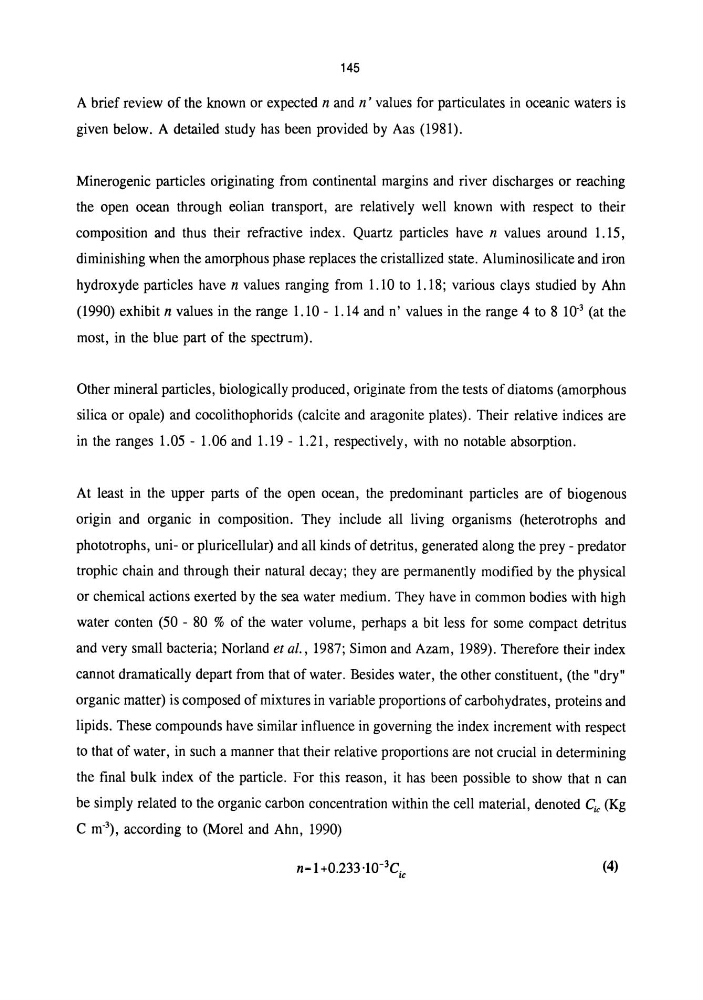
the final bulk index of the particle. For this reason, it has been possible to show that n can
be simply related to the organic carbon concentration within the cell material, denoted C ic (Kg
C m,3), according to (Morel and Ahn, 1990)
(4)
A brief review of the known or expected nand n' values for particulates in oceanic waters is
given below. A detailed study has been provided by Aas (1981).
Minerogenic particles originating from continental margins and river discharges or reaching
the open ocean through eolian transport, are relatively well known with respect to their
composition and thus their refractive index. Quartz particles have n values around 1.15,
diminishing when the amorphous phase replaces the cristallized state. Aluminosilicate and iron
hydroxyde particles have n values ranging from 1.10 to 1.18; various clays studied by Ahn
(1990) exhibit n values in the range 1.10 - 1.14 and n' values in the range 4 to 8 10'3 (at the
most, in the blue part of the spectrum).
Other mineral particles, biologically produced, originate from the tests of diatoms (amorphous
silica or opale) and cocolithophorids (calcite and aragonite plates). Their relative indices are
in the ranges 1.05 - 1.06 and 1.19 - 1.21, respectively, with no notable absorption.
At least in the upper parts of the open ocean, the predominant particles are of biogenous
origin and organic in composition. They include all living organisms (heterotrophs and
phototrophs, uni- or pluricellular) and all kinds of detritus, generated along the prey - predator
trophic chain and through their natural decay; they are permanently modified by the physical
or chemical actions exerted by the sea water medium. They have in common bodies with high
water conten (50 - 80 % of the water volume, perhaps a bit less for some compact detritus
and very small bacteria; Norland et aZ., 1987; Simon and Azam, 1989). Therefore their index
cannot dramatically depart from that of water. Besides water, the other constituent, (the "dry"
organic matter) is composed of mixtures in variable proportions of carbohydrates, proteins and
lipids. These compounds have similar influence in governing the index increment with respect
to that of water, in such a manner that their relative proportions are not crucial in determining
the final bulk index of the particle. For this reason, it has been possible to show that n can
be simply related to the organic carbon concentration within the cell material, denoted C ic (Kg
C m,3), according to (Morel and Ahn, 1990)
(4)