

146
Note that this relationship does not apply to species with hard external walls. It has been
verified for free-living bacteria (C ic = 180 - 275 kg m- 3 ), for heterotrophic flagellates (150 -
170 kg m- 3 ), and for a cyanobacterium (140 - 220 kg m- 3 ) (see Stramski and Morel, 1989).
Its general applicability in the case of other phototrophic organisms remains to be verified.
Mostly in response to the variable water content rather than to the organic composition,
phytoplanktonic organisms exhibit real relative index in the range 1.01 - 1.09 (Spinrad and
Brown, 1986; Ackleson and Spinrad, 1988; Bricaud et at., 1988; and references therein). The
lowest values, which have been distinctly observed for diatoms, account for the presence of
vacuoles. Gas vacuolate cyanobacteria form a special category and also behave as very "soft"
particles, with low n values of the order of 1.01 (Dubelaar et at., 1987).
Very likely, the most colored and absorbing particles in the open ocean are algal cells. With
the additive effects of chlorophyll and carotenoids in the blue part of the spectrum (430 - 450
nm), the imaginary (relative) part of the index, n', could be as high as 0.015 for strongly
pigmented cells (Hymenomonas etongata; Ahn, 1990). Nonetheless, n' rarely reaches 0.01 at
these wavelengths, (see Table IL2 in Bricaud, 1989), a value still high and comparable to (or
actually higher than) that of a common "black" glass. In the red absorption peak of the sole
chlorophyll, the n' values are obviously slightly lower (1 to 6 10- 3 , Bricaud, 1989); they may
be enhanced by the presence of phycocyanin (as in Synechocystis; see in Stramski and Morel,
1989) or other phycobilin pigments.
Almost colorless heterotrophic bacteria and other larger protists have very low n' values (10-4
- 10- 3 ), except in the vicinity of the (d) Soret band of cytochrome (around 412 nm), where n'
peaks at 0.8 to 1.6 10- 3 for free-living bacteria and at 0.6 to 0.9 10- 3 for ciliates and flagellates
(Morel and Ahn, 1990; 1991).
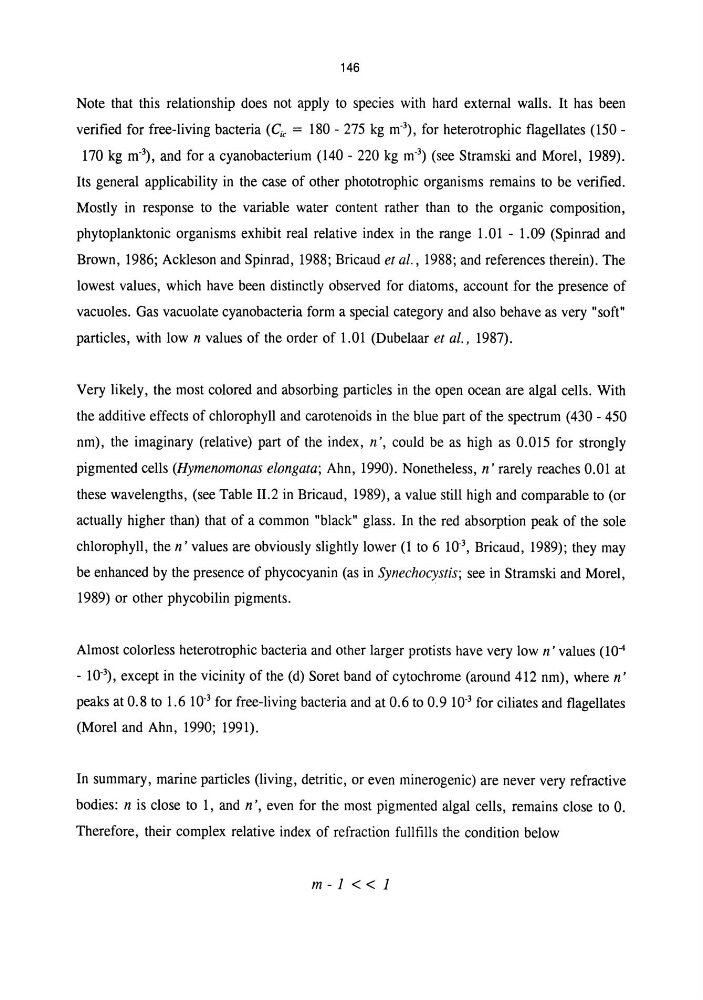
In summary, marine particles (living, detritic, or even minerogenic) are never very refractive
bodies: n is close to 1, and n', even for the most pigmented algal cells, remains close to O.
Therefore, their complex relative index of refraction fullfills the condition below
m-J« J
Note that this relationship does not apply to species with hard external walls. It has been
verified for free-living bacteria (C ic = 180 - 275 kg m- 3 ), for heterotrophic flagellates (150 -
170 kg m- 3 ), and for a cyanobacterium (140 - 220 kg m- 3 ) (see Stramski and Morel, 1989).
Its general applicability in the case of other phototrophic organisms remains to be verified.
Mostly in response to the variable water content rather than to the organic composition,
phytoplanktonic organisms exhibit real relative index in the range 1.01 - 1.09 (Spinrad and
Brown, 1986; Ackleson and Spinrad, 1988; Bricaud et at., 1988; and references therein). The
lowest values, which have been distinctly observed for diatoms, account for the presence of
vacuoles. Gas vacuolate cyanobacteria form a special category and also behave as very "soft"
particles, with low n values of the order of 1.01 (Dubelaar et at., 1987).
Very likely, the most colored and absorbing particles in the open ocean are algal cells. With
the additive effects of chlorophyll and carotenoids in the blue part of the spectrum (430 - 450
nm), the imaginary (relative) part of the index, n', could be as high as 0.015 for strongly
pigmented cells (Hymenomonas etongata; Ahn, 1990). Nonetheless, n' rarely reaches 0.01 at
these wavelengths, (see Table IL2 in Bricaud, 1989), a value still high and comparable to (or
actually higher than) that of a common "black" glass. In the red absorption peak of the sole
chlorophyll, the n' values are obviously slightly lower (1 to 6 10- 3 , Bricaud, 1989); they may
be enhanced by the presence of phycocyanin (as in Synechocystis; see in Stramski and Morel,
1989) or other phycobilin pigments.
Almost colorless heterotrophic bacteria and other larger protists have very low n' values (10-4
- 10- 3 ), except in the vicinity of the (d) Soret band of cytochrome (around 412 nm), where n'
peaks at 0.8 to 1.6 10- 3 for free-living bacteria and at 0.6 to 0.9 10- 3 for ciliates and flagellates
(Morel and Ahn, 1990; 1991).
In summary, marine particles (living, detritic, or even minerogenic) are never very refractive
bodies: n is close to 1, and n', even for the most pigmented algal cells, remains close to O.
Therefore, their complex relative index of refraction fullfills the condition below
m-J« J