

144
When dealing with the natural environment and the variety of suspended living and non-living
material, another characteristic at the level of the entire population is the size distribution. The
description of the number of particles as a function of their size is directly involved in the
formation of the optical properties of a water body which contains such a population. The
present knowledge concerning these successive points is briefly reviewed below.
Index of refraction of marine parlicles
After having impinged upon a homogeneous substance, the propagation of electromagnetic
waves is affected in two ways: i) the phase velocity is modified in relation to the real part of
the index of refraction, denoted ns and ii) the field strength and thus the energy transported
by the waves are progressively damped by absorption, which is described by the imaginary
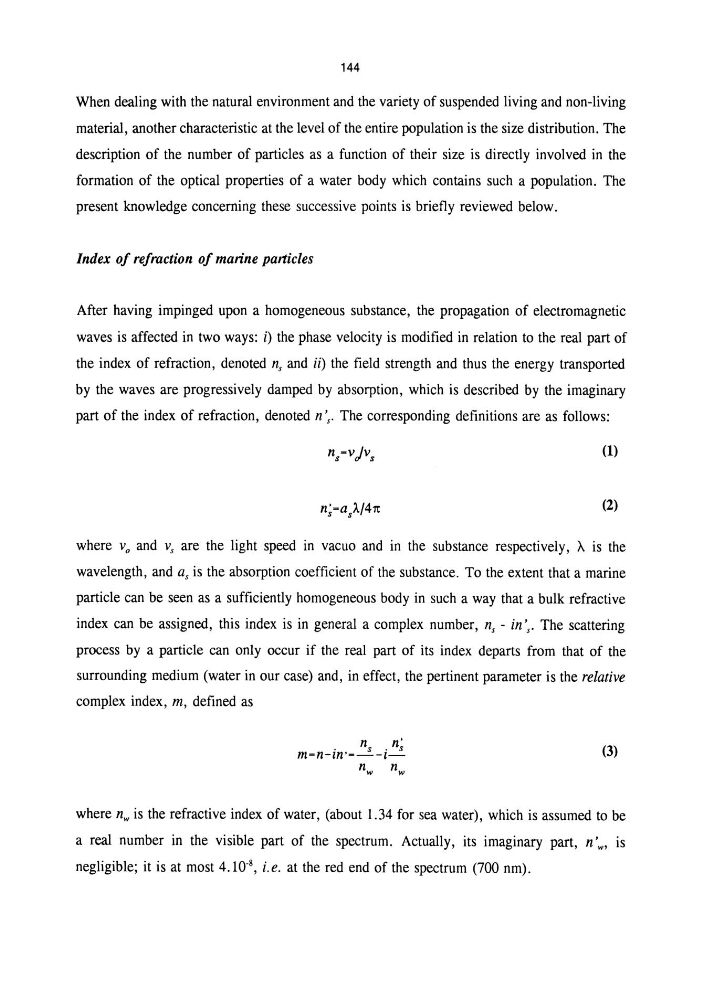
part of the index of refraction, denoted n's. The corresponding definitions are as follows:
(1)
(2)
where Vo and Vs are the light speed in vacuo and in the substance respectively, A is the
wavelength, and as is the absorption coefficient of the substance. To the extent that a marine
particle can be seen as a sufficiently homogeneous body in such a way that a bulk refractive
index can be assigned, this index is in general a complex number, ns - in's' The scattering
process by a particle can only occur if the real part of its index departs from that of the
surrounding medium (water in our case) and, in effect, the pertinent parameter is the relative
complex index, m, defined as
. ns. n;
m-n-/n'---I(3)
nw nw
where nw is the refractive index of water, (about 1.34 for sea water), which is assumed to be
a real number in the visible part of the spectrum. Actually, its imaginary part, n'w, is
negligible; it is at most 4.10- 8 , i.e. at the red end of the spectrum (700 nm).
When dealing with the natural environment and the variety of suspended living and non-living
material, another characteristic at the level of the entire population is the size distribution. The
description of the number of particles as a function of their size is directly involved in the
formation of the optical properties of a water body which contains such a population. The
present knowledge concerning these successive points is briefly reviewed below.
Index of refraction of marine parlicles
After having impinged upon a homogeneous substance, the propagation of electromagnetic
waves is affected in two ways: i) the phase velocity is modified in relation to the real part of
the index of refraction, denoted ns and ii) the field strength and thus the energy transported
by the waves are progressively damped by absorption, which is described by the imaginary
part of the index of refraction, denoted n's. The corresponding definitions are as follows:
(1)
(2)
where Vo and Vs are the light speed in vacuo and in the substance respectively, A is the
wavelength, and as is the absorption coefficient of the substance. To the extent that a marine
particle can be seen as a sufficiently homogeneous body in such a way that a bulk refractive
index can be assigned, this index is in general a complex number, ns - in's' The scattering
process by a particle can only occur if the real part of its index departs from that of the
surrounding medium (water in our case) and, in effect, the pertinent parameter is the relative
complex index, m, defined as
. ns. n;
m-n-/n'---I(3)
nw nw
where nw is the refractive index of water, (about 1.34 for sea water), which is assumed to be
a real number in the visible part of the spectrum. Actually, its imaginary part, n'w, is
negligible; it is at most 4.10- 8 , i.e. at the red end of the spectrum (700 nm).