

6
DERIVATION OF AIR SEA FLUXES BY PARAMETERISATIONS
Three major uncertainties are associated with these formulae:
1. The determination of exchange coefficients C E and C H.
2. Systematic errors in the ship-based measurements of Ta - T sand qa - qs
3. Conversion of the original Beaufort estimates into wind speeds.
3.3.1 Exchange Coefficients
In this study we used the wind-speed and stability-dependent exchange coefficients of
BUNKER (1976), modified by ISEMER & HASSE (1987). Their comparison with several
open ocean measurements showed, that BUNKER's exchange coefficients are too high. Consequently, they reduced CE by 13% and CH by 17%, equivalent to a neutral Dalton-number
CEN near 1.25 10- 3 in the range oflow to moderate winds.
The stability dependence of CE and CH is usually expressed in terms of the air-sea temperature difference. Following ISEMER & HASSE we used the virtual temperature difference instead of the actual values, to take into account the influence of water vapor on the
density gradient.
3.3.2 Systematic Errors of Temperature Observations
1.0
0.8
p
0.6
T
rn 0.4
C
R
0<
0
0.2
(\J
0.259
J K
~
~]l;
~
~
~
~
~
~
~
~ V E ~ ~ ~ ~ ~ ~ ~ ~
->-'
0.0
~ ~ ~ ~ ~D ~ ~ ~ N ~ ~ ~ ~ ~ ~
~-0.2
:>
2-0.4
-0.6
-0.8
-1.0
0
10
20
30
ta vas
It has been known for a long time, that
temperature measurements on bord of merchant ships have considerable systematic
errors. Their consequences on heat flux
calculations were already pointed out by
DIETRICH (1950). Important for sensible
and latent heat fluxes are the small differences between air temperature Ta and wet
bulb temperature Tw respectively against
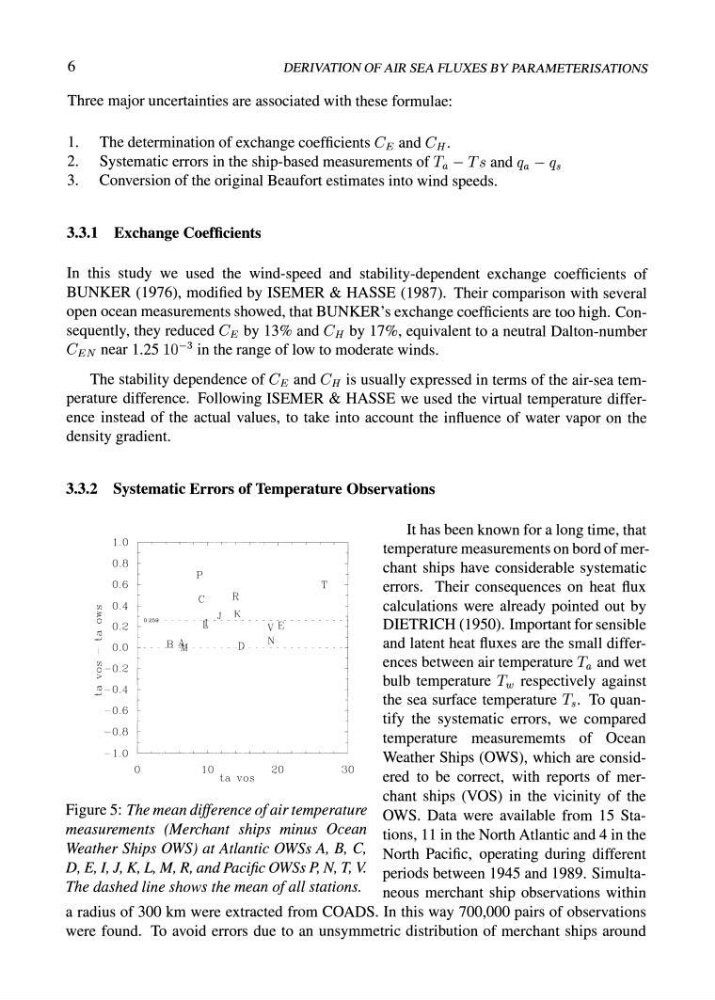
the sea surface temperature Ts. To quantify the systematic errors, we compared
temperature measurememts of ()cean
Weather Ships (()WS), which are considered to be correct, with reports of merchant ships (V()S) in the vicinity of the
Figure 5: The mean difference of air temperature ()WS. Data were available from 15 Stameasurements (Merchant ships minus Ocean tions, 11 in the North Atlantic and 4 in the
Weather Ships OWS) at Atlantic OWSs A, B, C, North Pacific, operating during different
D, E, I, 1, K, L, M, R, and Pacific OWSs P, N, T, V. periods between 1945 and 1989. SimultaThe dashed line shows the mean of all stations. neous merchant ship observations within
a radius of 300 kIn were extracted from C()ADS. In this way 700,000 pairs of observations
were found. To avoid errors due to an unsymmetric distribution of merchant ships around
DERIVATION OF AIR SEA FLUXES BY PARAMETERISATIONS
Three major uncertainties are associated with these formulae:
1. The determination of exchange coefficients C E and C H.
2. Systematic errors in the ship-based measurements of Ta - T sand qa - qs
3. Conversion of the original Beaufort estimates into wind speeds.
3.3.1 Exchange Coefficients
In this study we used the wind-speed and stability-dependent exchange coefficients of
BUNKER (1976), modified by ISEMER & HASSE (1987). Their comparison with several
open ocean measurements showed, that BUNKER's exchange coefficients are too high. Consequently, they reduced CE by 13% and CH by 17%, equivalent to a neutral Dalton-number
CEN near 1.25 10- 3 in the range oflow to moderate winds.
The stability dependence of CE and CH is usually expressed in terms of the air-sea temperature difference. Following ISEMER & HASSE we used the virtual temperature difference instead of the actual values, to take into account the influence of water vapor on the
density gradient.
3.3.2 Systematic Errors of Temperature Observations
1.0
0.8
p
0.6
T
rn 0.4
C
R
0<
0
0.2
(\J
0.259
J K
~
~]l;
~
~
~
~
~
~
~
~ V E ~ ~ ~ ~ ~ ~ ~ ~
->-'
0.0
~ ~ ~ ~ ~D ~ ~ ~ N ~ ~ ~ ~ ~ ~
~-0.2
:>
2-0.4
-0.6
-0.8
-1.0
0
10
20
30
ta vas
It has been known for a long time, that
temperature measurements on bord of merchant ships have considerable systematic
errors. Their consequences on heat flux
calculations were already pointed out by
DIETRICH (1950). Important for sensible
and latent heat fluxes are the small differences between air temperature Ta and wet
bulb temperature Tw respectively against
the sea surface temperature Ts. To quantify the systematic errors, we compared
temperature measurememts of ()cean
Weather Ships (()WS), which are considered to be correct, with reports of merchant ships (V()S) in the vicinity of the
Figure 5: The mean difference of air temperature ()WS. Data were available from 15 Stameasurements (Merchant ships minus Ocean tions, 11 in the North Atlantic and 4 in the
Weather Ships OWS) at Atlantic OWSs A, B, C, North Pacific, operating during different
D, E, I, 1, K, L, M, R, and Pacific OWSs P, N, T, V. periods between 1945 and 1989. SimultaThe dashed line shows the mean of all stations. neous merchant ship observations within
a radius of 300 kIn were extracted from C()ADS. In this way 700,000 pairs of observations
were found. To avoid errors due to an unsymmetric distribution of merchant ships around