

NET LONGWAVE RADIATION
5
3.2 Net Longwave Radiation
ISEMER & HASSE (1987) calculated the net heat loss of the sea surface due to longwave
radiation by a formula ofEFIMOVA (1961), which has been modified by BUNKER (1976).
It was in good agreement with a radiation transfer model of FUNG (1984), but only clear sky
conditions were tested.
Recent calculations in the quasi-enclosed Mediterranean Sea show, that net longwave
radiation LR needs to be considerably larger to balance the well measured heat flux through
the strait of Gibraltar. BUNKER et ai. (1982) proposed a new scheme including the effects of
different cloud types. Compared to his previous formula the mean LR for the Mediterranean
Sea is increased from 52 Wm- 2 to 67 Wm- 2 •
For our calculations we used an algorithm derived by BIGNAMI & ai. (1991), which
recently has been slightly revised by BIGNAMI (1995). The parameterization bases on measurements of radiative fluxes in the Tyrrhenian Sea (SCHIANO & aI., 1993).
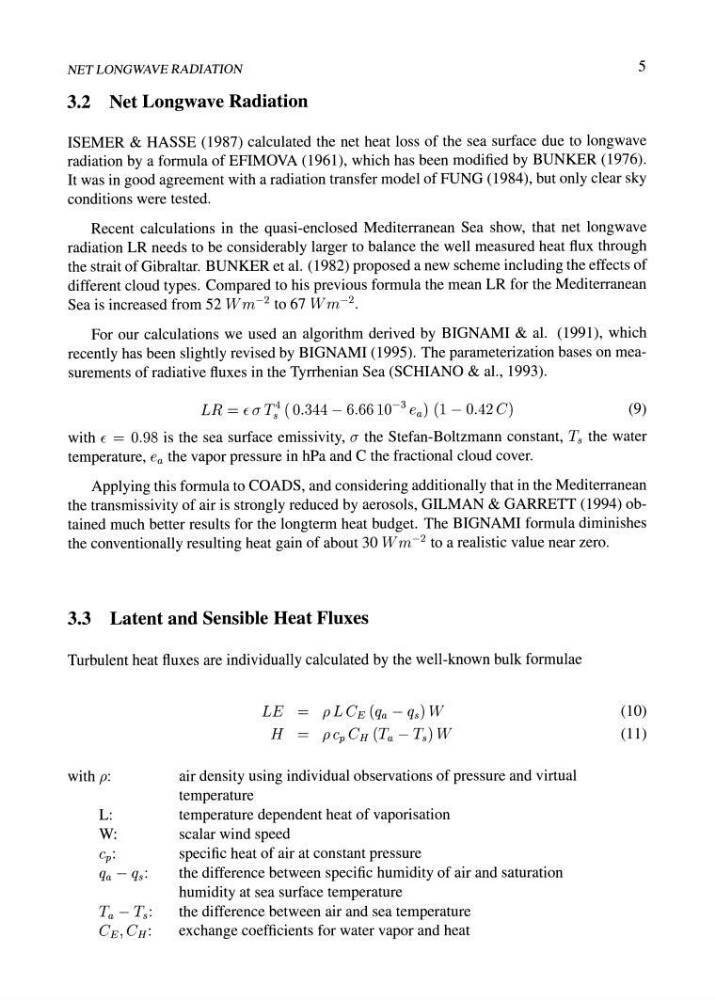
LR = E (J T s 4 ( 0.344 - 6.6610- 3 e a ) (1 - 0.42 C)
(9)
with E = 0.98 is the sea surface emissivity, (J the Stefan-Boltzmann constant, Ts the water
temperature, ea the vapor pressure in hPa and C the fractional cloud cover.
Applying this formula to COADS, and considering additionally that in the Mediterranean
the transmissivity of air is strongly reduced by aerosols, GILMAN & GARRETT (1994) obtained much better results for the longterm heat budget. The BIGNAMI formula diminishes
the conventionally resulting heat gain of about 30 W m -2 to a realistic value near zero.
3.3 Latent and Sensible Heat Fluxes
Turbulent heat fluxes are individually calculated by the well-known bulk formulae
with p:
L:
W:
LE
H
pLCE (qa - qs) W
pCp CH (Ta - Ts) W
air density using individual observations of pressure and virtual
temperature
temperature dependent heat of vaporisation
scalar wind speed
specific heat of air at constant pressure
the difference between specific humidity of air and saturation
humidity at sea surface temperature
the difference between air and sea temperature
exchange coefficients for water vapor and heat
(10)
(11)
5
3.2 Net Longwave Radiation
ISEMER & HASSE (1987) calculated the net heat loss of the sea surface due to longwave
radiation by a formula ofEFIMOVA (1961), which has been modified by BUNKER (1976).
It was in good agreement with a radiation transfer model of FUNG (1984), but only clear sky
conditions were tested.
Recent calculations in the quasi-enclosed Mediterranean Sea show, that net longwave
radiation LR needs to be considerably larger to balance the well measured heat flux through
the strait of Gibraltar. BUNKER et ai. (1982) proposed a new scheme including the effects of
different cloud types. Compared to his previous formula the mean LR for the Mediterranean
Sea is increased from 52 Wm- 2 to 67 Wm- 2 •
For our calculations we used an algorithm derived by BIGNAMI & ai. (1991), which
recently has been slightly revised by BIGNAMI (1995). The parameterization bases on measurements of radiative fluxes in the Tyrrhenian Sea (SCHIANO & aI., 1993).
LR = E (J T s 4 ( 0.344 - 6.6610- 3 e a ) (1 - 0.42 C)
(9)
with E = 0.98 is the sea surface emissivity, (J the Stefan-Boltzmann constant, Ts the water
temperature, ea the vapor pressure in hPa and C the fractional cloud cover.
Applying this formula to COADS, and considering additionally that in the Mediterranean
the transmissivity of air is strongly reduced by aerosols, GILMAN & GARRETT (1994) obtained much better results for the longterm heat budget. The BIGNAMI formula diminishes
the conventionally resulting heat gain of about 30 W m -2 to a realistic value near zero.
3.3 Latent and Sensible Heat Fluxes
Turbulent heat fluxes are individually calculated by the well-known bulk formulae
with p:
L:
W:
LE
H
pLCE (qa - qs) W
pCp CH (Ta - Ts) W
air density using individual observations of pressure and virtual
temperature
temperature dependent heat of vaporisation
scalar wind speed
specific heat of air at constant pressure
the difference between specific humidity of air and saturation
humidity at sea surface temperature
the difference between air and sea temperature
exchange coefficients for water vapor and heat
(10)
(11)