

211
22. RAY OPTICS APPROXIMATION FOR RANDOM CLUSTERS
OF GAUSSIAN SPHERES
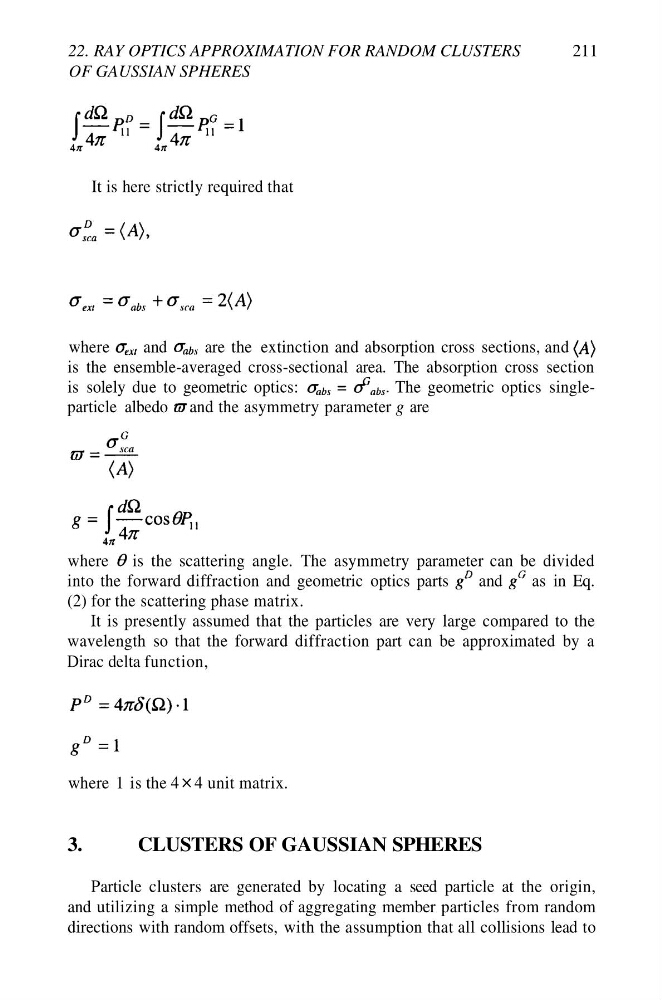
It is here strictly required that
where
and
are the extinction and absorption cross sections, and
is the ensemble-averaged cross-sectional area. The absorption cross section
is solely due to geometric optics:
The geometric optics singleparticle albedo and the asymmetry parameter g are
where is the scattering angle. The asymmetry parameter can be divided
into the forward diffraction and geometric optics parts
and
as in Eq.
(2) for the scattering phase matrix.
It is presently assumed that the particles are very large compared to the
wavelength so that the forward diffraction part can be approximated by a
Dirac delta function,
where 1 is the 4 × 4 unit matrix.
3.
CLUSTERS OF GAUSSIAN SPHERES
Particle clusters are generated by locating a seed particle at the origin,
and utilizing a simple method of aggregating member particles from random
directions with random offsets, with the assumption that all collisions lead to
22. RAY OPTICS APPROXIMATION FOR RANDOM CLUSTERS
OF GAUSSIAN SPHERES
It is here strictly required that
where
and
are the extinction and absorption cross sections, and
is the ensemble-averaged cross-sectional area. The absorption cross section
is solely due to geometric optics:
The geometric optics singleparticle albedo and the asymmetry parameter g are
where is the scattering angle. The asymmetry parameter can be divided
into the forward diffraction and geometric optics parts
and
as in Eq.
(2) for the scattering phase matrix.
It is presently assumed that the particles are very large compared to the
wavelength so that the forward diffraction part can be approximated by a
Dirac delta function,
where 1 is the 4 × 4 unit matrix.
3.
CLUSTERS OF GAUSSIAN SPHERES
Particle clusters are generated by locating a seed particle at the origin,
and utilizing a simple method of aggregating member particles from random
directions with random offsets, with the assumption that all collisions lead to