

210
Chapter 22
understanding the gradual changes in scattering characteristics when more
and more member particles are accrued into clusters.
In Section 2, the ray optics approximation is briefly discussed for
randomly oriented particles. Section 3 provides a brief summary of the
clustering algorithm and the Gaussian random sphere, and Section 4 shows
preliminary results from simulations. Conclusions close the paper in Section
5.
2.
RAY OPTICS APPROXIMATION
The ray optics treatment is described in Muinonen et al. (1989) and
(1996) and, in what follows, a short summary is given on the most essential
parts of the treatment. The cluster size is described by the size parameter
where is the wavenumber and
is the radius of an equal-projectedarea sphere.
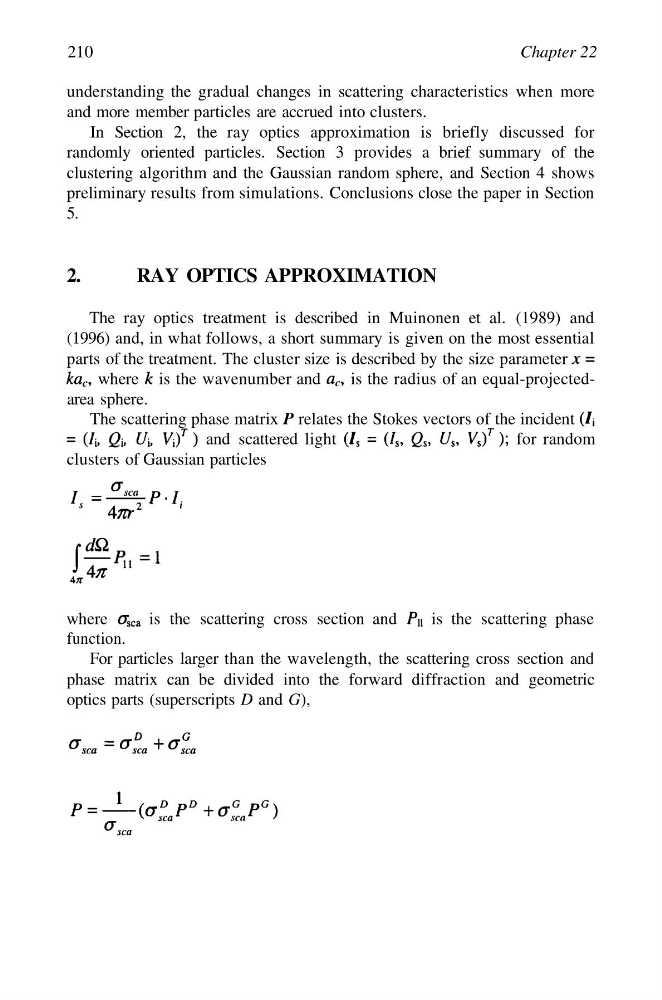
The scattering phase matrix P relates the Stokes vectors of the incident
and scattered light
for random
clusters of Gaussian particles
where
is the scattering cross section and
is the scattering phase
function.
For particles larger than the wavelength, the scattering cross section and
phase matrix can be divided into the forward diffraction and geometric
optics parts (superscripts D and G),
Chapter 22
understanding the gradual changes in scattering characteristics when more
and more member particles are accrued into clusters.
In Section 2, the ray optics approximation is briefly discussed for
randomly oriented particles. Section 3 provides a brief summary of the
clustering algorithm and the Gaussian random sphere, and Section 4 shows
preliminary results from simulations. Conclusions close the paper in Section
5.
2.
RAY OPTICS APPROXIMATION
The ray optics treatment is described in Muinonen et al. (1989) and
(1996) and, in what follows, a short summary is given on the most essential
parts of the treatment. The cluster size is described by the size parameter
where is the wavenumber and
is the radius of an equal-projectedarea sphere.
The scattering phase matrix P relates the Stokes vectors of the incident
and scattered light
for random
clusters of Gaussian particles
where
is the scattering cross section and
is the scattering phase
function.
For particles larger than the wavelength, the scattering cross section and
phase matrix can be divided into the forward diffraction and geometric
optics parts (superscripts D and G),