

212
Chapter 22
a capture. The aggregation is based on a pre-assigned hard-sphere-radius
for the member particles. The aggregation algorithm thus works correctly for
perfectly spherical particles, but the irregular Gaussian spheres, depending
on how relates to their radii, may “overlap” or “levitate” in the cluster. In
what follows, a short review is given on the shapes of the member particles,
the Gaussian random sphere.
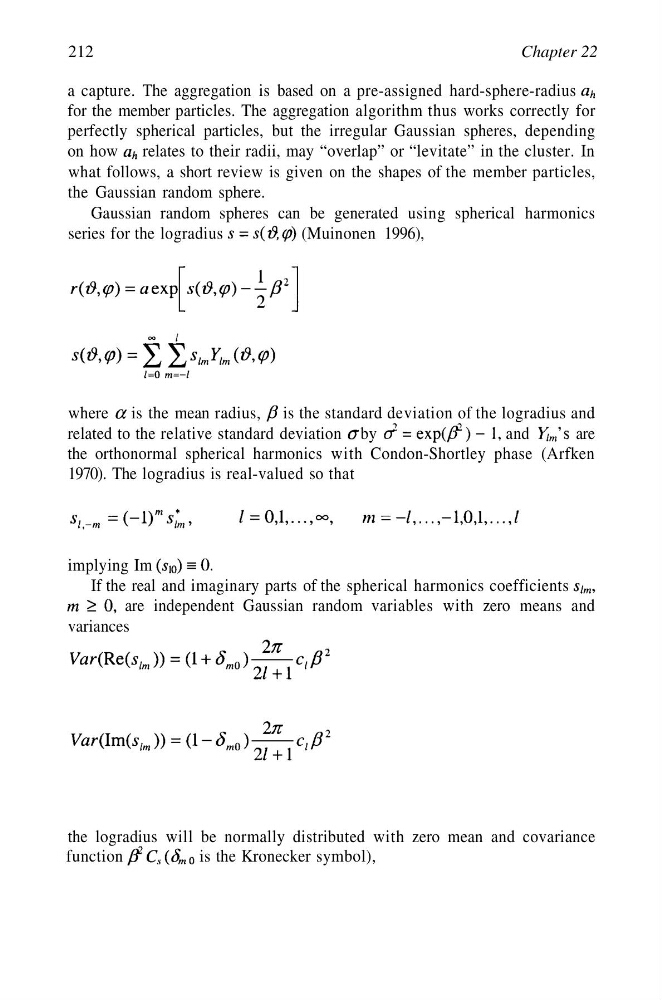
Gaussian random spheres can be generated using spherical harmonics
series for the logradius
(Muinonen 1996),
where is the mean radius, is the standard deviation of the logradius and
related to the relative standard deviation by
and
are
the orthonormal spherical harmonics with Condon-Shortley phase (Arfken
1970). The logradius is real-valued so that
implying Im
If the real and imaginary parts of the spherical harmonics coefficients
are independent Gaussian random variables with zero means and
variances
the logradius will be normally distributed with zero mean and covariance
function
is the Kronecker symbol),
Chapter 22
a capture. The aggregation is based on a pre-assigned hard-sphere-radius
for the member particles. The aggregation algorithm thus works correctly for
perfectly spherical particles, but the irregular Gaussian spheres, depending
on how relates to their radii, may “overlap” or “levitate” in the cluster. In
what follows, a short review is given on the shapes of the member particles,
the Gaussian random sphere.
Gaussian random spheres can be generated using spherical harmonics
series for the logradius
(Muinonen 1996),
where is the mean radius, is the standard deviation of the logradius and
related to the relative standard deviation by
and
are
the orthonormal spherical harmonics with Condon-Shortley phase (Arfken
1970). The logradius is real-valued so that
implying Im
If the real and imaginary parts of the spherical harmonics coefficients
are independent Gaussian random variables with zero means and
variances
the logradius will be normally distributed with zero mean and covariance
function
is the Kronecker symbol),