

Overview of Image Processing
67
must be established to enable assignment of any given pixel to these classes.
The procedures that have been developed are grounded to a significant degree
in statistical decision theory, and are regarded as parametric classifiers. Two
classification approaches are followed - supervised and unsupervised.
2.6.1
Supervised Classification
We illustrate the principles involved by first setting N = 2, that is, we will
initially look at assigning each pixel to one of two classes. This is referred to
as the binary hypothesis-testing problem or binary classification. Suppose x
represents the intensity value of a pixel. Clearly, x is a vector for a multispectral
and hyperspectral image. We represent the PDF of x for Class 1 by fxlc 1 (y).
Thus, the probability that pixel values from an object of Class 1 fall into a region
x E A is given by
p(x E A ICd = f fxlCI (y)dy,
(2.18)
yEA
where the integral is multidimensional. The PDF for measurements from
Class 2 are defined accordingly by subscripting with the numeral 2.
The widely used maximum-likelihood (ML) decision rule assigns a pixel
with value y to Class 1 if and only if
fxlCI (y) > fxlC2 (y) .
(2.19)
Otherwise, the rule assigns the pixel to Class 2. The principle for the rule is as
follows. If the two classes contribute equally in the image, then there is a greater
probability of Class 1 pixels being in the neighborhood of y than Class 2 pixels
for any y satisfying (2.19). However, the two classes may not contribute pixels
in equal proportion in which case one has to take their individual probabilities
of occurrence into account.
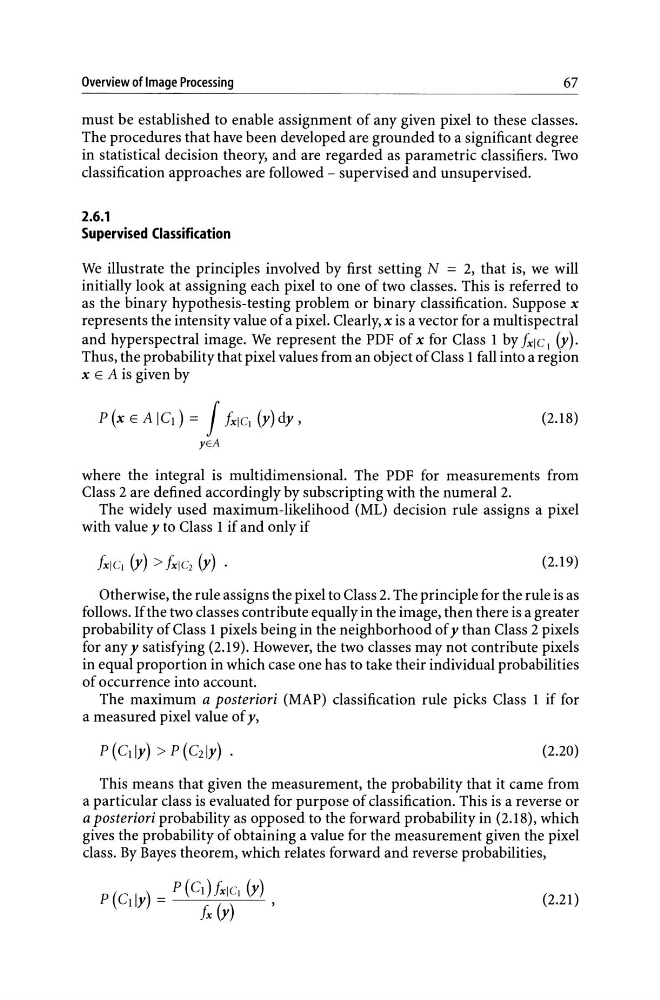
The maximum a posteriori (MAP) classification rule picks Class 1 if for
a measured pixel value of y,
(2.20)
This means that given the measurement, the probability that it came from
a particular class is evaluated for purpose of classification. This is a reverse or
a posteriori probability as opposed to the forward probability in (2.18), which
gives the probability of obtaining a value for the measurement given the pixel
class. By Bayes theorem, which relates forward and reverse probabilities,
(2.21)
67
must be established to enable assignment of any given pixel to these classes.
The procedures that have been developed are grounded to a significant degree
in statistical decision theory, and are regarded as parametric classifiers. Two
classification approaches are followed - supervised and unsupervised.
2.6.1
Supervised Classification
We illustrate the principles involved by first setting N = 2, that is, we will
initially look at assigning each pixel to one of two classes. This is referred to
as the binary hypothesis-testing problem or binary classification. Suppose x
represents the intensity value of a pixel. Clearly, x is a vector for a multispectral
and hyperspectral image. We represent the PDF of x for Class 1 by fxlc 1 (y).
Thus, the probability that pixel values from an object of Class 1 fall into a region
x E A is given by
p(x E A ICd = f fxlCI (y)dy,
(2.18)
yEA
where the integral is multidimensional. The PDF for measurements from
Class 2 are defined accordingly by subscripting with the numeral 2.
The widely used maximum-likelihood (ML) decision rule assigns a pixel
with value y to Class 1 if and only if
fxlCI (y) > fxlC2 (y) .
(2.19)
Otherwise, the rule assigns the pixel to Class 2. The principle for the rule is as
follows. If the two classes contribute equally in the image, then there is a greater
probability of Class 1 pixels being in the neighborhood of y than Class 2 pixels
for any y satisfying (2.19). However, the two classes may not contribute pixels
in equal proportion in which case one has to take their individual probabilities
of occurrence into account.
The maximum a posteriori (MAP) classification rule picks Class 1 if for
a measured pixel value of y,
(2.20)
This means that given the measurement, the probability that it came from
a particular class is evaluated for purpose of classification. This is a reverse or
a posteriori probability as opposed to the forward probability in (2.18), which
gives the probability of obtaining a value for the measurement given the pixel
class. By Bayes theorem, which relates forward and reverse probabilities,
(2.21)