

66
2: Raghuveer M. Rao, Manoj K. Arora
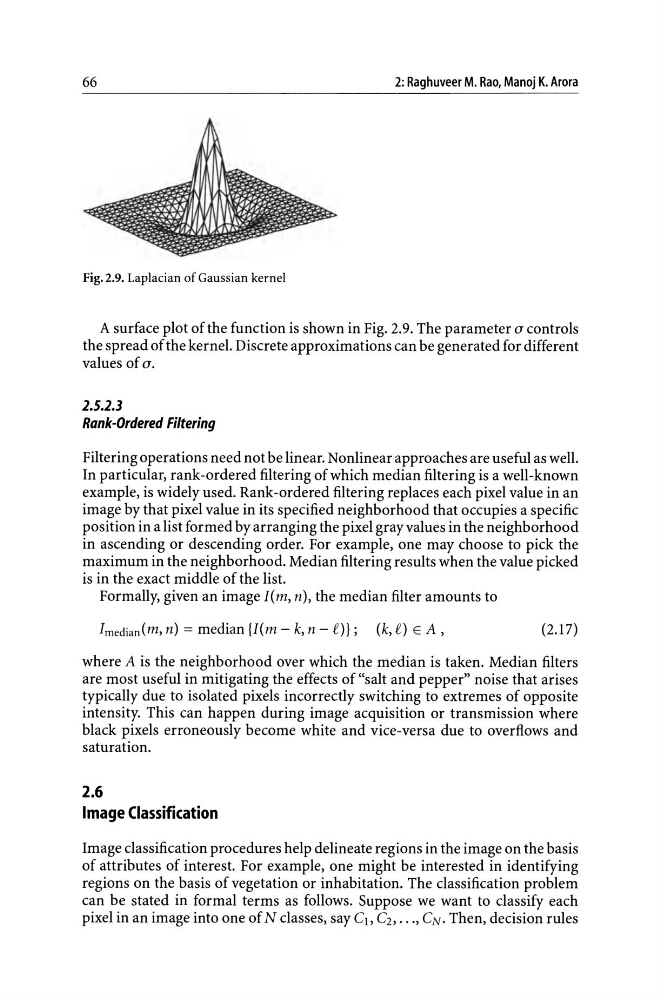
Fig. 2.9. Laplacian of Gaussian kernel
A surface plot of the function is shown in Fig. 2.9. The parameter 0 controls
the spread of the kernel. Discrete approximations can be generated for different
values of o.
2.5.2.3
Rank-Ordered Filtering
Filtering operations need not be linear. Nonlinear approaches are useful as well.
In particular, rank-ordered filtering of which median filtering is a well-known
example, is widely used. Rank-ordered filtering replaces each pixel value in an
image by that pixel value in its specified neighborhood that occupies a specific
position in a list formed by arranging the pixel gray values in the neighborhood
in ascending or descending order. For example, one may choose to pick the
maximum in the neighborhood. Median filtering results when the value picked
is in the exact middle of the list.
Formally, given an image I{m, n), the median filter amounts to
Imedian{m, n) = median (I{m - k, n - C)}; (k, C) E A,
(2.17)
where A is the neighborhood over which the median is taken. Median filters
are most useful in mitigating the effects of "salt and pepper" noise that arises
typically due to isolated pixels incorrectly switching to extremes of opposite
intensity. This can happen during image acquisition or transmission where
black pixels erroneously become white and vice-versa due to overflows and
saturation.
2.6
Image Classification
Image classification procedures help delineate regions in the image on the basis
of attributes of interest. For example, one might be interested in identifying
regions on the basis of vegetation or inhabitation. The classification problem
can be stated in formal terms as follows. Suppose we want to classify each
pixel in an image into one of N classes, say C 1, C2, .•• , C N. Then, decision rules
2: Raghuveer M. Rao, Manoj K. Arora
Fig. 2.9. Laplacian of Gaussian kernel
A surface plot of the function is shown in Fig. 2.9. The parameter 0 controls
the spread of the kernel. Discrete approximations can be generated for different
values of o.
2.5.2.3
Rank-Ordered Filtering
Filtering operations need not be linear. Nonlinear approaches are useful as well.
In particular, rank-ordered filtering of which median filtering is a well-known
example, is widely used. Rank-ordered filtering replaces each pixel value in an
image by that pixel value in its specified neighborhood that occupies a specific
position in a list formed by arranging the pixel gray values in the neighborhood
in ascending or descending order. For example, one may choose to pick the
maximum in the neighborhood. Median filtering results when the value picked
is in the exact middle of the list.
Formally, given an image I{m, n), the median filter amounts to
Imedian{m, n) = median (I{m - k, n - C)}; (k, C) E A,
(2.17)
where A is the neighborhood over which the median is taken. Median filters
are most useful in mitigating the effects of "salt and pepper" noise that arises
typically due to isolated pixels incorrectly switching to extremes of opposite
intensity. This can happen during image acquisition or transmission where
black pixels erroneously become white and vice-versa due to overflows and
saturation.
2.6
Image Classification
Image classification procedures help delineate regions in the image on the basis
of attributes of interest. For example, one might be interested in identifying
regions on the basis of vegetation or inhabitation. The classification problem
can be stated in formal terms as follows. Suppose we want to classify each
pixel in an image into one of N classes, say C 1, C2, .•• , C N. Then, decision rules