

284
12: Teerasit Kasetkasem, Pramod K. Varshney
where
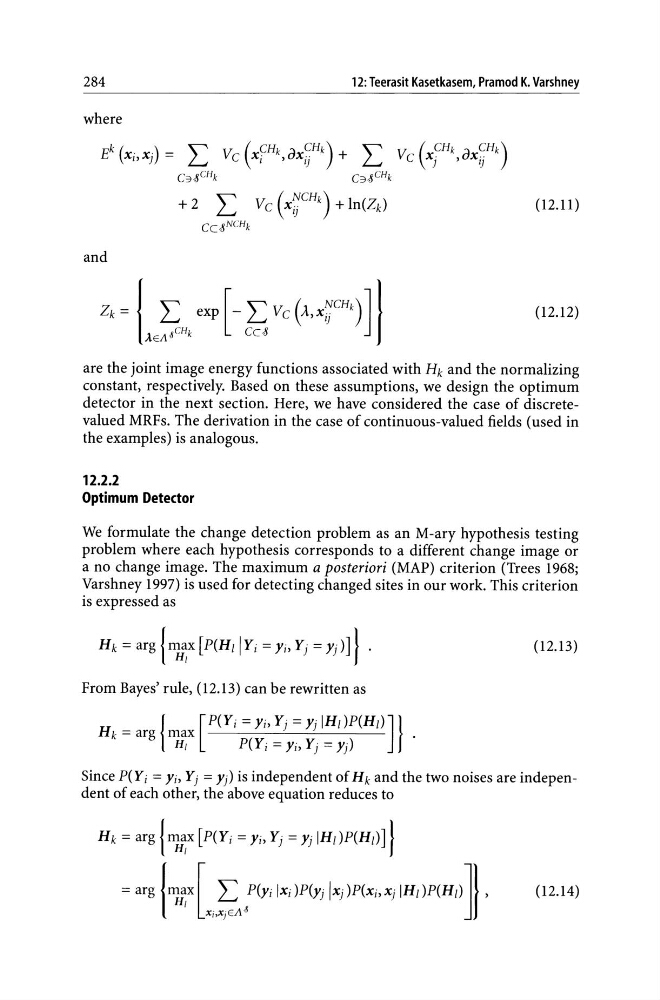
Ek (Xi,Xj) = L Vc (xfHk,ax~Hk) + L Vc (xfHk,ax~Hk)
Dlc~
Dlc~
+ 2 L Vc (x~CHk) + In(Zk)
(12.11)
CCI NCHk
and
(12.12)
are the joint image energy functions associated with Hk and the normalizing
constant, respectively. Based on these assumptions, we design the optimum
detector in the next section. Here, we have considered the case of discretevalued MRFs. The derivation in the case of continuous-valued fields (used in
the examples) is analogous.
12.2.2
Optimum Detector
We formulate the change detection problem as an M-ary hypothesis testing
problem where each hypothesis corresponds to a different change image or
a no change image. The maximum a posteriori (MAP) criterion (Trees 1968;
Varshney 1997) is used for detecting changed sites in our work. This criterion
is expressed as
Hk = arg {m~x [p(HzIYi = Yi, Yj = Yj)]} .
(12.13)
From Bayes' rule, (12.13) can be rewritten as
H k = arg max
]
]
{
[
P(Yi = Yi, y. = YIHz)P(Hz)]}
HI
P(Yi = Yi, Yj = Yj)
Since P(Yi = Yi, Yj = Yj) is independent of Hk and the two noises are independent of each other, the above equation reduces to
Hk = arg {mM [P(Yi = Yi, Yj = Yj IHz)P(Hz)] }
= arg lm~x [ L P(Yi IXi )P(Yj IXj )P(Xi, Xj 1Hz )P(HZ)]) ,
Xj,XjEJ\J
(12.14)
12: Teerasit Kasetkasem, Pramod K. Varshney
where
Ek (Xi,Xj) = L Vc (xfHk,ax~Hk) + L Vc (xfHk,ax~Hk)
Dlc~
Dlc~
+ 2 L Vc (x~CHk) + In(Zk)
(12.11)
CCI NCHk
and
(12.12)
are the joint image energy functions associated with Hk and the normalizing
constant, respectively. Based on these assumptions, we design the optimum
detector in the next section. Here, we have considered the case of discretevalued MRFs. The derivation in the case of continuous-valued fields (used in
the examples) is analogous.
12.2.2
Optimum Detector
We formulate the change detection problem as an M-ary hypothesis testing
problem where each hypothesis corresponds to a different change image or
a no change image. The maximum a posteriori (MAP) criterion (Trees 1968;
Varshney 1997) is used for detecting changed sites in our work. This criterion
is expressed as
Hk = arg {m~x [p(HzIYi = Yi, Yj = Yj)]} .
(12.13)
From Bayes' rule, (12.13) can be rewritten as
H k = arg max
]
]
{
[
P(Yi = Yi, y. = YIHz)P(Hz)]}
HI
P(Yi = Yi, Yj = Yj)
Since P(Yi = Yi, Yj = Yj) is independent of Hk and the two noises are independent of each other, the above equation reduces to
Hk = arg {mM [P(Yi = Yi, Yj = Yj IHz)P(Hz)] }
= arg lm~x [ L P(Yi IXi )P(Yj IXj )P(Xi, Xj 1Hz )P(HZ)]) ,
Xj,XjEJ\J
(12.14)