

Support Vector Machines for Classification of Multi- and Hyperspectral Data
243
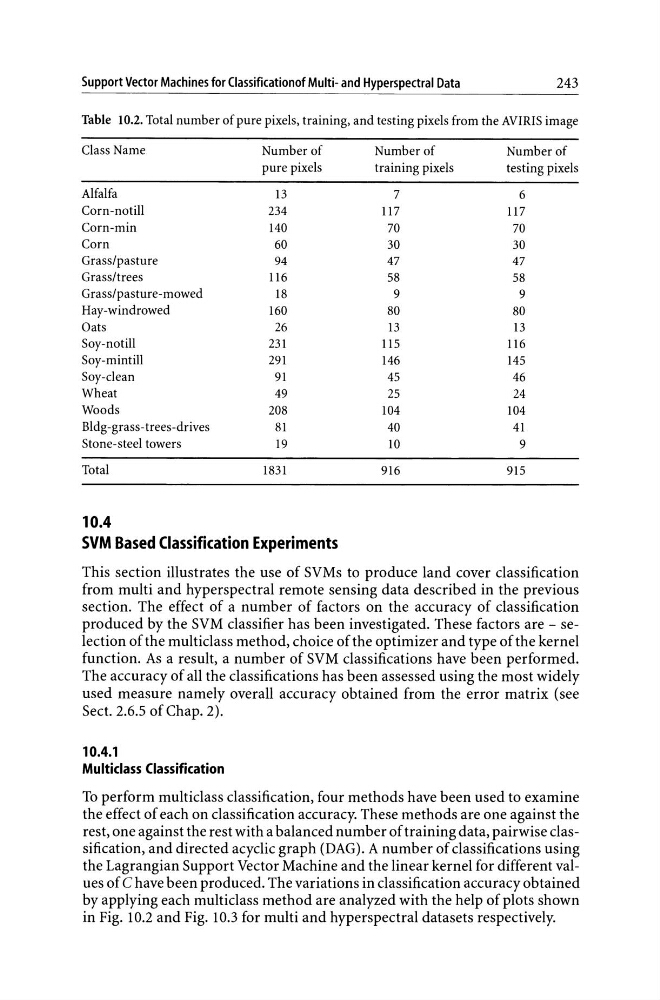
Table 10.2. Total number of pure pixels, training, and testing pixels from the AVIRIS image
Class Name
Number of
Number of
Number of
pure pixels
training pixels
testing pixels
Alfalfa
13
7
6
Corn-not ill
234
117
117
Corn-min
140
70
70
Corn
60
30
30
Grass/pasture
94
47
47
Grass/trees
116
58
58
Grass/pasture-mowed
18
9
9
Hay-windrowed
160
80
80
Oats
26
13
13
Soy-notill
231
115
116
Soy-mintill
291
146
145
Soy-clean
91
45
46
Wheat
49
25
24
Woods
208
104
104
Bldg -grass-trees-drives
81
40
41
Stone-steel towers
19
10
9
Total
1831
916
915
10.4
SVM Based Classification Experiments
This section illustrates the use of SVMs to produce land cover classification
from multi and hyperspectral remote sensing data described in the previous
section. The effect of a number of factors on the accuracy of classification
produced by the SVM classifier has been investigated. These factors are - selection of the multiclass method, choice of the optimizer and type of the kernel
function. As a result, a number of SVM classifications have been performed.
The accuracy of all the classifications has been assessed using the most widely
used measure namely overall accuracy obtained from the error matrix (see
Sect. 2.6.5 of Chap. 2).
10.4.1
Multiclass Classification
To perform multi class classification, four methods have been used to examine
the effect of each on classification accuracy. These methods are one against the
rest, one against the rest with a balanced number of training data, pairwise classification, and directed acyclic graph (DAG). A number of classifications using
the Lagrangian Support Vector Machine and the linear kernel for different values of C have been produced. The variations in classification accuracy obtained
by applying each multiclass method are analyzed with the help of plots shown
in Fig. lO.2 and Fig. lO.3 for multi and hyperspectral datasets respectively.
243
Table 10.2. Total number of pure pixels, training, and testing pixels from the AVIRIS image
Class Name
Number of
Number of
Number of
pure pixels
training pixels
testing pixels
Alfalfa
13
7
6
Corn-not ill
234
117
117
Corn-min
140
70
70
Corn
60
30
30
Grass/pasture
94
47
47
Grass/trees
116
58
58
Grass/pasture-mowed
18
9
9
Hay-windrowed
160
80
80
Oats
26
13
13
Soy-notill
231
115
116
Soy-mintill
291
146
145
Soy-clean
91
45
46
Wheat
49
25
24
Woods
208
104
104
Bldg -grass-trees-drives
81
40
41
Stone-steel towers
19
10
9
Total
1831
916
915
10.4
SVM Based Classification Experiments
This section illustrates the use of SVMs to produce land cover classification
from multi and hyperspectral remote sensing data described in the previous
section. The effect of a number of factors on the accuracy of classification
produced by the SVM classifier has been investigated. These factors are - selection of the multiclass method, choice of the optimizer and type of the kernel
function. As a result, a number of SVM classifications have been performed.
The accuracy of all the classifications has been assessed using the most widely
used measure namely overall accuracy obtained from the error matrix (see
Sect. 2.6.5 of Chap. 2).
10.4.1
Multiclass Classification
To perform multi class classification, four methods have been used to examine
the effect of each on classification accuracy. These methods are one against the
rest, one against the rest with a balanced number of training data, pairwise classification, and directed acyclic graph (DAG). A number of classifications using
the Lagrangian Support Vector Machine and the linear kernel for different values of C have been produced. The variations in classification accuracy obtained
by applying each multiclass method are analyzed with the help of plots shown
in Fig. lO.2 and Fig. lO.3 for multi and hyperspectral datasets respectively.