

208
x
n dimensional
observed data
For each observation vector x; do
-compute u;= Wx;
-compute
compute
g(u;) = (g (u;), """' g(u;) )
update
L'.W = «WW ' "r 1 {W+E{g(u;)/}
W",,=W,1d +kL'.W
abs (J(W,,1d x) - J(W,,,x) )
no
>---------'
J(W"Id X )
yes
u=Wx
m dimensional
independent components
8: Stefan A. Robila, Pramod K. Varshney
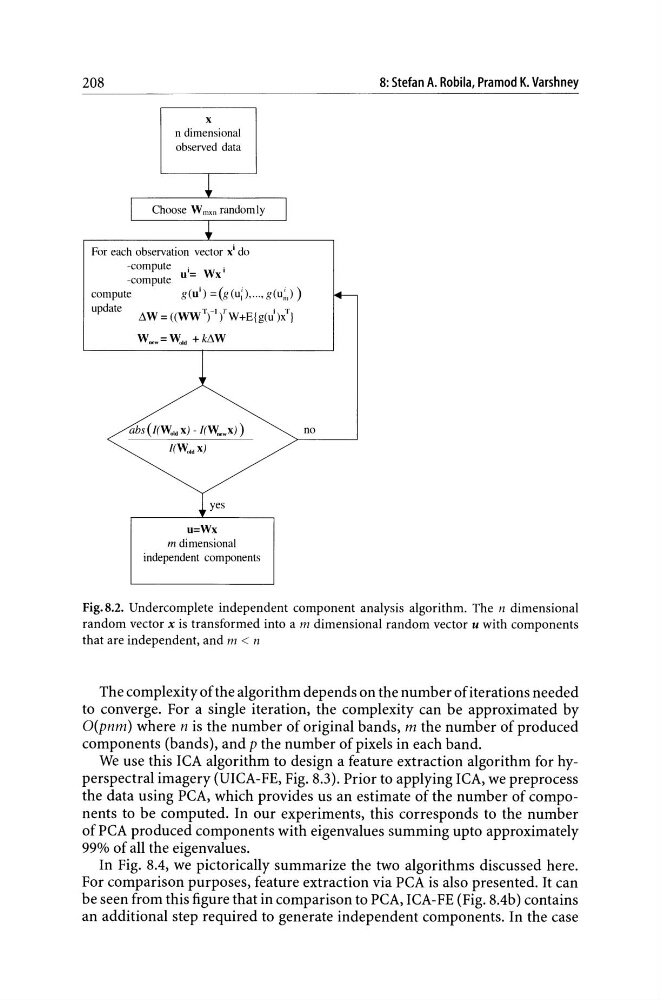
Fig.8.2. Undercomplete independent component analysis algorithm. The n dimensional
random vector x is transformed into a m dimensional random vector u with components
that are independent, and m < n
The complexity of the algorithm depends on the number of iterations needed
to converge. For a single iteration, the complexity can be approximated by
O(pnm) where n is the number of original bands, m the number of produced
components (bands), and p the number of pixels in each band.
We use this ICA algorithm to design a feature extraction algorithm for hyperspectral imagery (UICA-FE, Fig. 8.3). Prior to applying ICA, we preprocess
the data using PCA, which provides us an estimate of the number of components to be computed. In our experiments, this corresponds to the number
of PCA produced components with eigenvalues summing upto approximately
99% of all the eigenvalues.
In Fig. 8.4, we pictorically summarize the two algorithms discussed here.
For comparison purposes, feature extraction via PCA is also presented. It can
be seen from this figure that in comparison to PCA, ICA- FE (Fig. 8.4b) contains
an additional step required to generate independent components. In the case
x
n dimensional
observed data
For each observation vector x; do
-compute u;= Wx;
-compute
compute
g(u;) = (g (u;), """' g(u;) )
update
L'.W = «WW ' "r 1 {W+E{g(u;)/}
W",,=W,1d +kL'.W
abs (J(W,,1d x) - J(W,,,x) )
no
>---------'
J(W"Id X )
yes
u=Wx
m dimensional
independent components
8: Stefan A. Robila, Pramod K. Varshney
Fig.8.2. Undercomplete independent component analysis algorithm. The n dimensional
random vector x is transformed into a m dimensional random vector u with components
that are independent, and m < n
The complexity of the algorithm depends on the number of iterations needed
to converge. For a single iteration, the complexity can be approximated by
O(pnm) where n is the number of original bands, m the number of produced
components (bands), and p the number of pixels in each band.
We use this ICA algorithm to design a feature extraction algorithm for hyperspectral imagery (UICA-FE, Fig. 8.3). Prior to applying ICA, we preprocess
the data using PCA, which provides us an estimate of the number of components to be computed. In our experiments, this corresponds to the number
of PCA produced components with eigenvalues summing upto approximately
99% of all the eigenvalues.
In Fig. 8.4, we pictorically summarize the two algorithms discussed here.
For comparison purposes, feature extraction via PCA is also presented. It can
be seen from this figure that in comparison to PCA, ICA- FE (Fig. 8.4b) contains
an additional step required to generate independent components. In the case