

196
1 . 4 , - - - - - - - - - - - - - - - - - ,
1.3
1.2
1.1
~ 1
~
0.9
0.8
0.7
Q~
00
~
~
ro
M
E
x-displacement
a
0.9
0.8
0.7
0.6
59
60
61
62
63
64
65
y-displacement
c
7: Hua-mei Chen, Pramod K. Varshney
1 . 4 , - - - - - - - - - - - - - - - - - - ,
1.3
1.2
1.1
~1
0.9
0.8
0.7
0.6 0
2
3
4
5
y-displacement
b
1.1 ,---~---------,
0.9
~
0.8
0.7
0.6 0
2
3
4
5
6
y-displacement
d
6
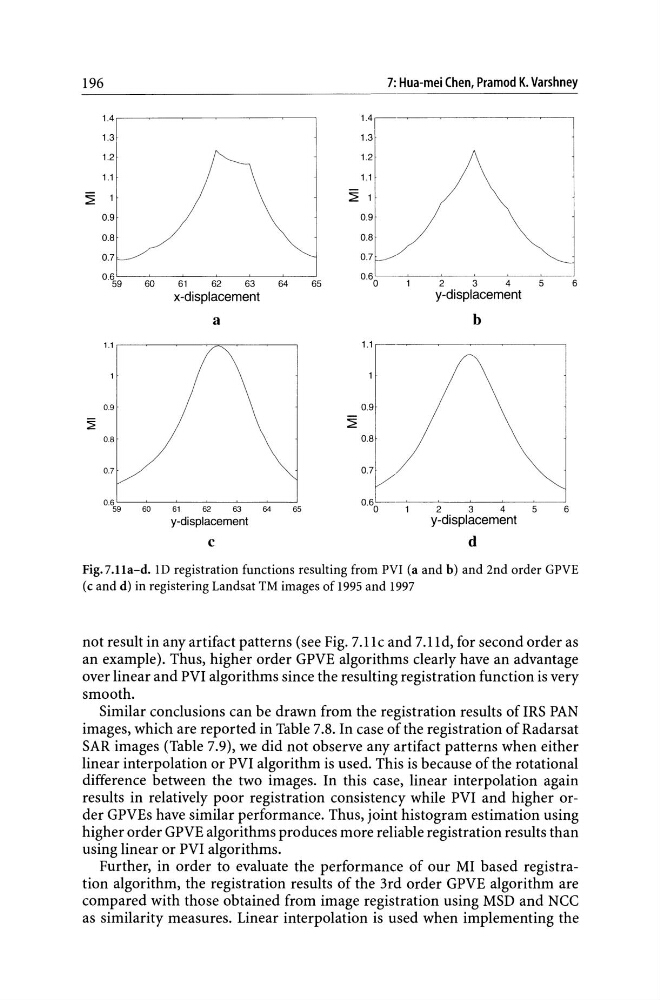
Fig.7.11a-d. lD registration functions resulting from PVI (a and b) and 2nd order GPVE
(c and d) in registering Landsat TM images of 1995 and 1997
not result in any artifact patterns (see Fig. 7.11 c and 7.11 d, for second order as
an example). Thus, higher order GPVE algorithms clearly have an advantage
over linear and PVI algorithms since the resulting registration function is very
smooth.
Similar conclusions can be drawn from the registration results of IRS PAN
images, which are reported in Table 7.8. In case of the registration of Radarsat
SAR images (Table 7.9), we did not observe any artifact patterns when either
linear interpolation or PVI algorithm is used. This is because of the rotational
difference between the two images. In this case, linear interpolation again
results in relatively poor registration consistency while PVI and higher order GPVEs have similar performance. Thus, joint histogram estimation using
higher order GPVE algorithms produces more reliable registration results than
using linear or PVI algorithms.
Further, in order to evaluate the performance of our MI based registration algorithm, the registration results of the 3rd order GPVE algorithm are
compared with those obtained from image registration using MSD and NCC
as similarity measures. Linear interpolation is used when implementing the
1 . 4 , - - - - - - - - - - - - - - - - - ,
1.3
1.2
1.1
~ 1
~
0.9
0.8
0.7
Q~
00
~
~
ro
M
E
x-displacement
a
0.9
0.8
0.7
0.6
59
60
61
62
63
64
65
y-displacement
c
7: Hua-mei Chen, Pramod K. Varshney
1 . 4 , - - - - - - - - - - - - - - - - - - ,
1.3
1.2
1.1
~1
0.9
0.8
0.7
0.6 0
2
3
4
5
y-displacement
b
1.1 ,---~---------,
0.9
~
0.8
0.7
0.6 0
2
3
4
5
6
y-displacement
d
6
Fig.7.11a-d. lD registration functions resulting from PVI (a and b) and 2nd order GPVE
(c and d) in registering Landsat TM images of 1995 and 1997
not result in any artifact patterns (see Fig. 7.11 c and 7.11 d, for second order as
an example). Thus, higher order GPVE algorithms clearly have an advantage
over linear and PVI algorithms since the resulting registration function is very
smooth.
Similar conclusions can be drawn from the registration results of IRS PAN
images, which are reported in Table 7.8. In case of the registration of Radarsat
SAR images (Table 7.9), we did not observe any artifact patterns when either
linear interpolation or PVI algorithm is used. This is because of the rotational
difference between the two images. In this case, linear interpolation again
results in relatively poor registration consistency while PVI and higher order GPVEs have similar performance. Thus, joint histogram estimation using
higher order GPVE algorithms produces more reliable registration results than
using linear or PVI algorithms.
Further, in order to evaluate the performance of our MI based registration algorithm, the registration results of the 3rd order GPVE algorithm are
compared with those obtained from image registration using MSD and NCC
as similarity measures. Linear interpolation is used when implementing the