

192
7: Hua-mei Chen, Pramod K. Varshney
a global maximum in Fig. 7.8b both at the position (0,0). Instead, it occurs
at (20, -14) for MSD and at (20, -12) for Nee. Thus, these two similarity
measures fail to register the two images accurately. In order to overcome this
potential difficulty pertaining to MSD and Nee similarity measures, a more
robust similarity measure is required. Since MI has been successful as a similarity measure for many multi-sensor registration problems, it is natural to
examine its efficacy for registration of images acquired at different times.
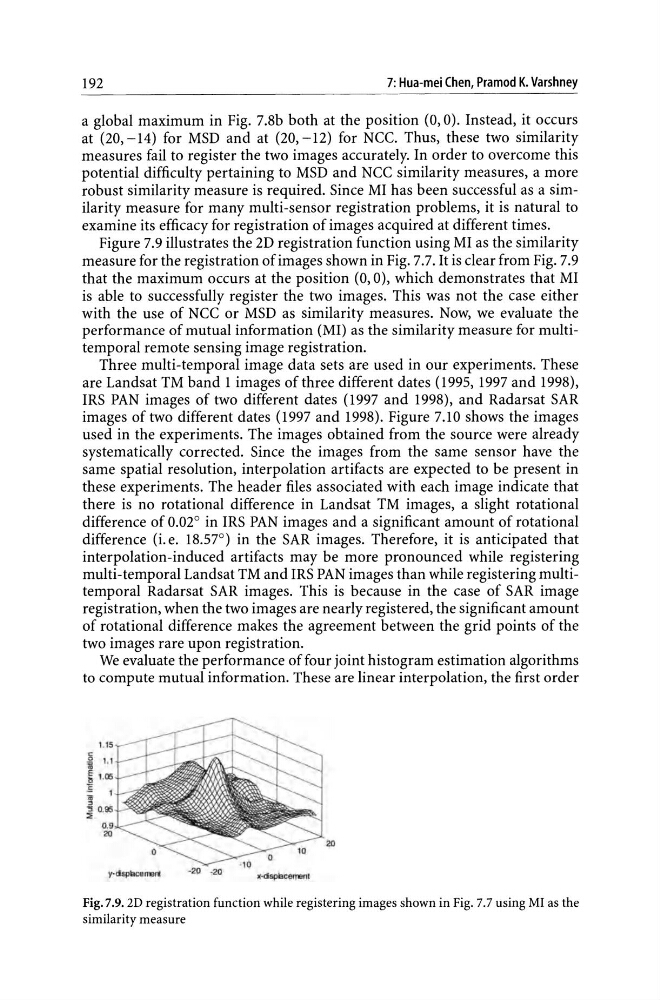
Figure 7.9 illustrates the 2D registration function using MI as the similarity
measure for the registration of images shown in Fig. 7.7. It is clear from Fig. 7.9
that the maximum occurs at the position (0,0), which demonstrates that MI
is able to successfully register the two images. This was not the case either
with the use of Nee or MSD as similarity measures. Now, we evaluate the
performance of mutual information (MI) as the similarity measure for multitemporal remote sensing image registration.
Three multi-temporal image data sets are used in our experiments. These
are Landsat TM band 1 images of three different dates (1995, 1997 and 1998),
IRS PAN images of two different dates (1997 and 1998), and Radarsat SAR
images of two different dates (1997 and 1998). Figure 7.10 shows the images
used in the experiments. The images obtained from the source were already
systematically corrected. Since the images from the same sensor have the
same spatial resolution, interpolation artifacts are expected to be present in
these experiments. The header files associated with each image indicate that
there is no rotational difference in Landsat TM images, a slight rotational
difference of 0.02° in IRS PAN images and a significant amount of rotational
difference (i. e. 18.57°) in the SAR images. Therefore, it is anticipated that
interpolation-induced artifacts may be more pronounced while registering
multi-temporal Landsat TM and IRS PAN images than while registering multitemporal Radarsat SAR images. This is because in the case of SAR image
registration, when the two images are nearly registered, the significant amount
of rotational difference makes the agreement between the grid points of the
two images rare upon registration.
We evaluate the performance of four joint histogram estimation algorithms
to compute mutual information. These are linear interpolation, the first order
y. clspBcemort
x-dspbcement
Fig. 7.9. 2D registration function while registering images shown in Fig. 7.7 using MI as the
similarity measure
7: Hua-mei Chen, Pramod K. Varshney
a global maximum in Fig. 7.8b both at the position (0,0). Instead, it occurs
at (20, -14) for MSD and at (20, -12) for Nee. Thus, these two similarity
measures fail to register the two images accurately. In order to overcome this
potential difficulty pertaining to MSD and Nee similarity measures, a more
robust similarity measure is required. Since MI has been successful as a similarity measure for many multi-sensor registration problems, it is natural to
examine its efficacy for registration of images acquired at different times.
Figure 7.9 illustrates the 2D registration function using MI as the similarity
measure for the registration of images shown in Fig. 7.7. It is clear from Fig. 7.9
that the maximum occurs at the position (0,0), which demonstrates that MI
is able to successfully register the two images. This was not the case either
with the use of Nee or MSD as similarity measures. Now, we evaluate the
performance of mutual information (MI) as the similarity measure for multitemporal remote sensing image registration.
Three multi-temporal image data sets are used in our experiments. These
are Landsat TM band 1 images of three different dates (1995, 1997 and 1998),
IRS PAN images of two different dates (1997 and 1998), and Radarsat SAR
images of two different dates (1997 and 1998). Figure 7.10 shows the images
used in the experiments. The images obtained from the source were already
systematically corrected. Since the images from the same sensor have the
same spatial resolution, interpolation artifacts are expected to be present in
these experiments. The header files associated with each image indicate that
there is no rotational difference in Landsat TM images, a slight rotational
difference of 0.02° in IRS PAN images and a significant amount of rotational
difference (i. e. 18.57°) in the SAR images. Therefore, it is anticipated that
interpolation-induced artifacts may be more pronounced while registering
multi-temporal Landsat TM and IRS PAN images than while registering multitemporal Radarsat SAR images. This is because in the case of SAR image
registration, when the two images are nearly registered, the significant amount
of rotational difference makes the agreement between the grid points of the
two images rare upon registration.
We evaluate the performance of four joint histogram estimation algorithms
to compute mutual information. These are linear interpolation, the first order
y. clspBcemort
x-dspbcement
Fig. 7.9. 2D registration function while registering images shown in Fig. 7.7 using MI as the
similarity measure