

MI Based Registration of Multi-Sensor and Multi-Temporal Images
187
floating image to be registered with the reference image R. Parameter set
[SOi, rOi, dxoi, dyoil is the initial search point used at each level i. When i =
L - 1, the initial search point is arbitrarily chosen. Parameter set lSi, ri, dxi, dyil
represents the position of the optimum found by the local optimizer at level i.
The initial search point at level i-I is then determined by the parameter set
obtained at the previous level i by dividing the scaling factor S by 2.
In our experiments, the spatial resolutions of the two original images were
given in the associated header files. Therefore, the scaling factors at each level
are known. They are listed in the rightmost column of Table 7.1. The simplex
search algorithm was employed as the local optimizer at each resolution level
(NeIder and Mead 1965). In addition, the header files showed no rotational
difference between the two images because they were both rectified to UTM
map projection system. Therefore, only the two displacements are to be determined to register the two images. The success of this multi-scale optimization
procedure strongly relies on the success of the optimization performed at the
lowest resolution level i = L - 1. Unfortunately, in our experiment, by choosing zero displacements along both directions as the initial search point did
not converge to the desired optimum and resulted in large registration error
as observed from visual inspection. To overcome this problem, we adopted
the hybrid global optimization procedure introduced in Sect. 3.6 at the lowest
resolution level. First, the floating image is partitioned into four equal-sized
subimages. After that, each of them is used as the floating image to register
with the reference image. The initial search point generator shown in Fig. 3.15
(see Chap. 3), is designed in the following manner:
1. Randomly generate 30 points within the search space. In the experiment,
the search space is defined as [dx = ±30 pixel, dy = ±30 pixel]
2. Choose the point that results in the maximum mutual information measure as the initial search point.
Using this hybrid global optimization procedure, the images can be registered successfully at the lowest resolution level, and therefore, at the consecutive
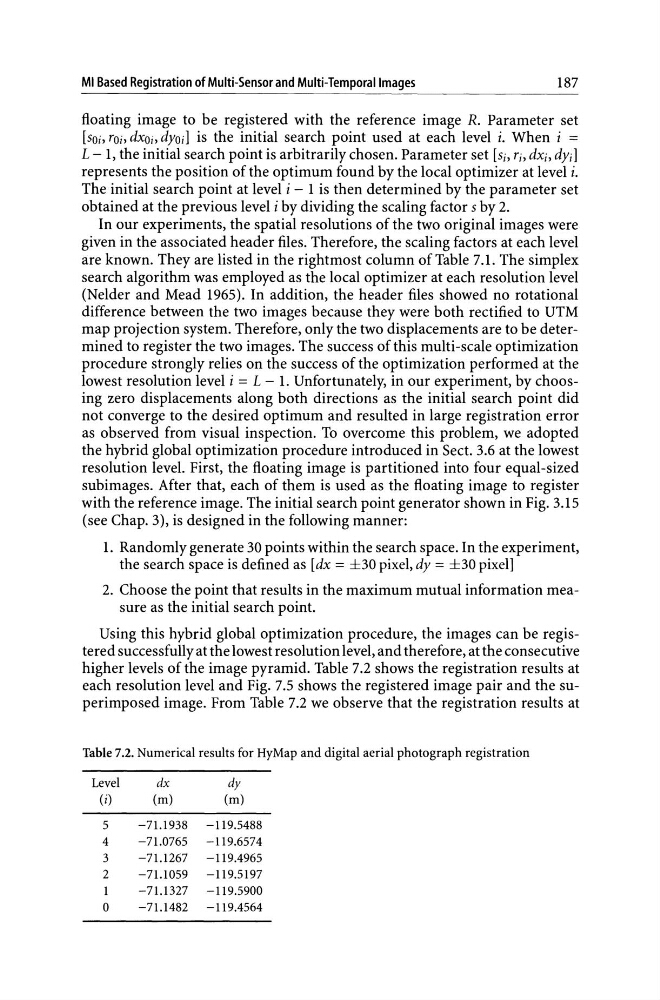
higher levels of the image pyramid. Table 7.2 shows the registration results at
each resolution level and Fig. 7.5 shows the registered image pair and the superimposed image. From Table 7.2 we observe that the registration results at
Table 7.2. Numerical results for HyMap and digital aerial photograph registration
Level
dx
dy
(i)
(m)
(m)
5
-71.1938 -119.5488
4
-71.0765 -119.6574
3
-71.1267 -119.4965
2
-71.1059 -119.5197
1
-71.1327 -119.5900
0
-71.1482 -119.4564
187
floating image to be registered with the reference image R. Parameter set
[SOi, rOi, dxoi, dyoil is the initial search point used at each level i. When i =
L - 1, the initial search point is arbitrarily chosen. Parameter set lSi, ri, dxi, dyil
represents the position of the optimum found by the local optimizer at level i.
The initial search point at level i-I is then determined by the parameter set
obtained at the previous level i by dividing the scaling factor S by 2.
In our experiments, the spatial resolutions of the two original images were
given in the associated header files. Therefore, the scaling factors at each level
are known. They are listed in the rightmost column of Table 7.1. The simplex
search algorithm was employed as the local optimizer at each resolution level
(NeIder and Mead 1965). In addition, the header files showed no rotational
difference between the two images because they were both rectified to UTM
map projection system. Therefore, only the two displacements are to be determined to register the two images. The success of this multi-scale optimization
procedure strongly relies on the success of the optimization performed at the
lowest resolution level i = L - 1. Unfortunately, in our experiment, by choosing zero displacements along both directions as the initial search point did
not converge to the desired optimum and resulted in large registration error
as observed from visual inspection. To overcome this problem, we adopted
the hybrid global optimization procedure introduced in Sect. 3.6 at the lowest
resolution level. First, the floating image is partitioned into four equal-sized
subimages. After that, each of them is used as the floating image to register
with the reference image. The initial search point generator shown in Fig. 3.15
(see Chap. 3), is designed in the following manner:
1. Randomly generate 30 points within the search space. In the experiment,
the search space is defined as [dx = ±30 pixel, dy = ±30 pixel]
2. Choose the point that results in the maximum mutual information measure as the initial search point.
Using this hybrid global optimization procedure, the images can be registered successfully at the lowest resolution level, and therefore, at the consecutive
higher levels of the image pyramid. Table 7.2 shows the registration results at
each resolution level and Fig. 7.5 shows the registered image pair and the superimposed image. From Table 7.2 we observe that the registration results at
Table 7.2. Numerical results for HyMap and digital aerial photograph registration
Level
dx
dy
(i)
(m)
(m)
5
-71.1938 -119.5488
4
-71.0765 -119.6574
3
-71.1267 -119.4965
2
-71.1059 -119.5197
1
-71.1327 -119.5900
0
-71.1482 -119.4564