

MI Based Registration of Multi-Sensor and Multi-Temporal Images
185
a
b
Fig.7.2a,b. Images used in the experiment. a Digital aerial photograph (red band) from
Eastman Kodak and b airborne HyMap image (band 9)
feasible to use the low resolution image, the HyMap image, as the floating image because the resulting MI registration function is very rough, which makes
the optimization barely possible.
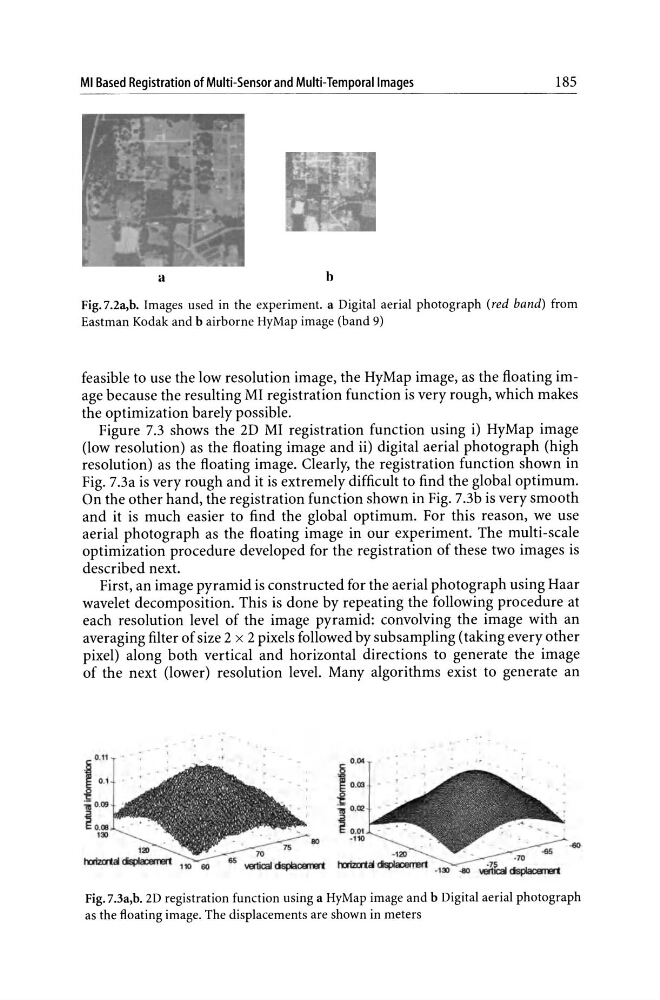
Figure 7.3 shows the 2D MI registration function using i) HyMap image
(low resolution) as the floating image and ii) digital aerial photograph (high
resolution) as the floating image. Clearly, the registration function shown in
Fig. 7.3a is very rough and it is extremely difficult to find the global optimum.
On the other hand, the registration function shown in Fig. 7.3b is very smooth
and it is much easier to find the global optimum. For this reason, we use
aerial photograph as the floating image in our experiment. The multi-scale
optimization procedure developed for the registration of these two images is
described next.
First, an image pyramid is constructed for the aerial photograph using Haar
wavelet decomposition. This is done by repeating the following procedure at
each resolution level of the image pyramid: convolving the image with an
averaging filter of size 2 x 2 pixels followed by subsampling (taking every other
pixel) along both vertical and horizontal directions to generate the image
of the next (lower) resolution level. Many algorithms exist to generate an
Fig.7.3a,b. 2D registration function using a HyMap image and b Digital aerial photograph
as the floating image. The displacements are shown in meters
185
a
b
Fig.7.2a,b. Images used in the experiment. a Digital aerial photograph (red band) from
Eastman Kodak and b airborne HyMap image (band 9)
feasible to use the low resolution image, the HyMap image, as the floating image because the resulting MI registration function is very rough, which makes
the optimization barely possible.
Figure 7.3 shows the 2D MI registration function using i) HyMap image
(low resolution) as the floating image and ii) digital aerial photograph (high
resolution) as the floating image. Clearly, the registration function shown in
Fig. 7.3a is very rough and it is extremely difficult to find the global optimum.
On the other hand, the registration function shown in Fig. 7.3b is very smooth
and it is much easier to find the global optimum. For this reason, we use
aerial photograph as the floating image in our experiment. The multi-scale
optimization procedure developed for the registration of these two images is
described next.
First, an image pyramid is constructed for the aerial photograph using Haar
wavelet decomposition. This is done by repeating the following procedure at
each resolution level of the image pyramid: convolving the image with an
averaging filter of size 2 x 2 pixels followed by subsampling (taking every other
pixel) along both vertical and horizontal directions to generate the image
of the next (lower) resolution level. Many algorithms exist to generate an
Fig.7.3a,b. 2D registration function using a HyMap image and b Digital aerial photograph
as the floating image. The displacements are shown in meters