

Markov Random Field Models
169
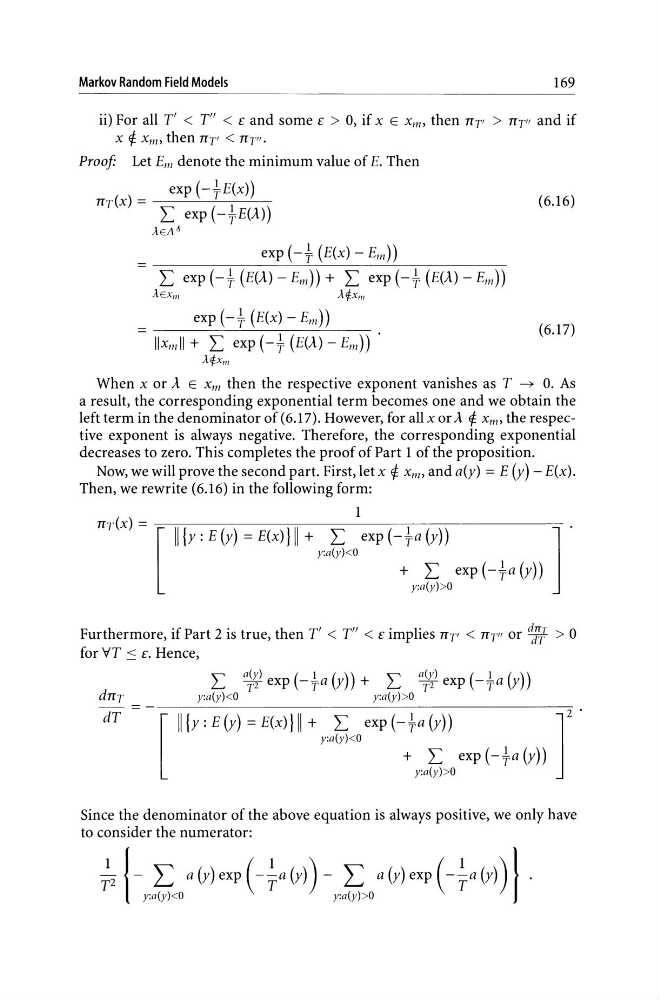
ii) For all T' < Til < E and some E > 0, if x E xm , then 1TT' > 1TT" and if
x f. Xm , then 1TT' < 1TT".
Proof Let Em denote the minimum value of E. Then
exp (-+E(x»)
1TT(X) = ----=---'----~,-------'--,L exp(-+E(A»)
(6.16)
AEAS
exp (-+ (E(x) - Em))
L exp (-+ (E(A) - Em)) + L exp (-+ (E(A) - Em))
AEXII/
A~Xm
exp (-+ (E(x) - Em))
= ---~~~~-~~-~
Ilxmll + L exp (-+ (E(A) - Em)) .
(6.17)
A~Xm
When x or A E Xm then the respective exponent vanishes as T ~ O. As
a result, the corresponding exponential term becomes one and we obtain the
left term in the denominator of (6.17). However, for all x or A f. xm , the respective exponent is always negative. Therefore, the corresponding exponential
decreases to zero. This completes the proof of Part 1 of the proposition.
Now, we will prove the second part. First, let x f. xm, and a(y) = E (y) - E(x).
Then, we rewrite (6.16) in the following form:
1
1TT(X) = [ II {y: E (y) = E(x)} I I + L exp (-+a (y))
l'
y:a(y)
y:a(y»O
Furthermore, if Part 2 is true, then T' < Til < E implies 1TT' < 1TT" or d::; > 0
for VT :s E. Hence,
d1TT
dT
L ai!2 exp (-+a (y)) + L aW exp (-+a (y))
y:a(y)
[
II {y: E (y) = E(x)} II + L exp (-+a (y))
y:a(y)
y:a(y) >0
J
Since the denominator of the above equation is always positive, we only have
to consider the numerator:
169
ii) For all T' < Til < E and some E > 0, if x E xm , then 1TT' > 1TT" and if
x f. Xm , then 1TT' < 1TT".
Proof Let Em denote the minimum value of E. Then
exp (-+E(x»)
1TT(X) = ----=---'----~,-------'--,L exp(-+E(A»)
(6.16)
AEAS
exp (-+ (E(x) - Em))
L exp (-+ (E(A) - Em)) + L exp (-+ (E(A) - Em))
AEXII/
A~Xm
exp (-+ (E(x) - Em))
= ---~~~~-~~-~
Ilxmll + L exp (-+ (E(A) - Em)) .
(6.17)
A~Xm
When x or A E Xm then the respective exponent vanishes as T ~ O. As
a result, the corresponding exponential term becomes one and we obtain the
left term in the denominator of (6.17). However, for all x or A f. xm , the respective exponent is always negative. Therefore, the corresponding exponential
decreases to zero. This completes the proof of Part 1 of the proposition.
Now, we will prove the second part. First, let x f. xm, and a(y) = E (y) - E(x).
Then, we rewrite (6.16) in the following form:
1
1TT(X) = [ II {y: E (y) = E(x)} I I + L exp (-+a (y))
l'
y:a(y)
y:a(y»O
Furthermore, if Part 2 is true, then T' < Til < E implies 1TT' < 1TT" or d::; > 0
for VT :s E. Hence,
d1TT
dT
L ai!2 exp (-+a (y)) + L aW exp (-+a (y))
y:a(y)
[
II {y: E (y) = E(x)} II + L exp (-+a (y))
y:a(y)
y:a(y) >0
J
Since the denominator of the above equation is always positive, we only have
to consider the numerator: