

Mutuallnformation:A Similarity Measure for Intensity Based Image Registration
103
0.6
0.6
0.5
0.5
~ 0.4
~ 0.4
0.3
0.3
0.2
0.2
-3
-2
-1
0
2
3
-3
-2
-1
0
2
3
a
b
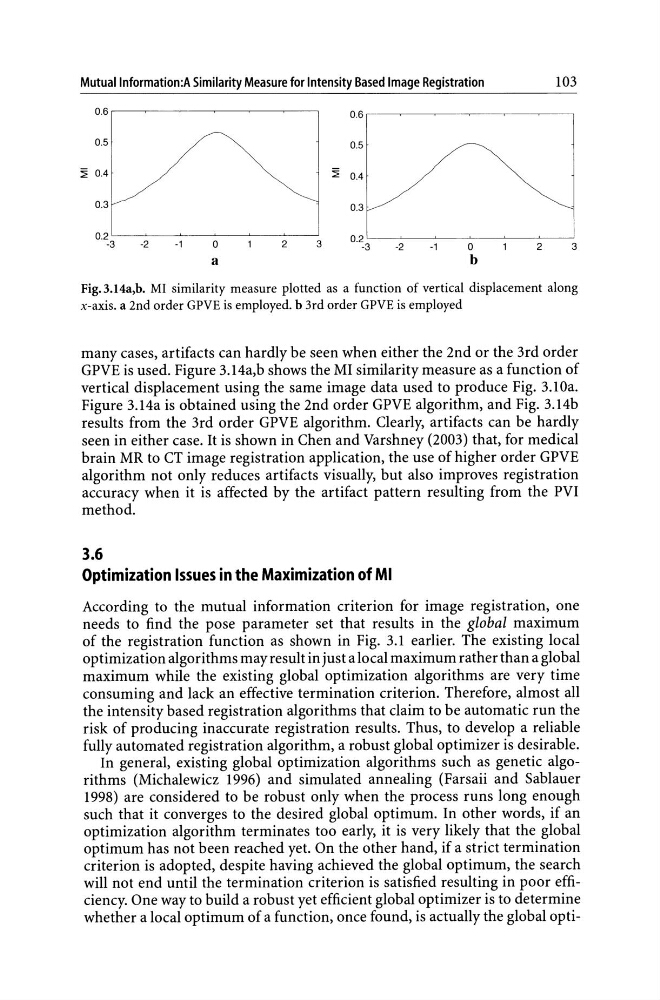
Fig.3.14a,b. MI similarity measure plotted as a function of vertical displacement along
x-axis. a 2nd order GPVE is employed. b 3rd order GPVE is employed
many cases, artifacts can hardly be seen when either the 2nd or the 3rd order
GPVE is used. Figure 3.14a,b shows the MI similarity measure as a function of
vertical displacement using the same image data used to produce Fig. 3.lOa.
Figure 3.14a is obtained using the 2nd order GPVE algorithm, and Fig. 3.14b
results from the 3rd order GPVE algorithm. Clearly, artifacts can be hardly
seen in either case. It is shown in Chen and Varshney (2003) that, for medical
brain MR to CT image registration application, the use of higher order GPVE
algorithm not only reduces artifacts visually, but also improves registration
accuracy when it is affected by the artifact pattern resulting from the PVI
method.
3.6
Optimization Issues in the Maximization of MI
According to the mutual information criterion for image registration, one
needs to find the pose parameter set that results in the global maximum
of the registration function as shown in Fig. 3.1 earlier. The existing local
optimization algorithms may result in just a local maximum rather than a global
maximum while the existing global optimization algorithms are very time
consuming and lack an effective termination criterion. Therefore, almost all
the intensity based registration algorithms that claim to be automatic run the
risk of producing inaccurate registration results. Thus, to develop a reliable
fully automated registration algorithm, a robust global optimizer is desirable.
In general, existing global optimization algorithms such as genetic algorithms (Michalewicz 1996) and simulated annealing (Farsaii and Sablauer
1998) are considered to be robust only when the process runs long enough
such that it converges to the desired global optimum. In other words, if an
optimization algorithm terminates too early, it is very likely that the global
optimum has not been reached yet. On the other hand, if a strict termination
criterion is adopted, despite having achieved the global optimum, the search
will not end until the termination criterion is satisfied resulting in poor efficiency. One way to build a robust yet efficient global optimizer is to determine
whether a local optimum of a function, once found, is actually the global opti-
103
0.6
0.6
0.5
0.5
~ 0.4
~ 0.4
0.3
0.3
0.2
0.2
-3
-2
-1
0
2
3
-3
-2
-1
0
2
3
a
b
Fig.3.14a,b. MI similarity measure plotted as a function of vertical displacement along
x-axis. a 2nd order GPVE is employed. b 3rd order GPVE is employed
many cases, artifacts can hardly be seen when either the 2nd or the 3rd order
GPVE is used. Figure 3.14a,b shows the MI similarity measure as a function of
vertical displacement using the same image data used to produce Fig. 3.lOa.
Figure 3.14a is obtained using the 2nd order GPVE algorithm, and Fig. 3.14b
results from the 3rd order GPVE algorithm. Clearly, artifacts can be hardly
seen in either case. It is shown in Chen and Varshney (2003) that, for medical
brain MR to CT image registration application, the use of higher order GPVE
algorithm not only reduces artifacts visually, but also improves registration
accuracy when it is affected by the artifact pattern resulting from the PVI
method.
3.6
Optimization Issues in the Maximization of MI
According to the mutual information criterion for image registration, one
needs to find the pose parameter set that results in the global maximum
of the registration function as shown in Fig. 3.1 earlier. The existing local
optimization algorithms may result in just a local maximum rather than a global
maximum while the existing global optimization algorithms are very time
consuming and lack an effective termination criterion. Therefore, almost all
the intensity based registration algorithms that claim to be automatic run the
risk of producing inaccurate registration results. Thus, to develop a reliable
fully automated registration algorithm, a robust global optimizer is desirable.
In general, existing global optimization algorithms such as genetic algorithms (Michalewicz 1996) and simulated annealing (Farsaii and Sablauer
1998) are considered to be robust only when the process runs long enough
such that it converges to the desired global optimum. In other words, if an
optimization algorithm terminates too early, it is very likely that the global
optimum has not been reached yet. On the other hand, if a strict termination
criterion is adopted, despite having achieved the global optimum, the search
will not end until the termination criterion is satisfied resulting in poor efficiency. One way to build a robust yet efficient global optimizer is to determine
whether a local optimum of a function, once found, is actually the global opti-