

Mutuallnformation:A Similarity Measure for Intensity Based Image Registration
99
0.7
11.5
0.6
11.4
~
e 11.3
~ 0.5
C
OJ
C 11.2
:Q.
0.4
11.1
0.3
11
-3
-2
-1
0
2
3
-3
-2
-1
0
2
3
a
b
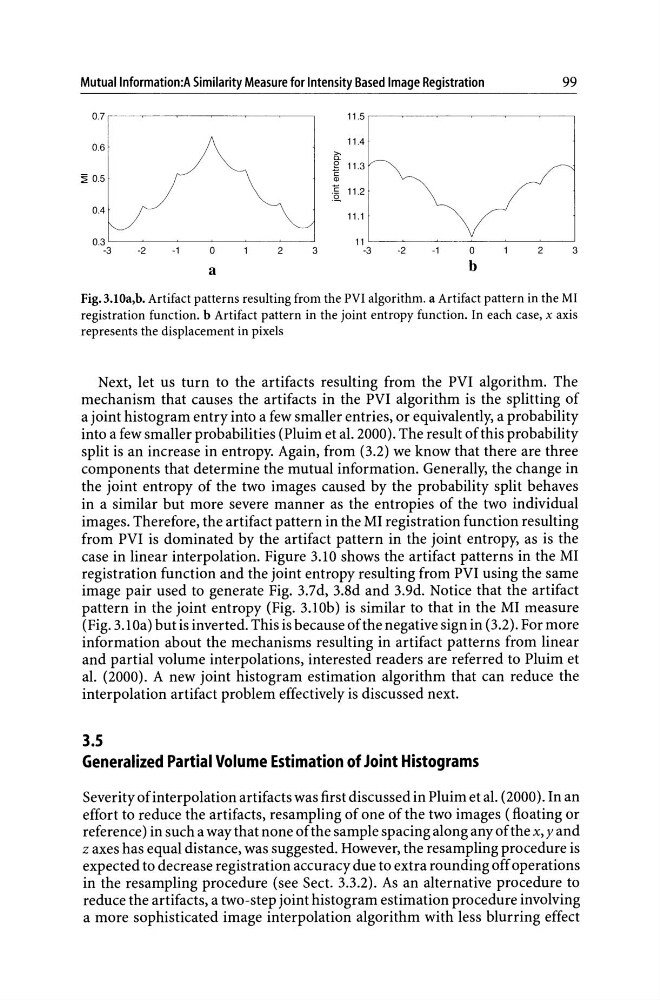
Fig. 3. 1 Oa,b. Artifact patterns resulting from the PVI algorithm. a Artifact pattern in the MI
registration function. b Artifact pattern in the joint entropy function. In each case, x axis
represents the displacement in pixels
Next, let us turn to the artifacts resulting from the PVI algorithm. The
mechanism that causes the artifacts in the PVI algorithm is the splitting of
a joint histogram entry into a few smaller entries, or equivalently, a probability
into a few smaller probabilities (Pluim et al. 2000). The result of this probability
split is an increase in entropy. Again, from (3.2) we know that there are three
components that determine the mutual information. Generally, the change in
the joint entropy of the two images caused by the probability split behaves
in a similar but more severe manner as the entropies of the two individual
images. Therefore, the artifact pattern in the MI registration function resulting
from PVI is dominated by the artifact pattern in the joint entropy, as is the
case in linear interpolation. Figure 3.10 shows the artifact patterns in the MI
registration function and the joint entropy resulting from PVI using the same
image pair used to generate Fig. 3.7d, 3.8d and 3.9d. Notice that the artifact
pattern in the joint entropy (Fig. 3.10b) is similar to that in the MI measure
(Fig. 3.1 Oa) but is inverted. This is because of the negative sign in (3.2). For more
information about the mechanisms resulting in artifact patterns from linear
and partial volume interpolations, interested readers are referred to Pluim et
al. (2000). A new joint histogram estimation algorithm that can reduce the
interpolation artifact problem effectively is discussed next.
3.S
Generalized Partial Volume Estimation of Joint Histograms
Severity of interpolation artifacts was first discussed in Pluim et al. (2000). In an
effort to reduce the artifacts, resampling of one of the two images ( floating or
reference) in such a way that none of the sample spacing along any of the x, y and
z axes has equal distance, was suggested. However, the resampling procedure is
expected to decrease registration accuracy due to extra rounding off operations
in the resampling procedure (see Sect. 3.3.2). As an alternative procedure to
reduce the artifacts, a two-step joint histogram estimation procedure involving
a more sophisticated image interpolation algorithm with less blurring effect
99
0.7
11.5
0.6
11.4
~
e 11.3
~ 0.5
C
OJ
C 11.2
:Q.
0.4
11.1
0.3
11
-3
-2
-1
0
2
3
-3
-2
-1
0
2
3
a
b
Fig. 3. 1 Oa,b. Artifact patterns resulting from the PVI algorithm. a Artifact pattern in the MI
registration function. b Artifact pattern in the joint entropy function. In each case, x axis
represents the displacement in pixels
Next, let us turn to the artifacts resulting from the PVI algorithm. The
mechanism that causes the artifacts in the PVI algorithm is the splitting of
a joint histogram entry into a few smaller entries, or equivalently, a probability
into a few smaller probabilities (Pluim et al. 2000). The result of this probability
split is an increase in entropy. Again, from (3.2) we know that there are three
components that determine the mutual information. Generally, the change in
the joint entropy of the two images caused by the probability split behaves
in a similar but more severe manner as the entropies of the two individual
images. Therefore, the artifact pattern in the MI registration function resulting
from PVI is dominated by the artifact pattern in the joint entropy, as is the
case in linear interpolation. Figure 3.10 shows the artifact patterns in the MI
registration function and the joint entropy resulting from PVI using the same
image pair used to generate Fig. 3.7d, 3.8d and 3.9d. Notice that the artifact
pattern in the joint entropy (Fig. 3.10b) is similar to that in the MI measure
(Fig. 3.1 Oa) but is inverted. This is because of the negative sign in (3.2). For more
information about the mechanisms resulting in artifact patterns from linear
and partial volume interpolations, interested readers are referred to Pluim et
al. (2000). A new joint histogram estimation algorithm that can reduce the
interpolation artifact problem effectively is discussed next.
3.S
Generalized Partial Volume Estimation of Joint Histograms
Severity of interpolation artifacts was first discussed in Pluim et al. (2000). In an
effort to reduce the artifacts, resampling of one of the two images ( floating or
reference) in such a way that none of the sample spacing along any of the x, y and
z axes has equal distance, was suggested. However, the resampling procedure is
expected to decrease registration accuracy due to extra rounding off operations
in the resampling procedure (see Sect. 3.3.2). As an alternative procedure to
reduce the artifacts, a two-step joint histogram estimation procedure involving
a more sophisticated image interpolation algorithm with less blurring effect