

Mutuallnformation:A Similarity Measure for Intensity Based Image Registration
97
1 . 6 , . - - - - - - - - - - - - - - - - ;
1.4
1.5
1.2
0.8
0.5 L-_~_~_~_~_~-----.J
-3
-2
-1
o
2
0.6 '--~-~-~-~-~-----'
-3
3
-2
-1
o
3
2
a
b
1.4 , - - - - - - - - - - - _ _ ,
0.7 r------"'"/"~---__,
1.2
0.6
:E 0.5
0.8
0.6
0.4
0.4 L-_~_~_~_~_~-----.J
-3
-2
-1
o
2
0.3 L-_~_~_~_~_~-----.J
-3
3
o
2
3
-2
-1
c
d
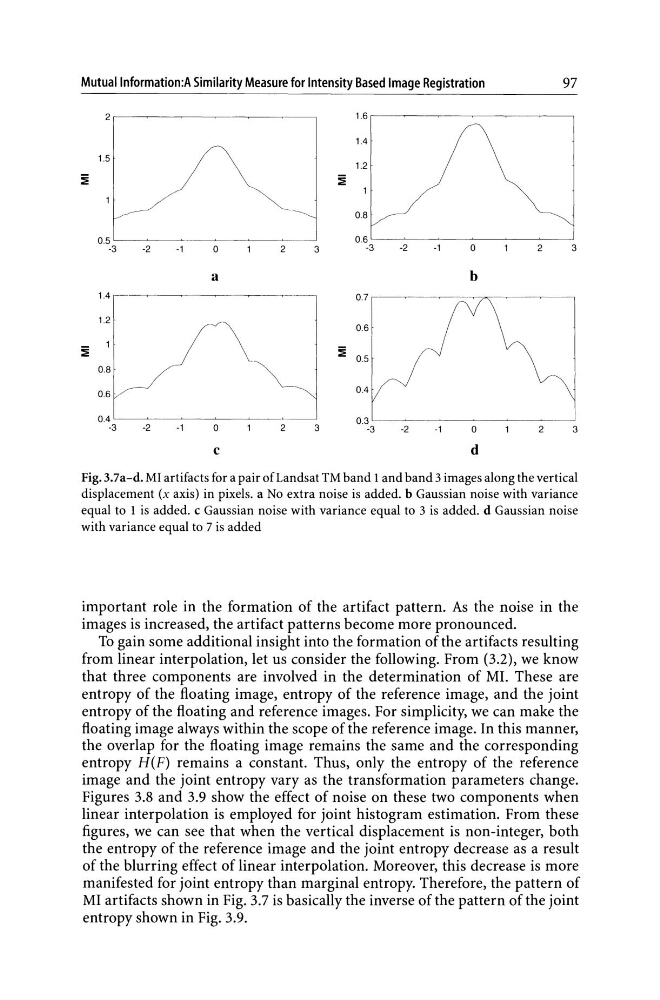
Fig. 3.7a-d. MI artifacts for a pair of Landsat TM band 1 and band 3 images along the vertical
displacement (x axis) in pixels. a No extra noise is added. b Gaussian noise with variance
equal to 1 is added. c Gaussian noise with variance equal to 3 is added. d Gaussian noise
with variance equal to 7 is added
important role in the formation of the artifact pattern. As the noise in the
images is increased, the artifact patterns become more pronounced.
To gain some additional insight into the formation of the artifacts resulting
from linear interpolation, let us consider the following. From (3.2), we know
that three components are involved in the determination of MI. These are
entropy of the floating image, entropy of the reference image, and the joint
entropy of the floating and reference images. For simplicity, we can make the
floating image always within the scope of the reference image. In this manner,
the overlap for the floating image remains the same and the corresponding
entropy H(F) remains a constant. Thus, only the entropy of the reference
image and the joint entropy vary as the transformation parameters change.
Figures 3.8 and 3.9 show the effect of noise on these two components when
linear interpolation is employed for joint histogram estimation. From these
figures, we can see that when the vertical displacement is non-integer, both
the entropy of the reference image and the joint entropy decrease as a result
of the blurring effect of linear interpolation. Moreover, this decrease is more
manifested for joint entropy than marginal entropy. Therefore, the pattern of
MI artifacts shown in Fig. 3.7 is basically the inverse of the pattern of the joint
entropy shown in Fig. 3.9.
97
1 . 6 , . - - - - - - - - - - - - - - - - ;
1.4
1.5
1.2
0.8
0.5 L-_~_~_~_~_~-----.J
-3
-2
-1
o
2
0.6 '--~-~-~-~-~-----'
-3
3
-2
-1
o
3
2
a
b
1.4 , - - - - - - - - - - - _ _ ,
0.7 r------"'"/"~---__,
1.2
0.6
:E 0.5
0.8
0.6
0.4
0.4 L-_~_~_~_~_~-----.J
-3
-2
-1
o
2
0.3 L-_~_~_~_~_~-----.J
-3
3
o
2
3
-2
-1
c
d
Fig. 3.7a-d. MI artifacts for a pair of Landsat TM band 1 and band 3 images along the vertical
displacement (x axis) in pixels. a No extra noise is added. b Gaussian noise with variance
equal to 1 is added. c Gaussian noise with variance equal to 3 is added. d Gaussian noise
with variance equal to 7 is added
important role in the formation of the artifact pattern. As the noise in the
images is increased, the artifact patterns become more pronounced.
To gain some additional insight into the formation of the artifacts resulting
from linear interpolation, let us consider the following. From (3.2), we know
that three components are involved in the determination of MI. These are
entropy of the floating image, entropy of the reference image, and the joint
entropy of the floating and reference images. For simplicity, we can make the
floating image always within the scope of the reference image. In this manner,
the overlap for the floating image remains the same and the corresponding
entropy H(F) remains a constant. Thus, only the entropy of the reference
image and the joint entropy vary as the transformation parameters change.
Figures 3.8 and 3.9 show the effect of noise on these two components when
linear interpolation is employed for joint histogram estimation. From these
figures, we can see that when the vertical displacement is non-integer, both
the entropy of the reference image and the joint entropy decrease as a result
of the blurring effect of linear interpolation. Moreover, this decrease is more
manifested for joint entropy than marginal entropy. Therefore, the pattern of
MI artifacts shown in Fig. 3.7 is basically the inverse of the pattern of the joint
entropy shown in Fig. 3.9.