

94
3: Hua-mei Chen
0.4
0.37 '----~----~---'
·21.56
·21.116
·20.56
·20.06
· 19.56
a
b
c
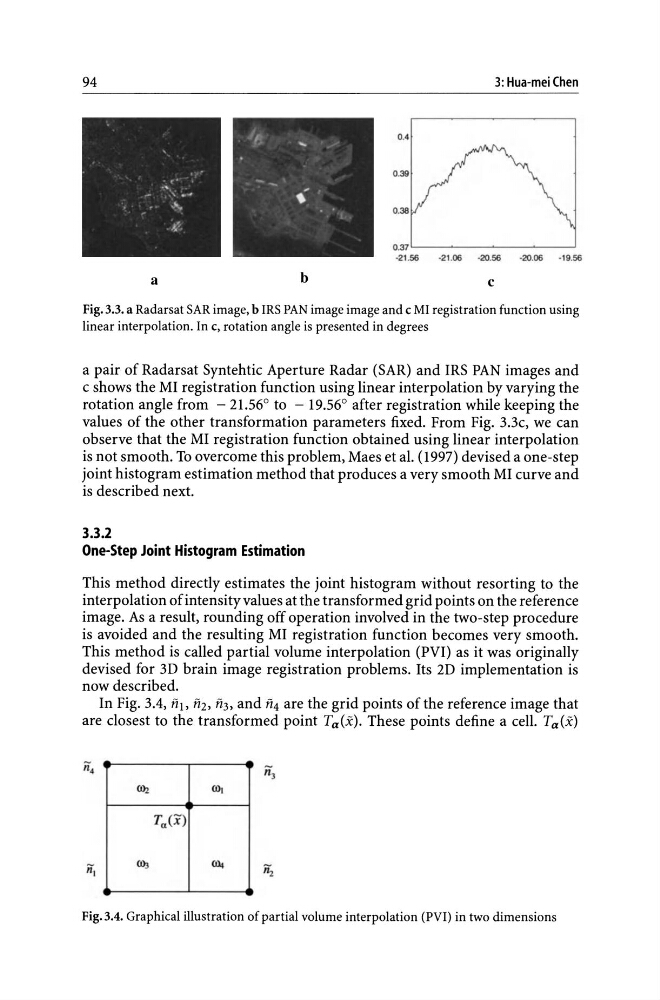
Fig. 3.3. a Radarsat SAR image, b IRS PAN image image and c MI registration function using
linear interpolation. In c, rotation angle is presented in degrees
a pair of Radarsat Syntehtic Aperture Radar (SAR) and IRS PAN images and
c shows the MI registration function using linear interpolation by varying the
rotation angle from - 21.56° to - 19.56° after registration while keeping the
values of the other transformation parameters fixed. From Fig. 3.3c, we can
observe that the MI registration function obtained using linear interpolation
is not smooth. To overcome this problem, Maes et al. (1997) devised a one-step
joint histogram estimation method that produces a very smooth MI curve and
is described next.
3.3.2
One-Step Joint Histogram Estimation
This method directly estimates the joint histogram without resorting to the
interpolation of intensity values at the transformed grid points on the reference
image. As a result, rounding off operation involved in the two-step procedure
is avoided and the resulting MI registration function becomes very smooth.
This method is called partial volume interpolation (PVI) as it was originally
devised for 3D brain image registration problems. Its 2D implementation is
now described.
In Fig. 3.4, 11I> 112, 113, and 114 are the grid points of the reference image that
are closest to the transformed point Ta(.x). These points define a cell. Ta(x)
0>2
(0,
Ta(x)
O>.!
CIlj
Fig. 3.4. Graphical illustration of partial volume interpolation (PVI) in two dimensions
3: Hua-mei Chen
0.4
0.37 '----~----~---'
·21.56
·21.116
·20.56
·20.06
· 19.56
a
b
c
Fig. 3.3. a Radarsat SAR image, b IRS PAN image image and c MI registration function using
linear interpolation. In c, rotation angle is presented in degrees
a pair of Radarsat Syntehtic Aperture Radar (SAR) and IRS PAN images and
c shows the MI registration function using linear interpolation by varying the
rotation angle from - 21.56° to - 19.56° after registration while keeping the
values of the other transformation parameters fixed. From Fig. 3.3c, we can
observe that the MI registration function obtained using linear interpolation
is not smooth. To overcome this problem, Maes et al. (1997) devised a one-step
joint histogram estimation method that produces a very smooth MI curve and
is described next.
3.3.2
One-Step Joint Histogram Estimation
This method directly estimates the joint histogram without resorting to the
interpolation of intensity values at the transformed grid points on the reference
image. As a result, rounding off operation involved in the two-step procedure
is avoided and the resulting MI registration function becomes very smooth.
This method is called partial volume interpolation (PVI) as it was originally
devised for 3D brain image registration problems. Its 2D implementation is
now described.
In Fig. 3.4, 11I> 112, 113, and 114 are the grid points of the reference image that
are closest to the transformed point Ta(.x). These points define a cell. Ta(x)
0>2
(0,
Ta(x)
O>.!
CIlj
Fig. 3.4. Graphical illustration of partial volume interpolation (PVI) in two dimensions