

Mutuallnformation:A Similarity Measure for Intensity Based Image Registration
93
(entropy) of one image by the knowledge of the other image. In other words,
the MI criterion implies that when two images are registered, one gains the
most knowledge about one image by observing the other one. For example,
based on (3.10), the uncertainty of F without the knowledge of R is H(F) and
its uncertainty when R is known is H(FIR). Therefore, the reduction in the uncertainty H(F) - H(FIR) defines the MI between F and R and its maximization
implies the most reduction in the uncertainty. Since its introduction, MI has
been accepted as one of the most accurate and robust similarity measures for
image registration.
3.3
Joint Histogram Estimation Methods
From (3.2) to (3.8), it is clear that the main task involved in determining the
mutual information between two images is to estimate the joint histogram of
the two images. Existing joint histogram estimation schemes may be categorized into two groups, depending on whether or not an intermediate image
resampling procedure for the reference image is required.
3.3.1
Two-Step Joint Histogram Estimation
Intuitively, a joint histogram can be estimated using a two-step procedure.
Assume that Xi represents the coordinates of the ith pixel of the floating image
and Pi represents the transformed coordinates of the pixel (i. e. Pi = Ta (Xi).
In general, Pi may not coincide with the coordinates of any grid point of the
reference image. Therefore, during the first step, one needs to evaluate the
intensity values of the reference image at the transformed grid point positions
through interpolation. Often, linear interpolation is employed. Other intensity
interpolation algorithms like cubic convolution interpolation (Keys 1981) and
cubic spline interpolation (Unser et al. 1993) may also be adopted. In general,
the interpolated values are not integers. Thus, one may resort to rounding off
the interpolated values to the nearest integer. After obtaining this intermediate
resampled reference image, the second step is to obtain the joint histogram by
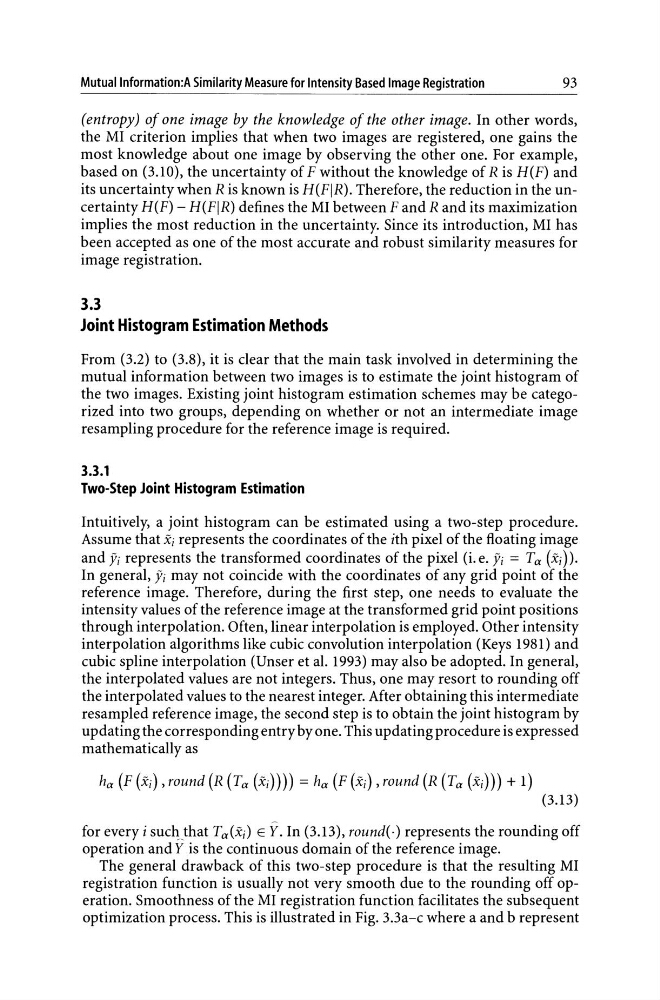
updating the corresponding entry by one. This updating procedure is expressed
mathematically as
(3.13)
for every i such~that Ta(Xi) E Y. In (3.13), round(·) represents the rounding off
operation and Y is the continuous domain of the reference image.
The general drawback of this two-step procedure is that the resulting MI
registration function is usually not very smooth due to the rounding off operation. Smoothness of the MI registration function facilitates the subsequent
optimization process. This is illustrated in Fig. 3.3a-c where a and b represent
93
(entropy) of one image by the knowledge of the other image. In other words,
the MI criterion implies that when two images are registered, one gains the
most knowledge about one image by observing the other one. For example,
based on (3.10), the uncertainty of F without the knowledge of R is H(F) and
its uncertainty when R is known is H(FIR). Therefore, the reduction in the uncertainty H(F) - H(FIR) defines the MI between F and R and its maximization
implies the most reduction in the uncertainty. Since its introduction, MI has
been accepted as one of the most accurate and robust similarity measures for
image registration.
3.3
Joint Histogram Estimation Methods
From (3.2) to (3.8), it is clear that the main task involved in determining the
mutual information between two images is to estimate the joint histogram of
the two images. Existing joint histogram estimation schemes may be categorized into two groups, depending on whether or not an intermediate image
resampling procedure for the reference image is required.
3.3.1
Two-Step Joint Histogram Estimation
Intuitively, a joint histogram can be estimated using a two-step procedure.
Assume that Xi represents the coordinates of the ith pixel of the floating image
and Pi represents the transformed coordinates of the pixel (i. e. Pi = Ta (Xi).
In general, Pi may not coincide with the coordinates of any grid point of the
reference image. Therefore, during the first step, one needs to evaluate the
intensity values of the reference image at the transformed grid point positions
through interpolation. Often, linear interpolation is employed. Other intensity
interpolation algorithms like cubic convolution interpolation (Keys 1981) and
cubic spline interpolation (Unser et al. 1993) may also be adopted. In general,
the interpolated values are not integers. Thus, one may resort to rounding off
the interpolated values to the nearest integer. After obtaining this intermediate
resampled reference image, the second step is to obtain the joint histogram by
updating the corresponding entry by one. This updating procedure is expressed
mathematically as
(3.13)
for every i such~that Ta(Xi) E Y. In (3.13), round(·) represents the rounding off
operation and Y is the continuous domain of the reference image.
The general drawback of this two-step procedure is that the resulting MI
registration function is usually not very smooth due to the rounding off operation. Smoothness of the MI registration function facilitates the subsequent
optimization process. This is illustrated in Fig. 3.3a-c where a and b represent